
Letters to a Friend, Written to Mrs. Ezra S. Carr, 1866-1879
John Muir
THE CLASSIC COLLECTION · 1902
"The Elements of Bacteriological Technique" by J. W. H. Eyre is a scientific publication written in the early 20th century. This comprehensive laboratory guide aims to equip medical, dental, and technical students with the foundation needed to conduct bacteriological research. The book covers a range of topics related to practical methods in bacteriology, including sterilization techniques, bacterial examination, and analysis methods, emphasizing the importance of personal instruction and practical application in a laboratory setting. At the start of the guide, Eyre lays out the essential laboratory regulations for handling infective materials, underscoring safety protocols designed to minimize infection risks. The opening portion also introduces the various types of glass apparatus commonly used in bacteriological work, explaining their selection and maintenance. This practical focus sets the stage for the detailed methodologies that follow, providing a solid foundation for readers who are keen to understand the intricacies of working with bacteria in a laboratory environment.
Introduction adapted from the source catalogue; source summaries may be automatically generated.
Free to read · English · 124,075 words · No account needed
MAKE TIME FOR A GOOD BOOK
On by default. Untick to stop anonymous reading totals. Each page counts after 10 seconds in view. How this works.
Anonymous counting is on unless you have switched it off.
{Unaltered.
4. Consistency: {Peptonised (character of solution).
{Coagulated.
{hard: solid.
5. Clot: Character {soft: floculent.
{ragged and broken up by gas
{bubbles.
(a) Coagulum undissolved.
(b) Coagulum finally peptonised, completely: incompletely.
Resulting solution, clear: turbid.
{Abundant.
{Scanty.
6. Whey: {Clear.
{Turbid.
{Coagulated by boiling, or not.
As a council of perfection preparations must be made from pure cultivations 4, 6, 8, 12, 18, and 24 hours; and subsequently at intervals of, say, twenty-four hours, during the entire period they are under observation, and examined--
(A) ~Living.--1.~ In ~hanging drop~, to determine motility or
non-motility.
In this connection it must be remembered that under certain conditions as to environment (e. g., when examined in an unsuitable medium, atmosphere, temperature, etc.) motile bacilli may fail to exhibit activity. No organism, therefore, should be recorded as non-motile from one observation only; a series of observations at different ages and under varying conditions should form the basis of an opinion as to the absence of true locomotion.
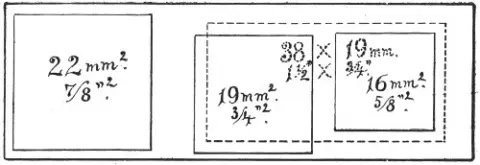
Size.--In the case of non-motile or sluggishly motile organisms, endeavour to measure several individuals in each hanging drop by means of the eyepiece micrometer or the eikonometer (vide page 63), and average the results.
If the organism is one which forms spores, observe--
(a) Spore Formation.--Prepare hanging-drop cultivations (vide page 78) from vegetative forms of the organism, adding a trace of magenta solution (0.5 per cent.) or other intra vitam stain (see page 77) to the drop, on the point of the platinum needle, to facilitate the observation of the phenomenon by rendering the bacilli more distinct.
Place the preparation on the stage of the microscope; if necessary,
using a warm stage.
Arrange illumination, etc., and select a solitary bacillus for observation, by the help of the 1/6-inch lens.
Substitute the 1/12-inch oil-immersion lens for the sixth, and observe the formation of the spore; if possible, measure any alteration in size which may occur by means of the Ramsden micrometer.
(b) Spore Germination.--Prepare hanging-drop cultivations from old cultivations in which no living vegetative forms are present, and observe the process of germination in a similar manner.
The comfort of the microscopist is largely enhanced in those cases where the period of observation is at all lengthy, by use of some form of eye screen before the unemployed eye, such as is figured on page 58 (Fig. 49).
If it is impossible to carry out the method suggested above, proceed as
follows:
(a) Spore Formation.--Plant the organism in broth and incubate under
optimum conditions.
At regular intervals, say every thirty minutes, remove a loopful of the cultivation and prepare a cover-slip film preparation.
Fix, while still wet, in the corrosive sublimate fixing solution.
Your reading position is saved on this browser. Take it to another device with a library code. Reading pages adapt to text, rather than matching a printed edition.
BEHIND THE BOOK
This eBook is for the use of anyone anywhere in the United States and most other parts of the world at no cost and with almost no restrictions whatsoever. You may copy it, give it away or re-use it under the terms of the Project Gutenberg License included with this eBook or online at www.gutenberg.org. If you are not located in the United States, you will have to check the laws of the country where you are located before using this eBook. Read the source licence.
The original source file, including credits and licence, is retained by this library. Request an original-format copy at no charge. Please include the book title and Project Gutenberg identifier #27713.
KEEP YOUR CURIOSITY GOING
John Muir

Asa Gray
Asa Gray

Florence Nightingale
Elizabeth Robins Pennell
Denison Olmsted