
Last letters from the living dead man
David Patterson (Spirit) Hatch
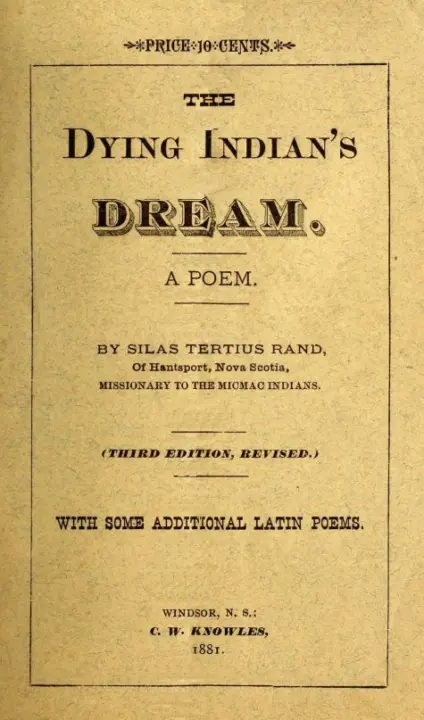
THE CLASSIC COLLECTION · 1881
"The Dying Indian's Dream: A Poem by Silas Tertius Rand" is a narrative poem written in the late 19th century. The work revolves around the final moments of an Indigenous man named John Paul, who reflects on his life's journey and his faith as he faces death. The poem explores themes of spirituality, cultural identity, and the hope for salvation, providing insight into the interactions between the Mic-Mac Indians and Christian missionaries during that era. In the poem, John Paul lies on his deathbed, recounting his life as a skilled hunter and loving father. While in his final moments, he experiences a vivid dream of heaven, filled with joy and the embrace of divine figures. As he transitions from life to death, he shares his visions with those around him, expressing immense peace and joy. His dream conveys a powerful sense of hope and comfort, as he envisions a welcoming and radiant afterlife where he will be reunited with loved ones. Ultimately, the poem serves as an uplifting testament to faith and the belief in eternal life amidst suffering and hardship.
Introduction adapted from the source catalogue; source summaries may be automatically generated.
Free to read · English · 4,713 words · No account needed
MAKE TIME FOR A GOOD BOOK
On by default. Untick to stop anonymous reading totals. Each page counts after 10 seconds in view. How this works.
Anonymous counting is on unless you have switched it off.
Tu, O Jesu, mihi es
Omnes res optabiles:
Aegrum, lapsum, sublevas,
Opem fesso, coeco, das:
Facile es sanctissimus;
Ego sum perimprobus,
Fœdus, plenus scelerum—
Tu, bonorum omnium.
Gratia satis est in Te,
Sontem perabsolvere.
Fluat flumen affatim,
Purus ut ex toto sim.
Jesus, Fons vitalis es:
Sumam quæ benigne des:
Vive mi in pectore,
Fons Aeternat Domine!
“Abide With Me, Fast Falls the Eventide.”
Mecum habita, Domine! ultima labitur hora diei: Quam tenebrae condensantur! Tu mecum habitato! Deficiunt adjutores, atque omnia grata; Tu, qui non spernes inopes, O mecum habitato!
Ad metam tenuis vitæ, properant rapidae horae; Blanditiae pereunt, et transit gloria mundi: Omnia mutari, corrumpique, undique vidi; Tu qui immutatus remanes, O mecum habitato.
Te, Domine, est mihi nunc opus omni hora fugienti: Tu solus valeas hostes mihi vincere saevos: Tu solus firmum me, et salvum ducere possis: In tranquillo, in turbinibus, Tu, O mecum habitato.
Hostes non timeo, quum Tu stas praesto beare; Adversi casus faciles sunt absque dolore; Terrores mortis, stimuli, et victoria, desunt; Laetatusque exsultabo, nam mecum habitabis.
Mi juvenescenti, blandus Tu nempe favisti; Ah me! quam brutus! quam perversusque remansi! Non discessisti a me, saepe ut deserui Te: O Domine, usque et ad extremum, Tu mecum habitato.
Ad oculos crucem dormitanti mihi monstra; Illustra tenebras, et me erige visere coelos: En, umbrae fugiunt! et mane rubescere coepit! In vita, in morte, O Domine, O Tu mecum habitato!
“Just as I Am Without One Plea.”
Sicuti sum—nec sine spe,
Quia Tu mortuus es pro me,
Et jubes ire me ad Te—
O Agnus Dei, venio.
Sicuti sum—nec haesitem,
Ut maculas abluerem;
Mundus per tuum sanguinem,
O Agnus Dei, venio.
Sicuti sum—jactatus sim,
Et dubitans dum conflixerim,
Certansque, timens, perdo vim,
O Agnus Dei, venio.
Sicuti sum—miserrime
Cœcus, nudusque omni re,
Ut omnia capiam in Te,
O Agnus Dei, venio.
Sicuti sum—recipies,
Purgabis, solves, eximes;
Nam credo quod promitteres:
O Agnus Dei, venio.
Sicuti sum—agnosco Te,
Salvasse per amorem me,
Ut tuus sim assidue:
O Agnus Dei, venio.
Misspelled words and printer errors have been corrected.
Inconsistencies in punctuation have been maintained.
A cover was created for this eBook.
[The end of The Dying Indian's Dream, by Silas Tertius Rand.]
End of Project Gutenberg's The Dying Indian's Dream, by Silas Tertius Rand
Your reading position is saved on this browser. Take it to another device with a library code. Reading pages adapt to text, rather than matching a printed edition.
BEHIND THE BOOK
This eBook is for the use of anyone anywhere in the United States and most other parts of the world at no cost and with almost no restrictions whatsoever. You may copy it, give it away or re-use it under the terms of the Project Gutenberg License included with this eBook or online at www.gutenberg.org. If you are not located in the United States, you will have to check the laws of the country where you are located before using this eBook. Read the source licence.
The original source file, including credits and licence, is retained by this library. Request an original-format copy at no charge. Please include the book title and Project Gutenberg identifier #50025.
KEEP YOUR CURIOSITY GOING
David Patterson (Spirit) Hatch

David Patterson (Spirit) Hatch

David Patterson (Spirit) Hatch

Edwin Abbott Abbott

Richard Watson
T. G. (Theophilus Gould) Steward