
Last letters from the living dead man
David Patterson (Spirit) Hatch
THE CLASSIC COLLECTION · 1881
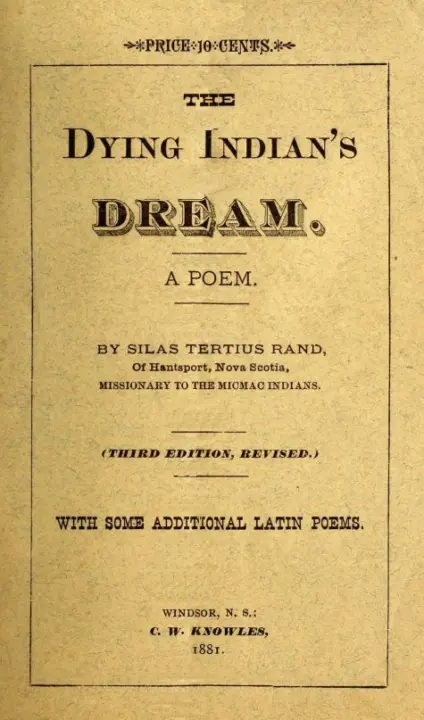
"The Dying Indian's Dream: A Poem by Silas Tertius Rand" is a narrative poem written in the late 19th century. The work revolves around the final moments of an Indigenous man named John Paul, who reflects on his life's journey and his faith as he faces death. The poem explores themes of spirituality, cultural identity, and the hope for salvation, providing insight into the interactions between the Mic-Mac Indians and Christian missionaries during that era. In the poem, John Paul lies on his deathbed, recounting his life as a skilled hunter and loving father. While in his final moments, he experiences a vivid dream of heaven, filled with joy and the embrace of divine figures. As he transitions from life to death, he shares his visions with those around him, expressing immense peace and joy. His dream conveys a powerful sense of hope and comfort, as he envisions a welcoming and radiant afterlife where he will be reunited with loved ones. Ultimately, the poem serves as an uplifting testament to faith and the belief in eternal life amidst suffering and hardship.
Introduction adapted from the source catalogue; source summaries may be automatically generated.
Free to read · English · 4,713 words · No account needed
MAKE TIME FOR A GOOD BOOK
On by default. Untick to stop anonymous reading totals. Each page counts after 10 seconds in view. How this works.
Anonymous counting is on unless you have switched it off.
3. Transeam caliginosa Loca, et calamitosa, Dura, dira, luctuosa, Hostes et obstantes; Non formido aerumnosa Mala, tetra, dolorosa; Gaudens fero lacrimosa, Inter Te amantes. Confidenter ibo Tecum; Nam Tu semper eris mecum; Tua virga, tuum pedum, Ample consolantes. 4. Mensam mihi preparasque, Coram hostes, panem dasque; In clementiâ prope stasque: Mea pax abundat: Sanctum oleum benignum, Super caput tam indignum Meum fundis,—clarum signum: Meum vas redundat.
5. Immo bonitas divina,
Valetudo genuina,
Cum clementiâ supernâ,
Et benignitas aeterna,
Semper me sequentur.
Dum in vita remanebo,
Dei gratiâ gaudebo:
Ejus domum habitabo,
Ejus nomen collaudabo,
Et indesinenter.
Psalmus C.
1. In Jehovam vos ovate,
Et gaudete, et cantate,
Omnes terram habitantes.
Laeti Dominum, servite,
Et cum gaudio gestite,
Coram Illum triumphantes.
2. Nostrûm Deus est Creator,
Dominator et Salvator,
Deus unus, Auctor rerum:
Fecit nos, et nos nutrivit,
Regit, tutat, repetivit,
Oves perditos ad Herum.
3. Ejus portas introite;
Claris laudibus adite;
Illum Dominum clamantes:
Illum bonum, semper verum,
Fidelissimumque Herum,
In eternum adorantes.
“Nearer My God to Thee.”
1. Propius, O Deus mi, propius ad
Te,
Etiamsi crux erit quæ tollat
me:
Canam continue—
Mi Deus, prope Te;
Propius, O Deus mi, propius ad
Te.
2. Erroni noctu quamvis similis,
Quiescam super stratum
lapidis,—
Delectat esse me
In somnis prope Te;
Propius, O Deus mi, propius ad
Te.
3. Ut scalae tunc ad coelos via
sit;
Quaecunque mihi des, clementiâ
fit:
Sunto coelicolae;
Nutantes vocent me,
Propius, O Deus mi, propius ad
Te.
4. Tum experrecta laude fulget
mens,
Petrosis malis “Bethel”
extruens:
Sic moeror urget me,
Mi Deus, prope Te,
Propius, O Deus mi, propius ad
Te.
5. Si laetis pennis findens aëra.
Relictis stellis, petam
supera—
Quam jucundissime,
Cantabo—Prope Te,
Propius, O Deus mi, propius ad
Te.
“Rock of Ages Cleft for Me.”
Rupes Saeculorum, Te,
Pro me fissa, condam me!
Aquae Fons et sanguinis,
Duplex tui lateris,
Scelerum purgatio
Sit, et expiatio.
Nunquam possim exsequi,
Tua lex quæ mandet mi;
Quamvis strenuus semper sim,
Atque semper fleverim,
Hoc nil expiaverit;
In Te solo salus sit.
Nil in manu tulero;
Tuae cruci hæreo;
Vestes mihi nudo des,
Inopemque subleves;
Fonti foedus advolo;
Nisi laves pereo.
Dum vitalem haurio vim,
Cumque moribundus sim,
Quum per stellas evolem,—
Ante tuum thronum stem,
Rupes Saeculorum, Te,
Pro me fissa, condam me.
“Jesus Refuge of My Soul!”
O Præsidium, Jesu mi,
Fugiam tuo pectori:
Torrens propius æstuet,
Dum procella fureret:
Hoc in vitæ turbine,
O Salvator, tege me!
Fac ut tutus, integer,
Tecum semper commorer.
Soli es Refugio:
Tibi lassus hæreo:
Ne relinque solum me;
Sit solatium per Te.
Tibi dum confisus sim,
Plenas opes tulerim:
Me defende, debilem,
Me tutator, inopem.
Your reading position is saved on this browser. Take it to another device with a library code. Reading pages adapt to text, rather than matching a printed edition.
BEHIND THE BOOK
This eBook is for the use of anyone anywhere in the United States and most other parts of the world at no cost and with almost no restrictions whatsoever. You may copy it, give it away or re-use it under the terms of the Project Gutenberg License included with this eBook or online at www.gutenberg.org. If you are not located in the United States, you will have to check the laws of the country where you are located before using this eBook. Read the source licence.
The original source file, including credits and licence, is retained by this library. Request an original-format copy at no charge. Please include the book title and Project Gutenberg identifier #50025.
KEEP YOUR CURIOSITY GOING
David Patterson (Spirit) Hatch

David Patterson (Spirit) Hatch

David Patterson (Spirit) Hatch

Edwin Abbott Abbott

Richard Watson
T. G. (Theophilus Gould) Steward