
Dark Hester
Anne Douglas Sedgwick
THE CLASSIC COLLECTION · 1898
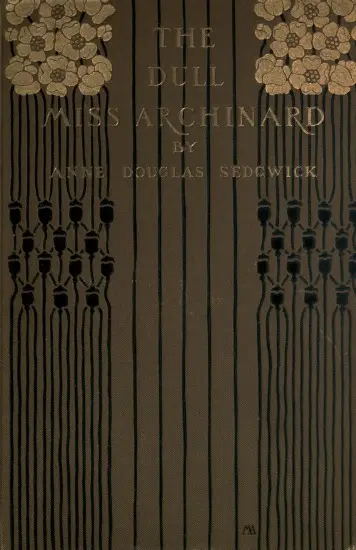
"The Dull Miss Archinard" by Anne Douglas Sedgwick is a novel written in the late 19th century. The narrative unfolds in a picturesque English countryside setting, exploring the lives and relationships of its characters, particularly focusing on the Archinard family and their interactions with their neighbor, Peter Odd. The story hints at themes of love, social expectations, and the complexities of human emotions, particularly through the dynamics between Peter Odd, his wife, and the Archinard sisters, Hilda and Katherine. At the start of the novel, we meet Peter Odd, a contemplative and somewhat melancholic man who enjoys fishing in the serene countryside. His solitude is interrupted by the joyful sounds of the Archinard daughters, which leads to an incident involving the more timid sister, Hilda, who is initially fearful of diving into the water. The events escalate when she jumps in to save Katherine, who is struggling in the water. This action sparks a connection between Peter and the sisters as he helps rescue Hilda, highlighting contrasts in courage and fear between the two girls. As Peter returns to his life at Allersley Manor, the opening chapters set the stage for the exploration of family dynamics, friendship, and the tension between personal desires and societal expectations.
Introduction adapted from the source catalogue; source summaries may be automatically generated.
Free to read · English · 66,404 words · No account needed
MAKE TIME FOR A GOOD BOOK
On by default. Untick to stop anonymous reading totals. Each page counts after 10 seconds in view. How this works.
Anonymous counting is on unless you have switched it off.
Hilda looked up a little shyly.
"Oh, I can't!" she exclaimed timidly.
"Can't you?" and Odd looked down at her a humorously pleading
interrogation.
"I can't say things well; and it is too sad to say--one can just bear to
read it."
"Just bear to say it--this once," Odd entreated.
They had reached the edge of the lawn, and stood on the grassy brink of the river. Hilda looked down into the clear running of the water.
"Isn't it pretty? I don't like deep water, where one can't see the bottom; here the grasses and the pebbles are as distinct as possible, and the minnows--don't you like to see them?"
"Yes, but Arcite. Don't make me tease you."
Hilda evidently determined not to play the coward a second time. The quiet pressure of Odd's hand was encouraging, and in a gentle, monotonous little voice that, with the soft breeze, the quickly running sunlit river, went into Odd's consciousness as a quaint, ineffaceable impression of sweetness and sadness, she recited:--
"Allas the wo! allas the peynes stronge,
That I for you have suffered, and so longe!
Allas the deth! allas myn Emelye!
Allas departing of our companye!
Allas myn hertes quene! allas, my wyf!
Myn hertes lady, endere of my lyf!
What is this world? What asketh man to have?
Now with his love, now in his colde grave
Allone, withouten any companye."
Odd's artistic sensibilities were very keen. He felt that painfully delicious constriction of the throat that the beautiful in art can give, especially the beautiful in tragic art. The far-away tale; the far-away tongue; the nearness of the pathos, poignant in its "white simplicity." And how well the monotonous little voice suited its melancholy.
"Allone, withouten any companye,"
he repeated. He looked down at Hilda; he had tactfully avoided looking at her while she spoke, fearing to embarrass her; her eyes were full of tears.
"Thanks, Hilda," he said. It struck him that this highly strung little girl had best not be allowed to dwell too long on Arcite and, after a sympathetic pause (Odd was a very sympathetic person), he added:
"Now are you going to take me into the garden?"
"Yes." Hilda turned from the river. "You know he had just gained her, that made it all the worse. If he had not loved her he would not have minded dying so much, and being alone. One can hardly bear it," Hilda repeated.
"It is intensely sad. I don't think you ought to have learned it by heart, Hilda. That's ungrateful of me, isn't it? But I am old enough to take an impersonal pleasure in sad things; I am afraid they make you sad."
Your reading position is saved on this browser. Take it to another device with a library code. Reading pages adapt to text, rather than matching a printed edition.
Anne Douglas Sedgwick
Anne Douglas Sedgwick

Anne Douglas Sedgwick

Anne Douglas Sedgwick
BEHIND THE BOOK
This eBook is for the use of anyone anywhere in the United States and most other parts of the world at no cost and with almost no restrictions whatsoever. You may copy it, give it away or re-use it under the terms of the Project Gutenberg License included with this eBook or online at www.gutenberg.org. If you are not located in the United States, you will have to check the laws of the country where you are located before using this eBook. Read the source licence.
The original source file, including credits and licence, is retained by this library. Request an original-format copy at no charge. Please include the book title and Project Gutenberg identifier #42109.
KEEP YOUR CURIOSITY GOING
Coulson Kernahan

Maurice Baring
Frances Wright
Cécile Tormay

Frederic Jesup Stimson

W. H. P. (William Henry Pope) Jarvis