
Dark Hester
Anne Douglas Sedgwick
THE CLASSIC COLLECTION · 1898
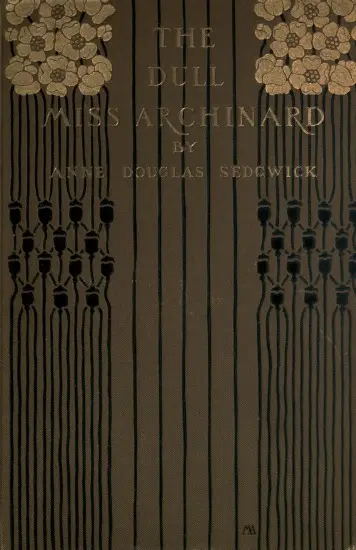
"The Dull Miss Archinard" by Anne Douglas Sedgwick is a novel written in the late 19th century. The narrative unfolds in a picturesque English countryside setting, exploring the lives and relationships of its characters, particularly focusing on the Archinard family and their interactions with their neighbor, Peter Odd. The story hints at themes of love, social expectations, and the complexities of human emotions, particularly through the dynamics between Peter Odd, his wife, and the Archinard sisters, Hilda and Katherine. At the start of the novel, we meet Peter Odd, a contemplative and somewhat melancholic man who enjoys fishing in the serene countryside. His solitude is interrupted by the joyful sounds of the Archinard daughters, which leads to an incident involving the more timid sister, Hilda, who is initially fearful of diving into the water. The events escalate when she jumps in to save Katherine, who is struggling in the water. This action sparks a connection between Peter and the sisters as he helps rescue Hilda, highlighting contrasts in courage and fear between the two girls. As Peter returns to his life at Allersley Manor, the opening chapters set the stage for the exploration of family dynamics, friendship, and the tension between personal desires and societal expectations.
Introduction adapted from the source catalogue; source summaries may be automatically generated.
Free to read · English · 66,404 words · No account needed
MAKE TIME FOR A GOOD BOOK
On by default. Untick to stop anonymous reading totals. Each page counts after 10 seconds in view. How this works.
Anonymous counting is on unless you have switched it off.
On the way home, cool evening shadows slanting across the road, Alicia declared that she had really enjoyed herself.
"Captain Archinard is quite jolly. He has seen everybody and everything under the sun. He is most entertaining, and Lord Allan is remarkably uncallow."
"He thinks of standing for Parliament next year. A nice, steady, honest young fellow. How do you like the Archinards, Peter?"
"The child--Hilda--is a dear child."
"She is awfully pretty," said Alicia, who could afford to be generous; "I like that colorless type."
"She is delicate, I am afraid," said Mary.
"She has the mouth of a Botticelli Madonna and the eyes of a Gainsborough; you know the portrait of Sheridan's wife at Dulwich?"
Alicia had never been to Dulwich. Mary assented.
"The other one--the ugly one--is very clever," Alicia went on; she was in a good temper evidently. Not that Alicia was ever exactly bad-tempered. "She said some very clever things and looked more."
"She is too clever perhaps," Mary remarked. "As for Mrs. Archinard, I should like to slap her. I think that my conventionality is of a tolerant order, but Mrs. Archinard's efforts at æsthetic originality make me feel grimly conventional."
"Mary! Mary! how delightful to hear such uncharitable remarks from you. I should rather like to slap her too, though she struck me as awfully conventional."
"Oh, she is, practically. It is the artistic argot that bores one so
much."
"She is awfully self-satisfied too. Dear me, Peter, I wish we had driven after all. I hate the next half-mile. It is just uphill enough to be irritating--fatigue without realizing exactly the cause of it. Why didn't we drive, Peter?"
"I thought we all preferred walking. You are a very energetic young
person as a rule."
"Not for tiresome country roads. They should be got over as quickly as
possible."
"Well, we will cut through the beech-woods as we came."
"Oh dear," Alicia yawned, "how tired I am already of those tiresome beech-woods. I wish it were autumn and that the hunting had begun. Captain Archinard gives me glowing accounts, and promises me a lead for the first good run. We must fill the house with people then, Peter."
"The house shall be filled to overflowing. Perhaps you would like some one now. Mrs. Laughton and her girls; you like them, don't you?"
Alicia wrinkled up her charming nose.
"Can't say I do. I've stopped with them too much perhaps. They bore me. I am afraid no one would come just now, everything is so gay in London. I wish I were there."
Your reading position is saved on this browser. Take it to another device with a library code. Reading pages adapt to text, rather than matching a printed edition.
Anne Douglas Sedgwick
Anne Douglas Sedgwick

Anne Douglas Sedgwick

Anne Douglas Sedgwick
BEHIND THE BOOK
This eBook is for the use of anyone anywhere in the United States and most other parts of the world at no cost and with almost no restrictions whatsoever. You may copy it, give it away or re-use it under the terms of the Project Gutenberg License included with this eBook or online at www.gutenberg.org. If you are not located in the United States, you will have to check the laws of the country where you are located before using this eBook. Read the source licence.
The original source file, including credits and licence, is retained by this library. Request an original-format copy at no charge. Please include the book title and Project Gutenberg identifier #42109.
KEEP YOUR CURIOSITY GOING
Coulson Kernahan

Maurice Baring
Frances Wright
Cécile Tormay

Frederic Jesup Stimson

W. H. P. (William Henry Pope) Jarvis