
Dark Hester
Anne Douglas Sedgwick
THE CLASSIC COLLECTION · 1898
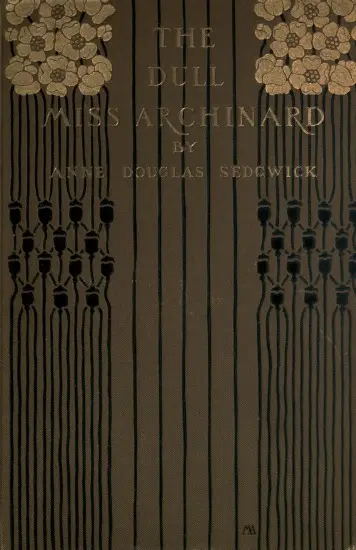
"The Dull Miss Archinard" by Anne Douglas Sedgwick is a novel written in the late 19th century. The narrative unfolds in a picturesque English countryside setting, exploring the lives and relationships of its characters, particularly focusing on the Archinard family and their interactions with their neighbor, Peter Odd. The story hints at themes of love, social expectations, and the complexities of human emotions, particularly through the dynamics between Peter Odd, his wife, and the Archinard sisters, Hilda and Katherine. At the start of the novel, we meet Peter Odd, a contemplative and somewhat melancholic man who enjoys fishing in the serene countryside. His solitude is interrupted by the joyful sounds of the Archinard daughters, which leads to an incident involving the more timid sister, Hilda, who is initially fearful of diving into the water. The events escalate when she jumps in to save Katherine, who is struggling in the water. This action sparks a connection between Peter and the sisters as he helps rescue Hilda, highlighting contrasts in courage and fear between the two girls. As Peter returns to his life at Allersley Manor, the opening chapters set the stage for the exploration of family dynamics, friendship, and the tension between personal desires and societal expectations.
Introduction adapted from the source catalogue; source summaries may be automatically generated.
Free to read · English · 66,404 words · No account needed
MAKE TIME FOR A GOOD BOOK
On by default. Untick to stop anonymous reading totals. Each page counts after 10 seconds in view. How this works.
Anonymous counting is on unless you have switched it off.
Hilda smiled a little, as if conscious that she was being put through the proper routine of questions, but a trustful smile, quite willing to give all information asked for.
"The Three Fates."
"You mean the Elgin Marbles?"
"Yes, with no heads; but one is rather glad they haven't."
"Why?" asked Odd, as she paused. Hilda did not seem sure of her own
reason.
"Perhaps they would be too beautiful with heads," she suggested. "Do you like dogs?" she added, suddenly turning the tables on him.
"Yes, I love dogs," Odd replied, with sincere enthusiasm.
"Three of our dogs are out there on the verandah, if you would care to
know them?"
"I should very much. Perhaps you'll show me the garden too; it looks
very jolly."
It was a pleasure to look at his extraordinarily pretty little Andromeda, and he was quite willing to spend the rest of his visit with her. They went out on the verandah, where, in the awning's shade, lay two very nice fox terriers. A dachshund sat gazing out upon the sunlit lawn in a dog's dignified reverie.
"Jack and Vic," Hilda said, pointing out the two fox terriers. "They just belong to the whole family, you know. And this dear old fellow is Palamon; Arcite is somewhere about; they are mine."
"Who named yours?"
"I did--after I read it; they had other names when they were given to me, but as I had never called them by them, I thought I had a right to change them. I wanted names with associations, like Katherine's setters; they are called Darwin and Spencer, because Katherine is very fond of science."
"Oh, is she?" said Odd, rather stupefied. "You seem to have a great many
dogs in couples."
"The others are not; they are more general dogs, like Jack and Vic."
Hilda still held Odd's hand: she stooped to stroke Arcite's pensive head, giving the fox terriers a pat as they passed them.
"So you are fond of Chaucer?" Odd said. They crossed the gravel path and
stepped on the lawn.
"Yes, indeed, he is my favorite poet. I have not read all, you know, but especially the Knight's Tale."
"That's your favorite?"
"Yes."
"And what is your favorite part of the Knight's Tale?"
"The part where Arcite dies."
"You like that?"
"Oh! so much; don't you?"
"Very much; as much, perhaps, as anything ever written. There never was a more perfect piece of pathos. Perhaps you remember it." He was rather curious to know how deep was this love for Chaucer.
"I learnt it by heart; I haven't a good memory, but I liked it so much."
"Perhaps you would say it to me."
Your reading position is saved on this browser. Take it to another device with a library code. Reading pages adapt to text, rather than matching a printed edition.
Anne Douglas Sedgwick
Anne Douglas Sedgwick

Anne Douglas Sedgwick

Anne Douglas Sedgwick
BEHIND THE BOOK
This eBook is for the use of anyone anywhere in the United States and most other parts of the world at no cost and with almost no restrictions whatsoever. You may copy it, give it away or re-use it under the terms of the Project Gutenberg License included with this eBook or online at www.gutenberg.org. If you are not located in the United States, you will have to check the laws of the country where you are located before using this eBook. Read the source licence.
The original source file, including credits and licence, is retained by this library. Request an original-format copy at no charge. Please include the book title and Project Gutenberg identifier #42109.
KEEP YOUR CURIOSITY GOING
Coulson Kernahan

Maurice Baring
Frances Wright
Cécile Tormay

Frederic Jesup Stimson

W. H. P. (William Henry Pope) Jarvis