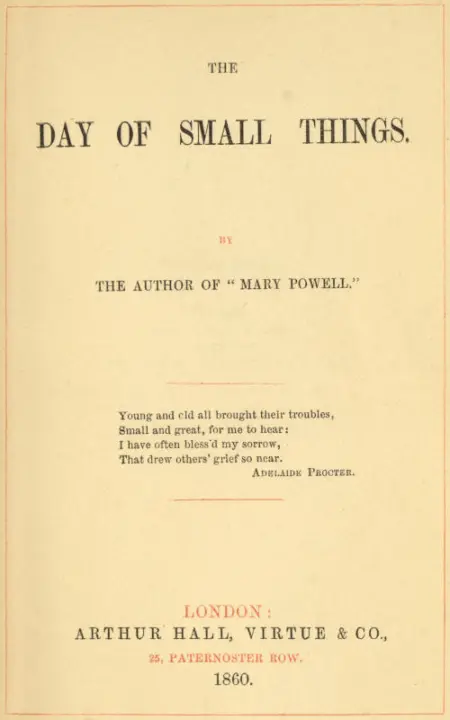
The Day of Small Things
Anne Manning

THE CLASSIC COLLECTION · 1863
"The Duchess of Trajetto" by Anne Manning is a historical novel written in the mid-19th century. It follows the life of Giulia di Gonzaga, the titular Duchess, as she navigates danger and intrigue in 16th-century Italy, particularly in the wake of a pirate attack led by Barbarossa. The narrative intertwines her personal struggles with themes of loyalty, love, and the complexities of her relationships with those around her, including her steely stepdaughter Isabella and the ambitious Cardinal Ippolito de’ Medici. The opening of the book sets a tense scene as the Duchess lies awake in her lavish chamber, troubled by ominous noises that herald an imminent threat. Instantly drawn into a night of chaos, she springs into action as pirate forces invade her castle. With her attendants—Caterina, an elderly woman, and Cynthia, a Moorish girl—she hurriedly attempts to escape the clutches of the marauders. The chaos and danger provide a gripping backdrop, highlighting Giulia's resilience and the intricate dynamics between her and her servants. This initial conflict propels the narrative forward, establishing both the stakes and the vibrant characters who will shape the Duchess's journey in a perilous world filled with political and personal intrigue.
Introduction adapted from the source catalogue; source summaries may be automatically generated.
Free to read · English · 44,083 words · No account needed
MAKE TIME FOR A GOOD BOOK
On by default. Untick to stop anonymous reading totals. Each page counts after 10 seconds in view. How this works.
Anonymous counting is on unless you have switched it off.
Giulia was recruiting her health, meantime, at Vittoria's charming
island-home of Ischia,
"Where nothing met the eye but sights of bliss."
--where a graceful simplicity, indeed, reigned, but under the regulation of the purest taste,--where duties, softened into pleasures, filled up every hour; and where leisure, never degenerating into laziness, was alternately dedicated to poetry, music, and painting, to the enjoyment of the most exquisite beauties of nature, to the cultivation of the mind, and to offices of charity and devotion. Among the poets and eminent men who here "invoked the muses and improved their vein," and who helped to make this remote rock famous, were Musefilo, Filocalo, Giovio, Bernardo Tasso, and many others. Bernardo Tasso thus sang the praises of this charmed islet--
"Superbo scoglio, altero e bel ricetto
Di tanti chiari eroi, d'imperadori,
Onde raggi di gloria escono fuori,
Ch' ogni altro lume fan scuro e negletto,
Se per vera virtute al ben perfetto
Salir si puote ed agli eterni onori
Queste più d'altre degne alme e migliori
V'andran che chiudi nel petroso petto.
Il lume è in te dell' armi; in te s'asconde
Casta beltà, valore e cortesia,
Quanta mai vide il tempo, o diede il cielo.
Ti sian secondi i fati, e il vento e l'onde
Rendanti onore, e l'aria tua natia
Abbia sempre temprato il caldo e il gelo!"
Nor did younger and gayer poets want younger and gayer beauties to inspire them than the two noble widows; for Vittoria's household comprised six or eight nobly-born girls who were being trained under her eye, and whom her conscientiousness prevented from turning over to the sole superintendence of the Mother of the maids.
"You might take more interest than you do, Giulia," said she, "in the education of your damsels. It would do them good, and you, too."
"Ah, nothing could be more tiresome to me," said Giulia. "I am most happy to leave them to Donna Caterina!"
"I doubt, however," said Vittoria, "whether we have even the right to keep fellow-creatures about us, of like affections and passions with ourselves, without providing some legitimate outlet for them, or supplying them with sufficient motives for their restraint."
"My girls seldom go into passions," said Giulia; "and I should think it impertinent to inquire into their affections."
"Why now, you incorrigible Giulia, did not you tell me of your fits of suppressed laughter while you were overhearing (actually eaves-dropping) that love dialogue between Tebaldo and Isaura? and of your laughing at her to her face, afterwards, in the presence of the other girls?"
"I gave her a pearl necklace," said the Duchess.
"Not till she married, months afterwards."
Your reading position is saved on this browser. Take it to another device with a library code. Reading pages adapt to text, rather than matching a printed edition.
Anne Manning

Anne Manning
Anne Manning
Anne Manning
BEHIND THE BOOK
This eBook is for the use of anyone anywhere in the United States and most other parts of the world at no cost and with almost no restrictions whatsoever. You may copy it, give it away or re-use it under the terms of the Project Gutenberg License included with this eBook or online at www.gutenberg.org. If you are not located in the United States, you will have to check the laws of the country where you are located before using this eBook. Read the source licence.
The original source file, including credits and licence, is retained by this library. Request an original-format copy at no charge. Please include the book title and Project Gutenberg identifier #42296.
KEEP YOUR CURIOSITY GOING
Cécile Tormay

Moritz Busch
Coulson Kernahan
John L. Ransom

Maurice Baring
Frances Wright