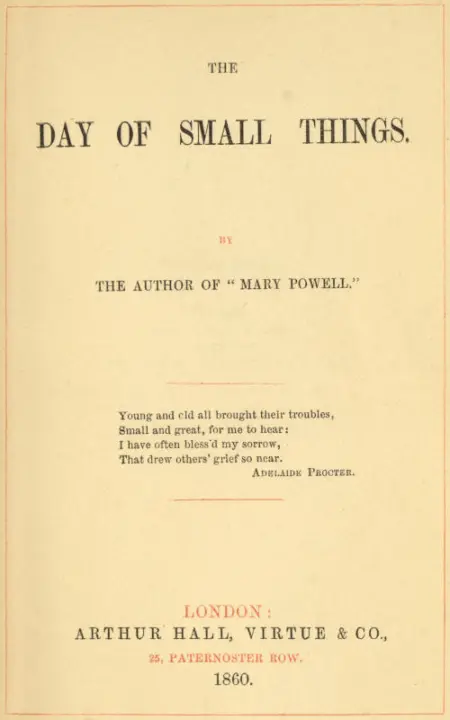
The Day of Small Things
Anne Manning
THE CLASSIC COLLECTION · 1863
"The Duchess of Trajetto" by Anne Manning is a historical novel written in the mid-19th century. It follows the life of Giulia di Gonzaga, the titular Duchess, as she navigates danger and intrigue in 16th-century Italy, particularly in the wake of a pirate attack led by Barbarossa. The narrative intertwines her personal struggles with themes of loyalty, love, and the complexities of her relationships with those around her, including her steely stepdaughter Isabella and the ambitious Cardinal Ippolito de’ Medici. The opening of the book sets a tense scene as the Duchess lies awake in her lavish chamber, troubled by ominous noises that herald an imminent threat. Instantly drawn into a night of chaos, she springs into action as pirate forces invade her castle. With her attendants—Caterina, an elderly woman, and Cynthia, a Moorish girl—she hurriedly attempts to escape the clutches of the marauders. The chaos and danger provide a gripping backdrop, highlighting Giulia's resilience and the intricate dynamics between her and her servants. This initial conflict propels the narrative forward, establishing both the stakes and the vibrant characters who will shape the Duchess's journey in a perilous world filled with political and personal intrigue.
Introduction adapted from the source catalogue; source summaries may be automatically generated.
Free to read · English · 44,083 words · No account needed
MAKE TIME FOR A GOOD BOOK
On by default. Untick to stop anonymous reading totals. Each page counts after 10 seconds in view. How this works.
Anonymous counting is on unless you have switched it off.
"Well, I own I let myself down on that occasion."
"As to letting yourself down, it is your keeping yourself up that I
complain of--"
"O, what a beautiful butterfly!--"
"My dear Giulia, don't run after it and put yourself in a fever. You are not quite a child now!"
"No, but I was a child once; and when I was a child-Duchess of thirteen, I thought that if I did not keep my maids at a distance, they would not respect me. And my mother's word had always been, 'Never associate, child, with servants.'"
"Servants and slaves, that may apply to very well," said Vittoria, who had not surmounted class-prejudices, "but your maids-of-honour are well-born, and though for a time they occupy subordinate positions, eventually they will marry respectably, it is to be hoped."
"And that hope is enough to enliven them, I suppose," said Giulia. "My dear Duke said to me, very soon after our marriage: 'Pargoletta!'--you know he loved to call me 'pargoletta,' or 'animetta,' or 'dolce alma mia,'--he said, 'Pargoletta, don't have much to say to your maids; they are light and frivolous, and will do you no good.' And I loved to obey him; and I love to obey him still, for he was a wise man."
"They might do you no good, but you might do them great good now," said
Vittoria.
"O, my dear, that set have long married off, and had their portions--so many ducats, a bed, bedding, and ewer and basin."
"The new set, then--"
"Here's a strawberry, I declare," said Giulia, diving into the leaves on the bank upon which they were sitting. "Do have it!"
"No, thank you. The--"
"I could no more preach and pray with my maids as you do, Vittoria, than
I could fly!"
"Why not?"
"I should die of shame."
"Nonsense," said the Marchioness, laughing.
"I really should. It would be so ridiculous."
"Quite otherwise, I think, if you undertook it in the right spirit."
"But I never could. It is not in me. They would all begin to laugh--"
"They must be under very poor control, then," said Vittoria.
"Besides, it would be so uncalled for--it would take their thoughts off
their proper work."
"What is their proper work?"
"To do vast quantities of embroidery and fine needlework."
"Well, I think your proper work is to care for their souls."
"That's Fra Silvano's office."
"Does he fulfil it?"
"Not very well, I'm afraid. He chatters and laughs with them too much."
"I should like to see him chatter and laugh with my maids," said Vittoria, kindling. "He should not do so twice."
Your reading position is saved on this browser. Take it to another device with a library code. Reading pages adapt to text, rather than matching a printed edition.
Anne Manning
Anne Manning
Anne Manning
Anne Manning
BEHIND THE BOOK
This eBook is for the use of anyone anywhere in the United States and most other parts of the world at no cost and with almost no restrictions whatsoever. You may copy it, give it away or re-use it under the terms of the Project Gutenberg License included with this eBook or online at www.gutenberg.org. If you are not located in the United States, you will have to check the laws of the country where you are located before using this eBook. Read the source licence.
The original source file, including credits and licence, is retained by this library. Request an original-format copy at no charge. Please include the book title and Project Gutenberg identifier #42296.
KEEP YOUR CURIOSITY GOING
Cécile Tormay

Moritz Busch
Coulson Kernahan
John L. Ransom

Maurice Baring
Frances Wright