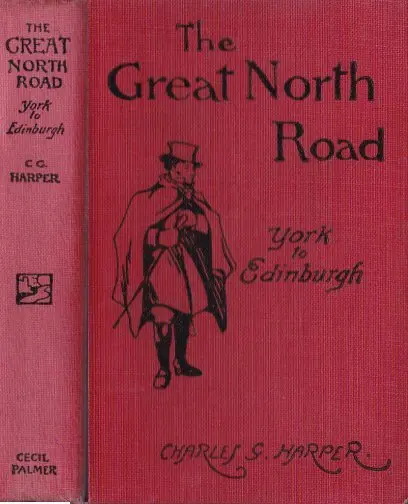
The Great North Road, the Old Mail Road to Scotland: York to Edinburgh
Charles G. (Charles George) Harper
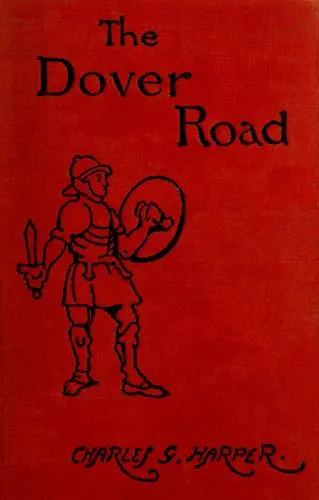
THE CLASSIC COLLECTION · 1895
"The Dover Road: Annals of an Ancient Turnpike" by Charles G. Harper is a historical account written in the early 20th century. The book explores the significant history and cultural importance of the Dover Road, one of England's oldest highways that connects London to Dover. The author reflects on the various historical events and notable figures associated with the road, aiming to capture its rich tapestry of life over centuries. The opening of this work sets the stage for a thorough exploration of the Dover Road's fascinating past. Harper introduces it as a highway laden with historical significance, referencing ancient Roman paths and the legendary figures who traversed its course. He vividly evokes the presence of historical actors, from legionaries of Rome to figures from the medieval period, emphasizing the continuous human drama played out along its stretch. The text promises a compelling combination of vivid storytelling and historical detail, making it a valuable resource for readers interested in England’s transportation history and its societal implications.
Introduction adapted from the source catalogue; source summaries may be automatically generated.
Free to read · English · 74,618 words · No account needed
MAKE TIME FOR A GOOD BOOK
On by default. Untick to stop anonymous reading totals. Each page counts after 10 seconds in view. How this works.
Anonymous counting is on unless you have switched it off.
Leaving Bexley Heath, the road becomes suddenly beautiful, where it loses the last of the mean shops--the cats'-meat vendors, the tinkers, the marine stores--that give so distinct and unwholesome a cachet to its long-drawn-out street. The highway goes down a hill overhung with tall trees, with chestnuts and hawthorns, whose blossoms fill the air in spring with sweet and heavy scents; but, in the hollow, gasworks contend with them, and generally, it is sad to say, come off easy victors. Follows then a nondescript bend of the road which brings one presently into Crayford, fifteen miles from London.
Antiquaries are divided in opinion over the ancient history of Crayford. While some incline to the belief that it is the site of the Roman Noviomagus, others are prone to select Keston Common as the locality of that shadowy camp and city. The question will probably never be settled beyond a doubt, but the weight of evidence is strong in favour of Keston Common, eight miles away to the south-west. Here still exist the traces of great earthworks, covering a space of a hundred acres, while numerous finds of Roman coins and pottery have been made from time to time. At Crayford, on the other hand, the only presumptive evidence is to be found in this having been that old Roman military way, Watling Street, and, in the very slender thread of allusion to the name of Noviomagus, supposed, on the authority of Hasted, to be extant in the title of the half-forgotten manor of Newbury.
But, however vague may be the connection between Noviomagus and Crayford, certain it is that here, in 457, was fought that tremendous battle between the Saxons under Hengist, and the Britons commanded by Vortigern, a conflict in which four thousand of the Romanised Britons were slain. It was in 449 that Hengist and Horsa, brother-chiefs[1] of the Jutish-Saxons, landed at Ebbsfleet, in Thanet, at the invitation of Vortigern, who sought their aid against the Picts and the Sea-rovers. They came in three ships, and their original force could scarcely have numbered more than five hundred men. But, having warred for the Britons, and fought side by side with them against the Scots, they soon perceived how defenceless was the land. "They sent," says the Anglo-Saxon chronicler, "to the Angles, and bade them be told of the worthlessness of the Britons, and the richness of the land." In response to this invitation, there came from over sea the men of the Old Saxons, the Jutes, and the Angles; and, six years after the landing of the two brothers, these treacherous allies, strengthened in number, felt strong enough to attempt the seizure of Kent. Pretexts for a quarrel were readily found, and, through the mists that hang about the scanty records of that time, we hear first of the Battle of Aylesford, fought in 455, in which the Britons experienced their first great defeat. Here, though, Horsa was slain, and to Hengist, with his son Esc, was left the foundation of the Saxon kingdom of Kent. The Battle of Crayford for a time left all this fertile corner of England to the Saxons. "The Britons," says the chronicler, "forsook the land of Kent, and in great consternation fled to London." But, though enervated by long years of luxury, and so greatly demoralised by defeats, the Britons had yet some force left. Vortigern, "the betrayer of Britain," as he has come down to us in the pages of history, was overthrown by another enemy, a rival British prince, that doughty Romanised chieftain, Aurelius Ambrosianus, who, after defeating that weak king, gathered up the scattered patriots, and fell upon the Saxons with such fury that they were driven back to that Isle of Thanet which had originally been given them for their services against the Scots of Strathclyde. "Falchions drank blood that day; the buzzard buried his horny beak in the carcases of the slain; the eagles feasted royally on the flesh of them that fell; and the whitening bones of the Northmen long afterwards strewed the fair land of Kent."
Your reading position is saved on this browser. Take it to another device with a library code. Reading pages adapt to text, rather than matching a printed edition.
Charles G. (Charles George) Harper
Charles G. (Charles George) Harper
Charles G. (Charles George) Harper
BEHIND THE BOOK
This eBook is for the use of anyone anywhere in the United States and most other parts of the world at no cost and with almost no restrictions whatsoever. You may copy it, give it away or re-use it under the terms of the Project Gutenberg License included with this eBook or online at www.gutenberg.org. If you are not located in the United States, you will have to check the laws of the country where you are located before using this eBook. Read the source licence.
The original source file, including credits and licence, is retained by this library. Request an original-format copy at no charge. Please include the book title and Project Gutenberg identifier #36589.
KEEP YOUR CURIOSITY GOING
Wilfrid Scawen Blunt
Wilfrid Scawen Blunt

E. W. (Edgar Watson) Howe
Cécile Tormay

Moritz Busch
John L. Ransom