THE CLASSIC COLLECTION✦My diaries, being a personal narrative of events 1888-1914, Part 2 (1900-1914)CLASSIC FREE BOOKS
My diaries, being a personal narrative of events 1888-1914, Part 2 (1900-1914)
Wilfrid Scawen Blunt
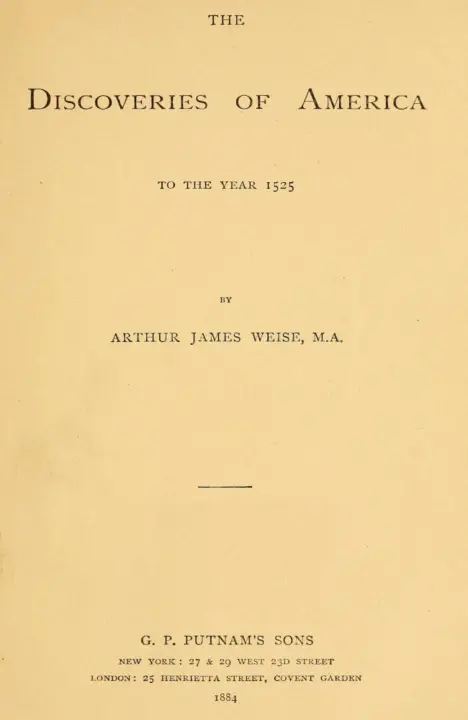
THE CLASSIC COLLECTION · 1884
"The Discoveries of America to the Year 1525" by Arthur James Weise is a historical account written in the late 19th century. This work delves into the early explorations of the American continent, focusing on the significant discoveries made before 1525, particularly by Columbus and other European explorers. The book aims to clarify various narratives about the discovery of America, critically examining the contributions of different explorers and offering insights into the civilizations that existed before European contact. The opening of the book presents a preface that establishes the historical context of America's early discovery and the inhabitants of the continent. Weise discusses the skepticism faced by Columbus and how earlier records, including Egyptian and Greek accounts, hint at a rich and complex civilization in the Americas long before European contact. Additionally, he highlights the contrasting views regarding the supposed discoveries made by the Northmen and other explorers, laying a foundation for the detailed accounts to follow. Overall, the opening sets the stage for a comprehensive exploration of the different narratives surrounding the discovery of America, emphasizing the blend of myth and historical fact.
Introduction adapted from the source catalogue; source summaries may be automatically generated.
Free to read · English · 127,443 words · No account needed
MAKE TIME FOR A GOOD BOOK
On by default. Untick to stop anonymous reading totals. Each page counts after 10 seconds in view. How this works.
Anonymous counting is on unless you have switched it off.
[229] La Cosa’s map, on three large sheets of paper, is contained in Les monuments de la géographie ou recueil d’anciennes cartes européennes et orientales ... publiés en fac-similé de la grandeur des originaux par M. Jomard, membre de l’institut de France, Paris. Imprimerie de Beau, a Saint-Germain-en-Laye.
[230] Vide Section of La Cosa’s map in the cover-pocket.
[231] Raccolta di navigationi e viaggi. Ramusio. vol. i. fol. 374.
[232] Little is known concerning the early history of Giovanni Caboto. In the archives of Venice is the record of his naturalization, dated March 28, 1476, which shows that he had lived in that city more than fifteen years before the privilege of citizenship was granted to him. Archives of Venice: Senato Terra 1473-1477. tom. vii. p. 109.
[233] An effaced part of the dispatch.
[234] Archives of Simancas. Capitulaciones con Inglaterra. Legajo ii.
fol. 16.
Calendar of letters, dispatches, and state papers relating to the negotiations between England and Spain, preserved in the archives of Simancas and elsewhere. Edited by G. A. Bergenroth. London, 1862. vol. i. p. 89.
[235] Public Records. Bill number 51.
[236] Hakluyt. vol. iii. pp. 4, 5. Rymer’s Foedera. London, 1727. fols.
595, 596.
[237] The history and antiquities of the city of Bristol. By William
Barrett. 1789. p. 172.
[238] In the privy-purse accounts of King Henry VII. is this entry: “Aug. 10, 1497. To hym that found the new Isle, 10 £.”
[239] Diarii di Marin Sanuto. tom. i. fol. 374. MS. in Marciana library,
Venice.
Calendar of state papers and manuscripts relating to English affairs in the archives and collections of Venice and other libraries of northern Italy. Edited by Rawdon Brown. London, 1864. vol. ii. p. 262.
[240] Sforza archives, Milan. Calendar of state papers. London, 1864.
vol. ii. p. 260.
[241] “Esta tierra fue descubierta por Ioan Caboto Veneciano, y Sebastian Caboto su hijo, anno del nascimierte de nuestro Saluador Iesu Christo de m. cccc. xciiii. a ueinte y quatro de lunio por la mannana, ala qual pusieron nobre prima tierra uista, y a una isla grade que esta par de la dha tierra, le pusieron nombre sánt Ioan, por auer sido descubierta el mismo dia.”—Tabla primera. No. 8.
The Latin inscription, which seems to be a translation of the Spanish one, reads: “Terram hanc olim nobis clausam, aperuit, Ioannes Cabotus Venetus, necno Sebastianus Cabotus eius filius, anno ab orbe redempto 1494. die uero 24. Iuly, hora 5. sub dilùculo, qua terra primu uisam appellarut & Insula quanda magna ei opposita, Insula diui Ioannis nominarut, quippe quæ solenni die festo diui Ioannis aperta fuit.”—Tabula prima. No. 8.
Your reading position is saved on this browser. Take it to another device with a library code. Reading pages adapt to text, rather than matching a printed edition.
BEHIND THE BOOK
This eBook is for the use of anyone anywhere in the United States and most other parts of the world at no cost and with almost no restrictions whatsoever. You may copy it, give it away or re-use it under the terms of the Project Gutenberg License included with this eBook or online at www.gutenberg.org. If you are not located in the United States, you will have to check the laws of the country where you are located before using this eBook. Read the source licence.
The original source file, including credits and licence, is retained by this library. Request an original-format copy at no charge. Please include the book title and Project Gutenberg identifier #67766.
KEEP YOUR CURIOSITY GOING
Wilfrid Scawen Blunt
Wilfrid Scawen Blunt

E. W. (Edgar Watson) Howe
Cécile Tormay

Moritz Busch
John L. Ransom