THE CLASSIC COLLECTION✦My diaries, being a personal narrative of events 1888-1914, Part 2 (1900-1914)CLASSIC FREE BOOKS
My diaries, being a personal narrative of events 1888-1914, Part 2 (1900-1914)
Wilfrid Scawen Blunt
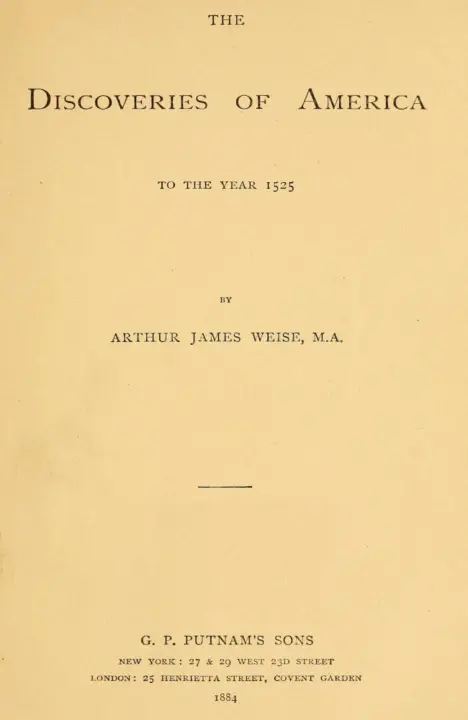
THE CLASSIC COLLECTION · 1884
"The Discoveries of America to the Year 1525" by Arthur James Weise is a historical account written in the late 19th century. This work delves into the early explorations of the American continent, focusing on the significant discoveries made before 1525, particularly by Columbus and other European explorers. The book aims to clarify various narratives about the discovery of America, critically examining the contributions of different explorers and offering insights into the civilizations that existed before European contact. The opening of the book presents a preface that establishes the historical context of America's early discovery and the inhabitants of the continent. Weise discusses the skepticism faced by Columbus and how earlier records, including Egyptian and Greek accounts, hint at a rich and complex civilization in the Americas long before European contact. Additionally, he highlights the contrasting views regarding the supposed discoveries made by the Northmen and other explorers, laying a foundation for the detailed accounts to follow. Overall, the opening sets the stage for a comprehensive exploration of the different narratives surrounding the discovery of America, emphasizing the blend of myth and historical fact.
Introduction adapted from the source catalogue; source summaries may be automatically generated.
Free to read · English · 127,443 words · No account needed
MAKE TIME FOR A GOOD BOOK
On by default. Untick to stop anonymous reading totals. Each page counts after 10 seconds in view. How this works.
Anonymous counting is on unless you have switched it off.
[220] Claudii Ptolemei viri Alexandrini mathematicae disciplinae philosophi doctissimi geographiae opus novissima traductione e Graecorum archetypis castigatissime pressum: cæteris ante lucubratorum multo praestantius.... Anno Christi Opt. Max. MDXIII. Marcii xii. Pressus hic Ptolemæus Argentinae vigilantissima castigatione, industriaque Joannis Schotti urbis indigenae.
[221] Vide Map: Universalior cogniti orbis tabula ex recentibus confecta observationibus: in cover-pocket.
The somewhat similar inscriptions on the maps of 1501-1504 and 1513: “Hec terra cum ad iacentib’ insulis inuenta est per Columbu ianuensem ex mandato Regis Castelle.”—This land with the adjacent islands was discovered by Columbus, a Genoese, by the command of the king of Spain,—are authoritative declarations that the admiral was the discoverer of the represented territory.
[222] Ruysch has printed on his map these words on a scroll, on the west side of Cuba: “HVC VSQ NAVES FERDINADI REGIS HISPANIE PVENERVT,”—As far as this place the ships of Ferdinand, king of Spain, come.
[223] Juan de la Cosa, in 1493, accompanied Columbus, on his second voyage, as a cartographer. In 1499 he explored the coast of Paria with Alonso de Hojeda and Amerigo Vespucci. In November, 1509, he again sailed with Hojeda to South America, and heroically met his death while defending himself, when surrounded by a party of assailing savages, in the village of Yurbaco, in the province called Castilla del Oro by the Spaniards.
[224] Examen critique de l’histoire de la géographie du nouveau continent et des progrès de l’astronomie nautique aux quinzième et seizième siècles. Par Alexandre de Humboldt. Paris, 1836. tome troisième. pp. 167, 174, 183.
[225] Vide Notes on Columbus. [By Henry Harrisse.] New York, 1866. Jean et Sébastien Cabot, leur origine et leurs voyages. Par Henri Harrisse. Paris, 1881. pp. 52, 103, 156.
[226] Vide Historical and geographical notes, 1453-1530. By Henry Stevens. New Haven, 1869. p. 11.
[227] St. Christopher, it is said, after he was baptized by the bishop of Antioch, took up his abode in a desert, near a rapid stream, over which he carried travellers on his back. While bearing, one day, a child across the swollen flood, he discovered that it was the Christ, hence his name Christophorus, the Christ-bearer.
Speaking of his father’s name, Ferdinand Columbus remarks: “As St. Christopher is reported to have received that name because he carried Christ over the deep waters with great danger to himself, whence came the name of Christopher, and as he conveyed over the people whom no other could have carried, so Admiral Christophorus Colonus, imploring the assistance of Christ in that dangerous voyage, went over safely himself and his company, that those Indian nations might become citizens and inhabitants of the church triumphant in heaven.”—Historie del S. D. Fernando Colombo. cap. i.
[228] Abaco is one of the Bahama islands.
Your reading position is saved on this browser. Take it to another device with a library code. Reading pages adapt to text, rather than matching a printed edition.
BEHIND THE BOOK
This eBook is for the use of anyone anywhere in the United States and most other parts of the world at no cost and with almost no restrictions whatsoever. You may copy it, give it away or re-use it under the terms of the Project Gutenberg License included with this eBook or online at www.gutenberg.org. If you are not located in the United States, you will have to check the laws of the country where you are located before using this eBook. Read the source licence.
The original source file, including credits and licence, is retained by this library. Request an original-format copy at no charge. Please include the book title and Project Gutenberg identifier #67766.
KEEP YOUR CURIOSITY GOING
Wilfrid Scawen Blunt
Wilfrid Scawen Blunt

E. W. (Edgar Watson) Howe
Cécile Tormay

Moritz Busch
John L. Ransom