THE CLASSIC COLLECTION✦My diaries, being a personal narrative of events 1888-1914, Part 2 (1900-1914)CLASSIC FREE BOOKS
My diaries, being a personal narrative of events 1888-1914, Part 2 (1900-1914)
Wilfrid Scawen Blunt
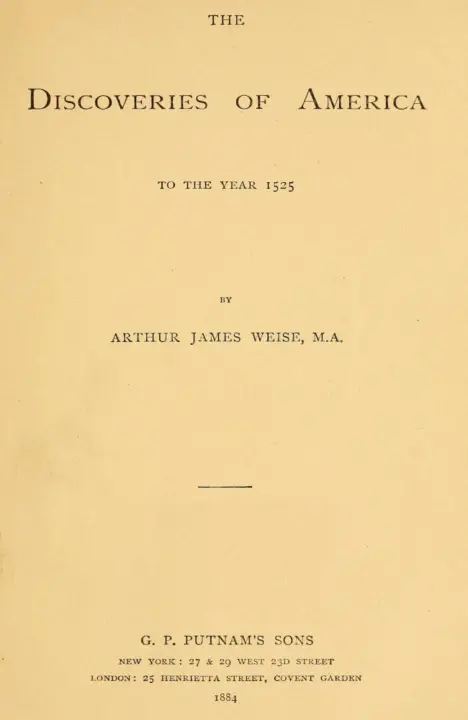
THE CLASSIC COLLECTION · 1884
"The Discoveries of America to the Year 1525" by Arthur James Weise is a historical account written in the late 19th century. This work delves into the early explorations of the American continent, focusing on the significant discoveries made before 1525, particularly by Columbus and other European explorers. The book aims to clarify various narratives about the discovery of America, critically examining the contributions of different explorers and offering insights into the civilizations that existed before European contact. The opening of the book presents a preface that establishes the historical context of America's early discovery and the inhabitants of the continent. Weise discusses the skepticism faced by Columbus and how earlier records, including Egyptian and Greek accounts, hint at a rich and complex civilization in the Americas long before European contact. Additionally, he highlights the contrasting views regarding the supposed discoveries made by the Northmen and other explorers, laying a foundation for the detailed accounts to follow. Overall, the opening sets the stage for a comprehensive exploration of the different narratives surrounding the discovery of America, emphasizing the blend of myth and historical fact.
Introduction adapted from the source catalogue; source summaries may be automatically generated.
Free to read · English · 127,443 words · No account needed
MAKE TIME FOR A GOOD BOOK
On by default. Untick to stop anonymous reading totals. Each page counts after 10 seconds in view. How this works.
Anonymous counting is on unless you have switched it off.
“John Caboto, a Venetian, and also Sebastian Caboto, his son, made the land accessible which formerly was closed to us, in the year of the redemption of the world 1494 [1497?], on the twenty-fourth day of July [June?] at five o’clock in the morning, which land he called the first seen, primum visam, and a large island opposite to it, he named the island of Saint John, because it was found on the day of the feast of Saint John.”
[242] “Sebastian Caboto capitan, y piloto mayor de la S. c. c. m. del Imperador don Carlos quinto deste nombre, y Rey nuestro sennor hizo esta figura extensa en plano, anno del nasciemᵒ de nro saluador Iesu Christo de m.d. xliiii. annos, tirada por grados de latitud y longitud con sus uientos como carta de marear, imitando en parte al Ptolomeo, y en parte alos modernos descobridores, asi Espannoles como Portugueses, y parte por su padre, y por el descubierto.”—Retulo del auctor.
[243] Archives of Milan. Annuario scientifico. Milan, 1866. p. 700.
[244] The thirteenth year of the reign of Henry VII. began on the
twenty-fifth of August, 1497.
[245] “Henry VII., 1498, March 22. To Lanslot Thirkill of London, upon a Prest for his shipp going towards the new Ilande, £. 20.—Item delivered to Launcelot Thirkill going towards the new Ile in Prest, £. 20.—April 1. Item to Thomas Bradley and Louncelot Thirkill going to the new Isle, £. 30.—To John Carter going to the newe Ile in reward 40. s.”—Excerpta historica. London, 1831. pp. 116, 117.
[246] Public Records. Bill number 6. Hakluyt. vol. iii. p. 5. Memoir of Sebastian Cabot. [Richard Biddle.] Phila. 1831. pp. 74, 75.
[247] Pedro de Ayala, the Spanish Ambassador, was sent to London in 1497.
[248] Bernardo Buil, a Benedictine monk, who accompanied Columbus on his second voyage, in 1493, and returned to Spain in 1494.
[249] Archives of Simancas. Tratado con Inglaterra. Leg. ii. Calendar of letters, dispatches, and state papers. London, 1862. vol. i. pp. 176, 177.
[250] The fourteenth year of the reign of Henry VII. began August 21, 1498, and ended August 21, 1499.
[251] The Chronicle of England, from Brute vnto this present yeare of Christ 1580. By John Stow. London, 1580. p. 862.
Robert Fabian, from whose work Stow obtained the information concerning Caboto’s voyage, was the author of the “Chronicle of England and France,” or, as he called it, “The concordance of stories.” He was born in London about the year 1450. Besides being an alderman of the city, he was one of its sheriffs in 1493. He died in London in 1512, and was buried in St. Michael’s, Cornhill.
[252] “Quare coactus fuit, uti ait, vela vertere et occidentem isequ tetenditque tamen ad meridiem, littore sese incurvante, ut Herculei freti latitudine ferè gradus æquarit ad occidentemque profectus tantum est, ut Cubam insulam à læua longitudine graduum penè parem habuerit.”
Your reading position is saved on this browser. Take it to another device with a library code. Reading pages adapt to text, rather than matching a printed edition.
BEHIND THE BOOK
This eBook is for the use of anyone anywhere in the United States and most other parts of the world at no cost and with almost no restrictions whatsoever. You may copy it, give it away or re-use it under the terms of the Project Gutenberg License included with this eBook or online at www.gutenberg.org. If you are not located in the United States, you will have to check the laws of the country where you are located before using this eBook. Read the source licence.
The original source file, including credits and licence, is retained by this library. Request an original-format copy at no charge. Please include the book title and Project Gutenberg identifier #67766.
KEEP YOUR CURIOSITY GOING
Wilfrid Scawen Blunt
Wilfrid Scawen Blunt

E. W. (Edgar Watson) Howe
Cécile Tormay

Moritz Busch
John L. Ransom