THE CLASSIC COLLECTION✦Lost DiariesCLASSIC FREE BOOKS
Lost Diaries
Maurice Baring
THE CLASSIC COLLECTION · 1905
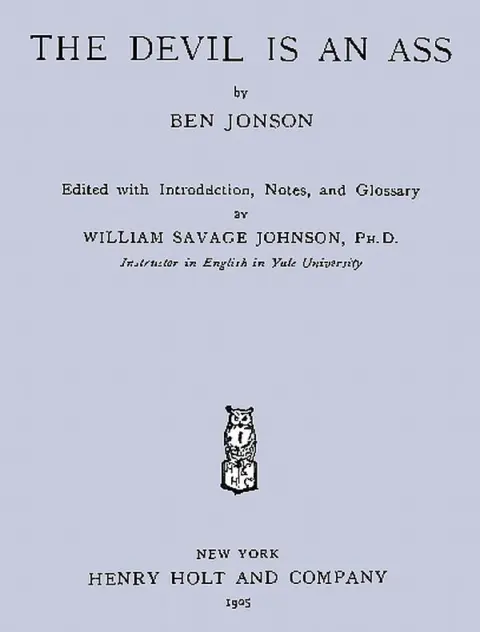
"The Devil is an Ass" by Ben Jonson is a Jacobean comedy first performed in 1616. When a minor devil named Pug begs to visit Earth, Satan warns him that London's vices have grown too sophisticated for a simple demon. Sent to plague the foolish Fabian Fitzdottrel, Pug finds himself hopelessly outmatched by cunning swindlers and charming gallants who converge on his master. As confidence men spin elaborate schemes and pursue Fitzdottrel's virtuous wife, the hapless devil discovers that human corruption far exceeds anything Hell has to offer.
Introduction adapted from the source catalogue; source summaries may be automatically generated.
Free to read · English · 107,369 words · No account needed
MAKE TIME FOR A GOOD BOOK
On by default. Untick to stop anonymous reading totals. Each page counts after 10 seconds in view. How this works.
Anonymous counting is on unless you have switched it off.
For ‘cut-works’ see note 1. 1. 128.
=3. 3. 24 With your blowne roses.= Compare 1. 1. 127,
and B. & Fl., Cupid’s Revenge:
No man to warm your shirt, and blow your roses.
and Jonson, Ep. 97, Wks. 8. 201:
His rosy ties and garters so o’erblown.
=3. 3. 25 Godwit.= The godwit was formerly in great repute as a table delicacy. Thomas Muffett in Health’s Improvement, p. 99, says: ‘A fat godwit is so fine and light meat, that noblemen (yea, and merchants too, by your leave) stick not to buy them at four nobles a dozen.’
Cf. also Sir T. Browne, Norf. Birds, Wks., 1835, 4. 319: God-wyts ... accounted the daintiest dish in England; and, I think, for the bigness of the biggest price.’ Jonson mentions the godwit in this connection twice in the Sil. Wom. (Wks. 3. 350 and 388), and in Horace, Praises of a Country Life (Wks. 9. 121) translates ‘attagen Ionicus’ by ‘Ionian godwit.’
=3. 3. 26 The Globes, and Mermaides!= Theatres and taverns. Mr. Halliwell-Phillipps has proved that the Globe Theatre on the Bankside, Southwark, the summer theatre of Shakespeare and his fellows, was built in 1599. It was erected from materials brought by Richard Burbage and Peter Street from the theatre in Shoreditch. On June 29, 1613, it was destroyed by fire, but was rebuilt without delay in a superior style, and this time with a roof of tile, King James contributing to the cost. Chamberlaine, writing to Alice Carleton (June 30, 1614), calls the Globe Playhouse ‘the fairest in England.’ It was pulled down Apr. 15, 1644.
Only the Lord Chamberlain’s Company (the King’s Men) seems to have acted here. It was the scene of several of Shakespeare’s plays and two of Jonson’s, Every Man out and Every Man in (Halliwell-Phillips, Illustrations, p. 43). The term ‘summer theatre’ is applicable only to the rebuilt theatre (ibid., p. 44). In Ev. Man out (quarto, Wks. 2. 196) Johnson refers to ‘this fair-fitted Globe’, and in the Execration upon Vulcan (Wks. 8. 404) to the burning of the ‘Globe, the glory of the Bank.’ In Poetaster (Wks. 2. 430) he uses the word again as a generic term: ‘your Globes, and your Triumphs.’
There seem to have been two Mermaid Taverns, one of which stood in Bread Street with passage entrances from Cheapside and Friday Street, and the other in Cornhill. They are often referred to by the dramatists. Cf. the famous lines written by Francis Beaumont to Ben Jonson, B. & Fl., Wks., ed. 1883, 2. 708; City Match, O. Pl. 9. 334, etc. Jonson often mentions the Mermaid. Cf. Inviting a Friend, Wks. 8. 205:
Is a pure cup of rich Canary Wine,
Which is the Mermaid’s now, but shall be mine.
On the famous Voyage, Wks. 8. 234:
At Bread-Street’s Mermaid having dined, and merry,
Proposed to go to Holborn in a wherry.
Bart. Fair, Wks. 4. 356-7: ‘your Three Cranes, Mitre,
and Mermaid-men!’
Your reading position is saved on this browser. Take it to another device with a library code. Reading pages adapt to text, rather than matching a printed edition.
BEHIND THE BOOK
This eBook is for the use of anyone anywhere in the United States and most other parts of the world at no cost and with almost no restrictions whatsoever. You may copy it, give it away or re-use it under the terms of the Project Gutenberg License included with this eBook or online at www.gutenberg.org. If you are not located in the United States, you will have to check the laws of the country where you are located before using this eBook. Read the source licence.
The original source file, including credits and licence, is retained by this library. Request an original-format copy at no charge. Please include the book title and Project Gutenberg identifier #50150.
KEEP YOUR CURIOSITY GOING
Maurice Baring
W. B. (William Butler) Yeats
Edward Martyn

John Brougham & Charlotte Brontë
Marguerite Merington
Leonid Andreyev