THE CLASSIC COLLECTION✦Lost DiariesCLASSIC FREE BOOKS
Lost Diaries
Maurice Baring
THE CLASSIC COLLECTION · 1905
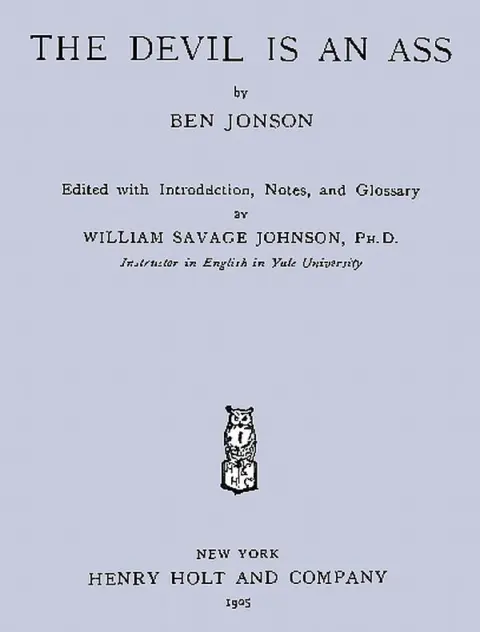
"The Devil is an Ass" by Ben Jonson is a Jacobean comedy first performed in 1616. When a minor devil named Pug begs to visit Earth, Satan warns him that London's vices have grown too sophisticated for a simple demon. Sent to plague the foolish Fabian Fitzdottrel, Pug finds himself hopelessly outmatched by cunning swindlers and charming gallants who converge on his master. As confidence men spin elaborate schemes and pursue Fitzdottrel's virtuous wife, the hapless devil discovers that human corruption far exceeds anything Hell has to offer.
Introduction adapted from the source catalogue; source summaries may be automatically generated.
Free to read · English · 107,369 words · No account needed
MAKE TIME FOR A GOOD BOOK
On by default. Untick to stop anonymous reading totals. Each page counts after 10 seconds in view. How this works.
Anonymous counting is on unless you have switched it off.
Nam propriae telluris erum natura neque illum
Nec me nec quemquam statuit; nos expulit ille,
Ilium aut nequities, aut vafri inscitia juris
Postremo expellet certe vivacior haeres.
Nunc ager Umbreni sub nomine, nuper Ofelli
Dictus, erit nulli proprius, sed cadet in usum
Nunc mihi, nunc alii.
Gifford quotes a part of the passage and adds: ‘What follows is
admirably turned by Pope:
Shades that to Bacon might retreat afford,
Become the portion of a booby lord;
And Helmsley, once proud Buckingham’s delight,
Slides to a scrivener, or city knight.’
A much closer imitation is found in Webster, Devil’s Law Case,
Wks. 2. 37:
Those lands that were the clients art now become
The lawyer’s: and those tenements that were
The country gentleman’s, are now grown
To be his tailor’s.
=2. 4. 32 not do’it first.= Cf. 1. 6. 14 and note.
=2. 5. 10 And garters which are lost, if shee can shew ’hem.= Gifford thinks the line should read: ‘can not shew’. Cunningham gives a satisfactory explanation: ‘As I understand this it means that if a gallant once saw the garters he would never rest until he obtained possession of them, and they would thus be lost to the family. Garters thus begged from the ladies were used by the gallants as hangers for their swords and poniards. See Every Man out of his Humour, Wks. 2. 81: “O, I have been graced by them beyond all aim of affection: this is her garter my dagger hangs in;” and again p. 194. We read also in Cynthia’s Revels, Wks. 2. 266, of a gallant whose devotion to a lady in such that he
Salutes her pumps,
Adores her hems, her skirts, her knots, her curls,
Will spend his patrimony for a garter,
Or the least feather in her bounteous fan.’
Gifford’s theory that ladies had some mode of displaying their garters is contradicted by the following:
Mary. These roses will shew rare: would ’twere in fashion That the garters might be seen too! --Massinger, City Madam, Wks., p. 317.
Cf. also Cynthia’s Revels, Wks. 2. 296.
=2. 5. 14 her owne deare reflection, in her glasse.= ‘They must haue their looking glasses caryed with them wheresoeuer they go, ... no doubt they are the deuils spectacles to allure vs to pride, and consequently to distruction for euer.’--Stubbes, Anat., Part 1, P. 79.
=2. 6. 21 and done the worst defeate vpon my selfe.= Defeat is often used by Shakespeare in this sense. See Schmidt, and compare Hamlet 2. 2. 598:
--A king
Upon whose property and most dear life
A damn’d defeat was made.
=2. 6. 32 a body intire.= Cf. 5. 6. 48.
=2. 6. 35 You make me paint.= Gifford quotes from the Two Noble
Kinsmen:
How modestly she blows and paints the sun
With her chaste blushes.
Your reading position is saved on this browser. Take it to another device with a library code. Reading pages adapt to text, rather than matching a printed edition.
BEHIND THE BOOK
This eBook is for the use of anyone anywhere in the United States and most other parts of the world at no cost and with almost no restrictions whatsoever. You may copy it, give it away or re-use it under the terms of the Project Gutenberg License included with this eBook or online at www.gutenberg.org. If you are not located in the United States, you will have to check the laws of the country where you are located before using this eBook. Read the source licence.
The original source file, including credits and licence, is retained by this library. Request an original-format copy at no charge. Please include the book title and Project Gutenberg identifier #50150.
KEEP YOUR CURIOSITY GOING
Maurice Baring
W. B. (William Butler) Yeats
Edward Martyn

John Brougham & Charlotte Brontë
Marguerite Merington
Leonid Andreyev