THE CLASSIC COLLECTION✦Lost DiariesCLASSIC FREE BOOKS
Lost Diaries
Maurice Baring
THE CLASSIC COLLECTION · 1905
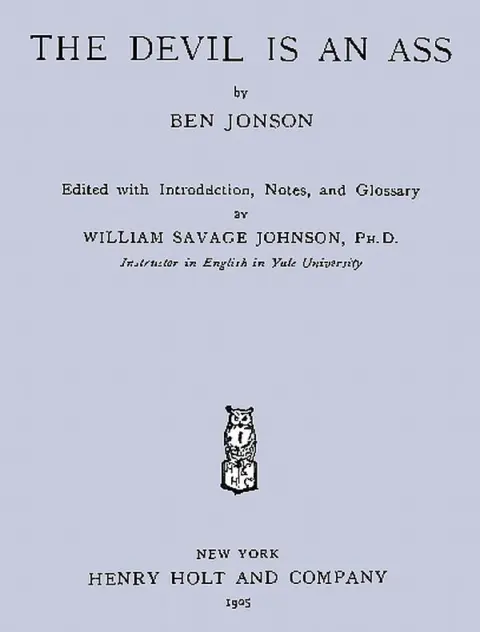
"The Devil is an Ass" by Ben Jonson is a Jacobean comedy first performed in 1616. When a minor devil named Pug begs to visit Earth, Satan warns him that London's vices have grown too sophisticated for a simple demon. Sent to plague the foolish Fabian Fitzdottrel, Pug finds himself hopelessly outmatched by cunning swindlers and charming gallants who converge on his master. As confidence men spin elaborate schemes and pursue Fitzdottrel's virtuous wife, the hapless devil discovers that human corruption far exceeds anything Hell has to offer.
Introduction adapted from the source catalogue; source summaries may be automatically generated.
Free to read · English · 107,369 words · No account needed
MAKE TIME FOR A GOOD BOOK
On by default. Untick to stop anonymous reading totals. Each page counts after 10 seconds in view. How this works.
Anonymous counting is on unless you have switched it off.
See Lehman’s edition, Leipzig, 1826, 6. 215. As Gifford says, the allusion was doubtless more familiar in Jonson’s day than in our own. The story is retold in Harsnet’s Declaration (p. 102), and Lucian’s work seems to have played a rather important part in the discussion of witchcraft.
=1. 6. 161 To scape his lading.= Cf. note 1. 4. 72.
=1. 6. 180 To other ensignes.= ‘I. e., to horns, the
Insignia of a cuckold.’--G.
=1. 6. 187 For the meere names sake.= ‘I. e. the name of
the play.’--W.
=1. 6. 195 the sad contract.= See variants. W. and G. are
doubtless correct.
=1. 6. 214 a guilt caroch.= ‘There was some distinction apparently between caroch and coach. I find in Lord Bacon’s will, in which he disposed of so much imaginary wealth, the following bequest: “I give also to my wife my four coach geldings, and my best caroache, and her own coach mares and caroache.”’--C.
Minsheu says that a carroch is a great coach. Cf. also Taylor’s
Wks., 1630:
No coaches, or carroaches she doth crave.
Rom Alley, O. Pl., 2d ed., 5. 475:
No, nor your jumblings,
In horslitters, in coaches or caroches.
Greene’s Tu Quoque, O. Pl., 2d ed., 7. 28:
May’st draw him to the keeping of a coach
For country, and carroch for London.
Cf. also Dekker, Non-dram. Wks. 1. 111. Finally the matter is settled by Howes (p. 867), who gives the date of the introduction of coaches as 1564, and adds: ‘Lastly, euen at this time, 1605, began the ordinary use of Caroaches.’ In Cyn. Rev., Wks. 2. 281, Gifford changes carroch to coach.
=1. 6. 216 Hide-parke.= Jonson speaks of coaching in Hyde Park in the Prologue to the Staple of News, Wks. 5. 157, and in The World in the Moon, Wks. 7. 343. Pepys has many references to it in his Diary. ‘May 7, 1662. And so, after the play was done, she and The Turner and Mrs. Lucin and I to the Parke; and there found them out, and spoke to them; and observed many fine ladies, and staid till all were gone almost.’
‘April 22, 1664. In their coach to Hide Parke, where great plenty of gallants, and pleasant it was, only for the dust.’
Ashton in his Hyde Park (p. 59) quotes from a ballad in the British Museum (c 1670-5) entitled, News from Hide Park, In which the following lines occur:
Of all parts of England, Hide-park hath the name, For Coaches and Horses, and Persons of fame.
Your reading position is saved on this browser. Take it to another device with a library code. Reading pages adapt to text, rather than matching a printed edition.
BEHIND THE BOOK
This eBook is for the use of anyone anywhere in the United States and most other parts of the world at no cost and with almost no restrictions whatsoever. You may copy it, give it away or re-use it under the terms of the Project Gutenberg License included with this eBook or online at www.gutenberg.org. If you are not located in the United States, you will have to check the laws of the country where you are located before using this eBook. Read the source licence.
The original source file, including credits and licence, is retained by this library. Request an original-format copy at no charge. Please include the book title and Project Gutenberg identifier #50150.
KEEP YOUR CURIOSITY GOING
Maurice Baring
W. B. (William Butler) Yeats
Edward Martyn

John Brougham & Charlotte Brontë
Marguerite Merington
Leonid Andreyev