THE CLASSIC COLLECTION✦Lost DiariesCLASSIC FREE BOOKS
Lost Diaries
Maurice Baring
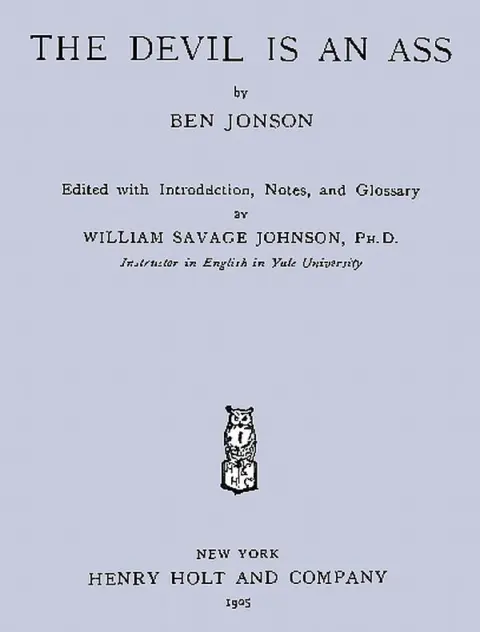
THE CLASSIC COLLECTION · 1905
"The Devil is an Ass" by Ben Jonson is a Jacobean comedy first performed in 1616. When a minor devil named Pug begs to visit Earth, Satan warns him that London's vices have grown too sophisticated for a simple demon. Sent to plague the foolish Fabian Fitzdottrel, Pug finds himself hopelessly outmatched by cunning swindlers and charming gallants who converge on his master. As confidence men spin elaborate schemes and pursue Fitzdottrel's virtuous wife, the hapless devil discovers that human corruption far exceeds anything Hell has to offer.
Introduction adapted from the source catalogue; source summaries may be automatically generated.
Free to read · English · 107,369 words · No account needed
MAKE TIME FOR A GOOD BOOK
On by default. Untick to stop anonymous reading totals. Each page counts after 10 seconds in view. How this works.
Anonymous counting is on unless you have switched it off.
=1. 6. 40 Yes, wusse.= Wusse is a corruption of wis, OE. gewis, certainly. Jonson uses the forms I wuss (Wks. 1. 102), I wusse (Wks. 6. 146), and Iwisse (Wks. 2. 379. the fol. reading; Gifford changing to I wiss), in addition to the present form. In some cases the word is evidently looked upon as a verb.
=1. 6. 58 sweet Pinnace.= Cf. 2. 2. 111 f. A woman is often compared to a ship. Nares cites B. & Fl., Woman’s Pr. 2. 6:
This pinck, this painted foist, this cockle-boat.
Cf. also Stap. of News, Wks. 5. 210:
She is not rigg’d, sir; setting forth some lady
Will cost as much as furnishing a fleet.--
Here she is come at last, and like a galley
Gilt in the prow.
Jonson plays on the names of Pinnacia in the New Inn, Wks. 5. 384:
‘Host. Pillage the Pinnace....
Lord B. Blow off her upper deck.
Lord L. Tear all her tackle.’
Pinnace, when thus applied to a woman, was almost always used with a conscious retention of the metaphor. Dekker is especially fond of the word. Match me in London, Wks. 4. 172:
--There’s a Pinnace
(Was mann’d out first by th’ City), is come to th’ Court,
New rigg’d.
Also Dekker, Wks. 4. 162; 3. 67, 77, 78.
When the word became stereotyped into an equivalent for procuress or prostitute, the metaphor was often dropped. Thus in Bart. Fair, Wks. 4. 386: ‘She hath been before me, punk, pinnace and bawd, any time these two and twenty years.’ Gifford says on this passage: ‘The usual gradation in infamy. A pinnace was a light vessel built for speed, generally employed as a tender. Hence our old dramatists constantly used the word for a person employed in love messages, a go-between in the worst sense, and only differing from a bawd in not being stationary.’ A glance at the examples given above will show, however, that the term was much more elastic than this explanation would indicate.
The dictionaries give no suggestion of the origin of the metaphor. I suspect that it may be merely a borrowing from classical usage. Cf. Menaechmi 2. 3. 442:
Ducit lembum dierectum nauis praedatoria.
In Miles Gloriosus 4. 1. 986, we have precisely the same application as in the English dramatists: ‘Haec celox (a swift sailing vessel) illiust, quae hinc agreditur, internuntia.’
=1. 6. 62 th’ are right.= Whalley’s interpretation is, of
course, correct. See variants.
=1. 6. 73 Not beyond that rush.= Rushes took the place of carpets in the days of Elizabeth. Shakespeare makes frequent reference to the custom (see Schmidt). The following passage from Dr. Bulleyne has often been quoted: ‘Rushes that grow upon dry groundes be good to strew in halles, chambers and galleries, to walk upon, defending apparel, as traynes of gownes and kertles from dust.’ Cf. also Cyn. Rev. 2. 5; Every Man out 3. 3.
Your reading position is saved on this browser. Take it to another device with a library code. Reading pages adapt to text, rather than matching a printed edition.
BEHIND THE BOOK
This eBook is for the use of anyone anywhere in the United States and most other parts of the world at no cost and with almost no restrictions whatsoever. You may copy it, give it away or re-use it under the terms of the Project Gutenberg License included with this eBook or online at www.gutenberg.org. If you are not located in the United States, you will have to check the laws of the country where you are located before using this eBook. Read the source licence.
The original source file, including credits and licence, is retained by this library. Request an original-format copy at no charge. Please include the book title and Project Gutenberg identifier #50150.
KEEP YOUR CURIOSITY GOING
Maurice Baring
W. B. (William Butler) Yeats
Edward Martyn

John Brougham & Charlotte Brontë
Marguerite Merington
Leonid Andreyev