THE CLASSIC COLLECTION✦Lost DiariesCLASSIC FREE BOOKS
Lost Diaries
Maurice Baring
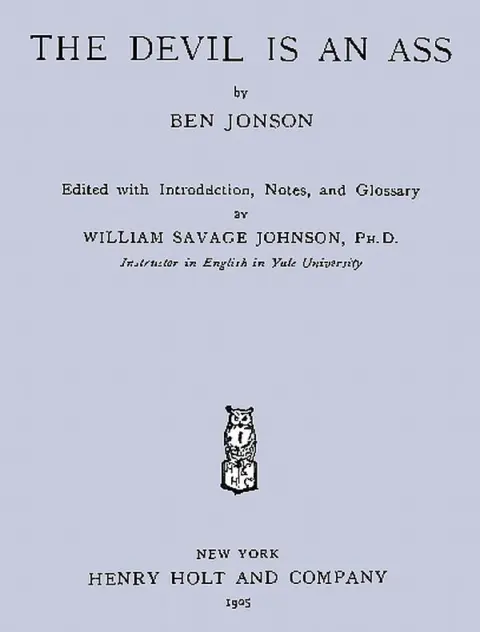
THE CLASSIC COLLECTION · 1905
"The Devil is an Ass" by Ben Jonson is a Jacobean comedy first performed in 1616. When a minor devil named Pug begs to visit Earth, Satan warns him that London's vices have grown too sophisticated for a simple demon. Sent to plague the foolish Fabian Fitzdottrel, Pug finds himself hopelessly outmatched by cunning swindlers and charming gallants who converge on his master. As confidence men spin elaborate schemes and pursue Fitzdottrel's virtuous wife, the hapless devil discovers that human corruption far exceeds anything Hell has to offer.
Introduction adapted from the source catalogue; source summaries may be automatically generated.
Free to read · English · 107,369 words · No account needed
MAKE TIME FOR A GOOD BOOK
On by default. Untick to stop anonymous reading totals. Each page counts after 10 seconds in view. How this works.
Anonymous counting is on unless you have switched it off.
The phrase occurs again in 1. 6. 161, where Wittipol calls Fitzdottrel an ass, and says that he cannot ‘scape his lading’. ‘You lade me’, then, seems to mean ‘You make an ass of me’. The same use of the word occurs in Dekker, Olde Fortunatus, Wks. 1. 125: ‘I should serue this bearing asse rarely now, if I should load him’. And again in the works of Taylor, the Water Poet, p. 311: ‘My Lines shall load an Asse, or whippe an Ape.’ Cf. also Bart. Fair, Wks. 4. 421: ‘Yes, faith, I have my lading, you see, or shall have anon; you may know whose beast I am by my burden.’
=1. 4. 83, 4 But, not beyond=, =A minute, or a second, looke for=. The omission of the comma after beyond by all the later editors destroys the sense. Fitzdottrel does not mean that Wittipol cannot have ‘beyond a minute’, but that he cannot have a minute beyond the quarter of an hour allowed him.
=1. 4. 96 Migniard.= ‘Cotgrave has in his dictionary, “Mignard--migniard, prettie, quaint, neat, feat, wanton, dainty, delicate.” In the Staple of News [Wks. 5. 221] Jonson tries to introduce the substantive migniardise, but happily without success.’--G.
=1. 4. 101 Prince Quintilian.= The reputation of this famous rhetorician (c 35-c 97 A. D.) is based on his great work entitled De Instiutione Oratoria Libri XII. The first English edition seems to have been made in 1641, but many Continental editions had preceded it. The title Prince seems to be gratuitous on Jonson’s part. He is mentioned again in Timber (ed. Schelling, 57. 29 and 81. 4).
=1. 5. 2= Cf. New Inn, Wks. 5. 323: ‘Host. What say you, sir? where are you, are you within? (Strikes LOVEL on the breast.)’
=1. 5. 8, 9. Old Africk, and the new America,
With all their fruite of Monsters.= Cf. Donne,
Sat., Wks. 2. 190 (ed. 1896):
Stranger ...
Than Afric’s monsters, Guiana’s rarities.
Brome, Queen’s Exchange, Wks. 3. 483: ‘What monsters are bred in Affrica?’ Glapthorne, Hollander, Wks., 1874, 1. 81: ‘If Africke did produce no other monsters,’ etc. The people of London at this time had a great thirst for monsters. See Alden, Bart. Fair, p. 185, and Morley, Memoirs of Bartholomew Fair.
=1. 5. 17 for hidden treasure.= ‘And when he is appeared, bind him with the bond of the dead above written: then saie as followeth. I charge thee N. by the father, to shew me true visions in this christall stone, if there be anie treasure hidden in such a place N. & wherein it now lieth, and how manie foot from this peece of earth, east, west, north, or south.’--Scot, Discovery, p. 355.
Most of the conjurers pretended to be able to recover stolen treasure. The laws against conjurers (see note 1. 2. 6) contained clauses forbidding the practice.
=1. 5. 21 his men of Art.= A euphemism for conjurer.
Cf. B. & Fl., Fair Maid of the Inn 2. 2:
Your reading position is saved on this browser. Take it to another device with a library code. Reading pages adapt to text, rather than matching a printed edition.
BEHIND THE BOOK
This eBook is for the use of anyone anywhere in the United States and most other parts of the world at no cost and with almost no restrictions whatsoever. You may copy it, give it away or re-use it under the terms of the Project Gutenberg License included with this eBook or online at www.gutenberg.org. If you are not located in the United States, you will have to check the laws of the country where you are located before using this eBook. Read the source licence.
The original source file, including credits and licence, is retained by this library. Request an original-format copy at no charge. Please include the book title and Project Gutenberg identifier #50150.
KEEP YOUR CURIOSITY GOING
Maurice Baring
W. B. (William Butler) Yeats
Edward Martyn

John Brougham & Charlotte Brontë
Marguerite Merington
Leonid Andreyev