THE CLASSIC COLLECTION✦Lost DiariesCLASSIC FREE BOOKS
Lost Diaries
Maurice Baring
THE CLASSIC COLLECTION · 1905
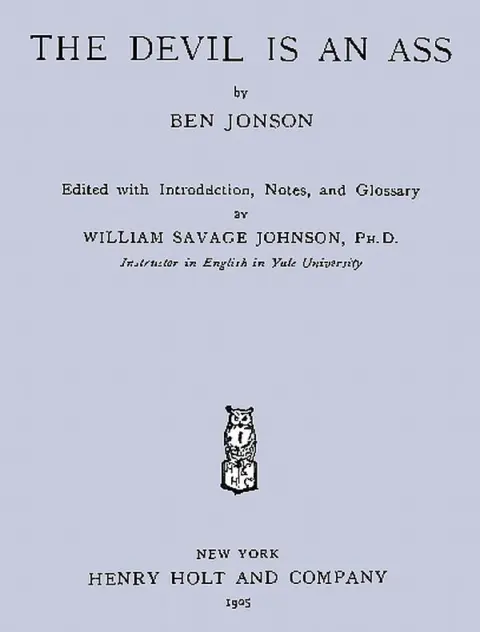
"The Devil is an Ass" by Ben Jonson is a Jacobean comedy first performed in 1616. When a minor devil named Pug begs to visit Earth, Satan warns him that London's vices have grown too sophisticated for a simple demon. Sent to plague the foolish Fabian Fitzdottrel, Pug finds himself hopelessly outmatched by cunning swindlers and charming gallants who converge on his master. As confidence men spin elaborate schemes and pursue Fitzdottrel's virtuous wife, the hapless devil discovers that human corruption far exceeds anything Hell has to offer.
Introduction adapted from the source catalogue; source summaries may be automatically generated.
Free to read · English · 107,369 words · No account needed
MAKE TIME FOR A GOOD BOOK
On by default. Untick to stop anonymous reading totals. Each page counts after 10 seconds in view. How this works.
Anonymous counting is on unless you have switched it off.
=1. 2. 27 his hard names.= A long list of the ‘diverse names of the divell’ is given in The Discovery, p. 436, and another in the Second Appendix, p. 522.
=1. 2. 31, 2 I long for thee. An’ I were with child by him, ... I could not more.= The expression is common enough. Cf. Eastward Hoe: ‘Ger. As I am a lady, I think I am with child already, I long for a coach so.’ Dekker, Shomakers Holiday, Wks. 1. 17: ‘I am with child till I behold this huffecap.’ The humors of the longing wife are a constant subject of ridicule. See Bart. Fair, Act 1, and Butler’s Hudibras, ed. 1819, 3. 78 and note.
=1. 2. 39 A thousand miles.= ‘Neither are they so much limited as Tradition would have them; for they are not at all shut up in any separated place: but can remove millions of miles in the twinkling of an eye.’--Scot, Discovery, Ap. II, p. 493.
=1. 2. 43 The burn’t child dreads the fire.= Jonson is fond of proverbial expressions. Cf. 1. 6. 125; 1. 6. 145; 5. 8. 142, 3, etc.
=1. 3. 5 while things be reconcil’d.= In Elizabethan English both while and whiles often meant ‘up to the time when’, as well as ‘during the time when’ (d. a similar use of ‘dum’ in Latin and of ἕ ος in Greek).--Abbot, §137.
For its frequent use in this sense in Shakespeare see Schmidt and note on Macbeth 3. 1. 51, Furness’s edition. Cf. also Nash, Prognostication, Wks. 2. 150: ‘They shall ly in their beds while noon.’
=1. 3. 8, 9 those roses Were bigge inough to hide a clouen
foote.= Dyce (Remarks, p. 289) quotes Webster, White
Devil, 1612:
--why, ’tis the devil;
I know him by a great rose he wears on’s shoe,
To hide his cloven foot.
Cunningham adds a passage from Chapman, Wks. 3. 145:
Fro. Yet you cannot change the old fashion (they say)
And hide your cloven feet.
Oph. No! I can wear roses that shall spread quite
Over them.
Gifford quotes Nash, Unfortunate Traveller, Wks. 5. 146: ‘Hee hath in eyther shoo as much taffaty for his tyings, as would serue for an ancient.’ Cf. also Dekker, Roaring Girle, Wks. 3. 200: ‘Haue not many handsome legges in silke stockins villanous splay feet for all their great roses?’
=1. 3. 13 My Cater.= Whalley changes to ‘m’acter’ on the authority of the Sad Shep. (vol. 4. 236):
--Go bear ’em in to Much
Th’ acater.
The form ‘cater’, however, is common enough. Indeed, if we are to judge from the examples in Nares and NED., it is much the more frequent, although the present passage is cited in both authorities under the longer form.
=1. 3. 21 I’le hearken.= W. and G. change to ‘I’d.’ The change is unnecessary if we consider the conditional clause as an after-thought on the part of Fitzdottrel. For a similar construction see 3. 6. 34-6.
Your reading position is saved on this browser. Take it to another device with a library code. Reading pages adapt to text, rather than matching a printed edition.
BEHIND THE BOOK
This eBook is for the use of anyone anywhere in the United States and most other parts of the world at no cost and with almost no restrictions whatsoever. You may copy it, give it away or re-use it under the terms of the Project Gutenberg License included with this eBook or online at www.gutenberg.org. If you are not located in the United States, you will have to check the laws of the country where you are located before using this eBook. Read the source licence.
The original source file, including credits and licence, is retained by this library. Request an original-format copy at no charge. Please include the book title and Project Gutenberg identifier #50150.
KEEP YOUR CURIOSITY GOING
Maurice Baring
W. B. (William Butler) Yeats
Edward Martyn

John Brougham & Charlotte Brontë
Marguerite Merington
Leonid Andreyev