THE CLASSIC COLLECTION✦An outlaw’s diary: the CommuneCLASSIC FREE BOOKS
An outlaw’s diary: the Commune
Cécile Tormay
THE CLASSIC COLLECTION · 1845
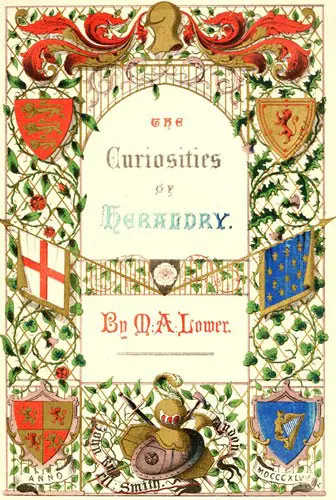
"The Curiosities of Heraldry" by Mark Antony Lower is a historical account written in the mid-19th century. This work delves into the principles and practices of heraldry, a system that denotes family lineage and nobility through intricate symbols and designs. The book aims to shed light on the often-overlooked significance and utility of heraldic study, enlivened by historical anecdotes and examples. The opening of the text presents a preface where Lower establishes the value of heraldry as an essential study for understanding not only genealogy but also the broader historical context of the Middle Ages. He reflects on the misconceptions surrounding heraldry, countering the view that it is merely an outdated collection of symbols. He emphasizes the poetic and practical aspects of heraldry, asserting that it is a rich field worthy of attention. The introduction sets the stage for a detailed exploration of the science of heraldry, hinting at its deep historical roots and its role in the social fabric of medieval society, ultimately preparing the reader for a thorough investigation into the subject throughout the subsequent chapters.
Introduction adapted from the source catalogue; source summaries may be automatically generated.
Free to read · English · 86,967 words · No account needed
MAKE TIME FOR A GOOD BOOK
On by default. Untick to stop anonymous reading totals. Each page counts after 10 seconds in view. How this works.
Anonymous counting is on unless you have switched it off.
[153] Between 1240 and 1245. (LXIV in Coll. Arm.)
[154] Chaffinch.
[155] Sphere of Gentry.
[156] Vide cut at the head of the present chapter.
[157] Vide English Surnames, p. 72, second edit.
[158] Gibbon, Bluemantle pursuivant, who flourished subsequently to Camden, made a collection of "Allusive Arms" containing some thousands of such coats. His MS. is in the College of Arms.
[159] Vide the Chapter of Rebuses, appended to my 'English Surnames,'
second edit. p. 261.
[160] It is a fact not unworthy of notice that Nicholas Breakspeare (Pope Adrian IV) and William Shakspeare both bore canting-arms; the former, 'Gu, a broken spear, or;' and the dramatist, 'Argent, on a bend sable, a spear of the first.'
[161] Debrett, edited by Wm. Courthope, Esq. [now Rouge-Croix.]
[162] Essai sur les Noms, &c., I, 240.
[163] Brydson's Summary View of Heraldry, pp. 98-9.
[164] Menestrier.
[165] Study of Heraldry, p. 70.
[166] Berry, Encycl. Herald.
[167] The ducal coronet antiently denoted command, and the chapeau, dignity; but in their modern application they have no such meaning.
[168] Edward III is the first monarch who introduced a crest (the lion statant-guardant) into his great seal. But this cannot be regarded as the first instance of the use of crests, for they appear nearly half a century earlier upon the seals of Edmund Crouchback, Earl of Lancaster. That they were in common use in Chaucer's time is obvious from the poet's description of the one borne by Sire Thopas, the tower and lily. Vide page 81.
[169] The crest of Exmew is generally blazoned as 'a dove supporting a text =r= by a branch of laurel.' As to the letter, it is certainly an X, not an R; and the bird is quite as much like a sea-gull, or MEW, as a dove. Hence a rebus upon the name was doubtless intended =x=-MEW! The crest of Bourchier shows the manner in which the crest was affixed to the helmet.
[170] Herald-painters of the present day neglect this rule, and generally paint the mantlings red, doubled or lined with white or ermine.
[171] In the seal of Ela, Countess of Salisbury, who was born in 1196, two lions rampant, or rather crawling, are introduced to fill up the spaces on each side of the lady's effigies. It is engraved in Sandford's Geneal. Hist.
[172] The following are the royal supporters, as given in Sandford's Genealogical History: Richard II, two angels; Henry IV, swan and antelope; Henry V, lion and antelope; Henry VI, two antelopes; Edward IV, lion and bull; Edward V, lion and hind; Richard III, two boars; Henry VII, dragon and greyhound; Henry VIII, lion and dragon; Edward VI, lion-guardant crowned and dragon; Mary, eagle and lion; Elizabeth, as Edward VI; James I, &c. lion and unicorn, as at present.
Your reading position is saved on this browser. Take it to another device with a library code. Reading pages adapt to text, rather than matching a printed edition.
BEHIND THE BOOK
This eBook is for the use of anyone anywhere in the United States and most other parts of the world at no cost and with almost no restrictions whatsoever. You may copy it, give it away or re-use it under the terms of the Project Gutenberg License included with this eBook or online at www.gutenberg.org. If you are not located in the United States, you will have to check the laws of the country where you are located before using this eBook. Read the source licence.
The original source file, including credits and licence, is retained by this library. Request an original-format copy at no charge. Please include the book title and Project Gutenberg identifier #38951.
KEEP YOUR CURIOSITY GOING
Cécile Tormay

Moritz Busch
John L. Ransom
Frances Wright
Cécile Tormay

Mabel Potter Daggett