THE CLASSIC COLLECTION✦An outlaw’s diary: the CommuneCLASSIC FREE BOOKS
An outlaw’s diary: the Commune
Cécile Tormay
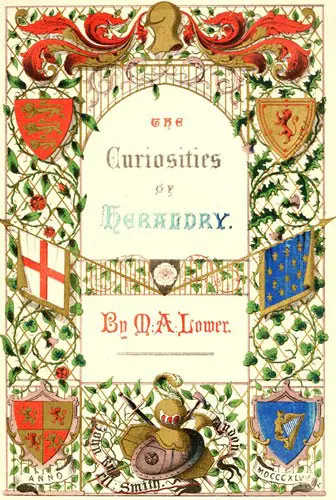
THE CLASSIC COLLECTION · 1845
"The Curiosities of Heraldry" by Mark Antony Lower is a historical account written in the mid-19th century. This work delves into the principles and practices of heraldry, a system that denotes family lineage and nobility through intricate symbols and designs. The book aims to shed light on the often-overlooked significance and utility of heraldic study, enlivened by historical anecdotes and examples. The opening of the text presents a preface where Lower establishes the value of heraldry as an essential study for understanding not only genealogy but also the broader historical context of the Middle Ages. He reflects on the misconceptions surrounding heraldry, countering the view that it is merely an outdated collection of symbols. He emphasizes the poetic and practical aspects of heraldry, asserting that it is a rich field worthy of attention. The introduction sets the stage for a detailed exploration of the science of heraldry, hinting at its deep historical roots and its role in the social fabric of medieval society, ultimately preparing the reader for a thorough investigation into the subject throughout the subsequent chapters.
Introduction adapted from the source catalogue; source summaries may be automatically generated.
Free to read · English · 86,967 words · No account needed
MAKE TIME FOR A GOOD BOOK
On by default. Untick to stop anonymous reading totals. Each page counts after 10 seconds in view. How this works.
Anonymous counting is on unless you have switched it off.
[84] Spenser uses this word:
"How the red roses flush up in her cheeks,
And the pure snow with goodly vermeil stain."
[85] Roll of Karlaverok, p. 26.
[86] In the 'Secretes of Master Alexis of Piedmont' are many recipes for
making this article.
[87] There is an extraordinary difference of opinion respecting the Mediaeval Latin, Sinopis. Ducange, with the authorities quoted above, make its colour green; but the sinoper, or ruddle of commerce, is of a dark red or purplish hue. In one of the Cottonian MSS. Nero, c. vi, fol. 156, is the following account of it: "Sinopim, colorem videlicet illum cujus tres sunt species, videlicet rubea, subrubea, et inter has media, invenerunt primitus, ut scribit Ysidorus viri regionis Ponticae in urbe eorum quam solent ipsi Sinopem vocitare."
[88] Page 205.
[89] It is a prevailing error that the bend sinister is a mark of dishonour, as betokening illegitimacy; this seems to have arisen from its having been confounded with the baton, which bearing differs from it both in being much narrower, and in being cut off from the borders of the escocheon.
[90] Among the sovereign states whose armorial ensigns are formed of such stripes are Cyprus, Hungary, Saxony, Austrasia, Burgundy, Arragon, and Germany under the descendants of Louis the Debonaire. The private families who bear armories so formed are innumerable.--Brydson, p. 66.
[91] These, as Mr. Planche (Hist. Brit. Costume, p. 151,) observes, are mostly heraldric terms. Ounding, or undeing, signifies a waved pattern or edge.
[92] Blaauw's Barons' War.
[93] Mylneris, miller's; yrne, iron; mylnys, mills; mylne-ston,
mill-stone.
[94] Furetiere, quoted by Dall.
[95] Accid. fol. 121.
[96] By a statute of temp. Edw. II. (apud Winton) every person not having a greater annual revenue in land than 100 pence, was compelled to have in his possession a bow and arrows, with other arms both offensive and defensive; but all such as had no possessions (in land), but could afford to purchase arms, were commanded to have a bow with sharp arrows if they resided without the royal forests, and a bow with round-headed arrows if their habitation was within the forests. The words of the statute are, "Ark et setes hors de foreste, et en foreste ark et piles." The word pile is supposed to be derived from the Latin 'pila,' a ball; and Strutt supposes this kind of missile to have been used to prevent the owners from killing the king's deer. In the following reign archery, as a pastime of the common people, began to be neglected, which occasioned the king to send a letter of complaint to the sheriffs of London, desiring them to see that the leisure time upon holidays was spent in the use of the bow. In the thirty-ninth year of this reign, 1365, the penalty incurred by offenders was imprisonment at the king's pleasure. The words of the letter are, "arcubus et sagittis, vel pilettis aut boltis," with bow and arrows, or piles or bolts. Vide Strutt's Sports and Pastimes. Edit. Hone, pp. 54, 55.
Your reading position is saved on this browser. Take it to another device with a library code. Reading pages adapt to text, rather than matching a printed edition.
BEHIND THE BOOK
This eBook is for the use of anyone anywhere in the United States and most other parts of the world at no cost and with almost no restrictions whatsoever. You may copy it, give it away or re-use it under the terms of the Project Gutenberg License included with this eBook or online at www.gutenberg.org. If you are not located in the United States, you will have to check the laws of the country where you are located before using this eBook. Read the source licence.
The original source file, including credits and licence, is retained by this library. Request an original-format copy at no charge. Please include the book title and Project Gutenberg identifier #38951.
KEEP YOUR CURIOSITY GOING
Cécile Tormay

Moritz Busch
John L. Ransom
Frances Wright
Cécile Tormay

Mabel Potter Daggett