THE CLASSIC COLLECTION✦An outlaw’s diary: the CommuneCLASSIC FREE BOOKS
An outlaw’s diary: the Commune
Cécile Tormay
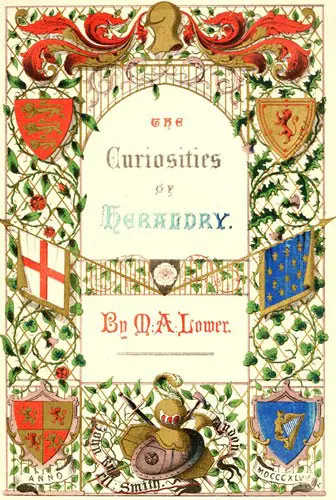
THE CLASSIC COLLECTION · 1845
"The Curiosities of Heraldry" by Mark Antony Lower is a historical account written in the mid-19th century. This work delves into the principles and practices of heraldry, a system that denotes family lineage and nobility through intricate symbols and designs. The book aims to shed light on the often-overlooked significance and utility of heraldic study, enlivened by historical anecdotes and examples. The opening of the text presents a preface where Lower establishes the value of heraldry as an essential study for understanding not only genealogy but also the broader historical context of the Middle Ages. He reflects on the misconceptions surrounding heraldry, countering the view that it is merely an outdated collection of symbols. He emphasizes the poetic and practical aspects of heraldry, asserting that it is a rich field worthy of attention. The introduction sets the stage for a detailed exploration of the science of heraldry, hinting at its deep historical roots and its role in the social fabric of medieval society, ultimately preparing the reader for a thorough investigation into the subject throughout the subsequent chapters.
Introduction adapted from the source catalogue; source summaries may be automatically generated.
Free to read · English · 86,967 words · No account needed
MAKE TIME FOR A GOOD BOOK
On by default. Untick to stop anonymous reading totals. Each page counts after 10 seconds in view. How this works.
Anonymous counting is on unless you have switched it off.
[45] The second book of Upton's treatise, written in the fifteenth century, is entitled 'Of Veterans, now called Heralds.'
[46] Nicolas' Karlaverok, p. 4.
[47] Nicolas' Karlaverok, p. 44. The charge here blazoned, a cross patee, is, in fact, a cross patonce.
[48] Ibid., Notes, p. 368.
[49] Waterhouse's Discourse, p. 77.
[50] Let it not be understood from this remark that I mean in the slightest degree to advocate war as a means of acquiring national greatness. The war which Edward waged against France was totally unjustifiable; and the desolating civil wars which followed the misgovernment of his pusillanimous grandson Richard, were (as many of our subsequent wars have been) a disgrace to the very name of England.
[51] Strutt's Roy. and Eccl. Antiq.
[52] Holinshed.
[53] The engraving above is from Royal MS., 14 E. iii. Brit. Mus.
[54] Decline and Fall, v. 6, p. 59.
[55] Apparently the village of Retiers, near Rennes, in Brittany.
[56] De Controversia in Curia Militari inter R. de Scrope and R. Grosvenor, Milites, Rege Ricardo Secundo, 1385-1390. E Recordis in Turre, Lond. Asservatis, vol. i, p. 178.
[57] Vide Historical and Allusive Arms; Loud. 1803, p. 43, et seq. Anecdotes of Heraldry and Chivalry; Worcester, 1795.
[58] Hutchinson's Cumberland, vol. i, p. 314. The arms borne by a junior branch of the Blencowes are 'Gules, a quarter argent,' the original coat of the family. The baron of Graystock's grant is sometimes borne as a quartering. The arms of his lordship, from which it is borrowed, were 'Barry of six, argent and azure, over all three chaplets gules.' According to a family tradition, Adam de Blencowe was standard-bearer to the Baron. Vide West's Antiquities of Furness, quoted by Hutchinson.
[59] Montagu's Study of Heraldry, Appendix A.
[60] One of the earliest grants of Arms preserved in the Heralds' Coll. is printed in the Appendix. It is of the time of Edward III.
[61] "Nihil sibi insignii accidisse quia nec ipse nec majores sui in bello unquam descendissent." Waterhouse, quoted by Dallaway.
[62] Dallaway.
[63] This was called dimidiation.
[64] The dimidiated coat represented on p. 36, is not the arms of a family, but those of the corporation of Hastings. Here three demi-lions are conjoined with three sterns of antient ships--a composition compared with which the griffin, cockatrice, and every other hybrid of a herald's imagination sinks into insignificance. That this singular shield is a dimidiation of two antient coats cannot be doubted. Three ships, in all probability, formed the original arms of the town--the dexter-half of the royal arms of England having been superimposed in commemoration of some great immunity granted to this antiently important corporation.
Your reading position is saved on this browser. Take it to another device with a library code. Reading pages adapt to text, rather than matching a printed edition.
BEHIND THE BOOK
This eBook is for the use of anyone anywhere in the United States and most other parts of the world at no cost and with almost no restrictions whatsoever. You may copy it, give it away or re-use it under the terms of the Project Gutenberg License included with this eBook or online at www.gutenberg.org. If you are not located in the United States, you will have to check the laws of the country where you are located before using this eBook. Read the source licence.
The original source file, including credits and licence, is retained by this library. Request an original-format copy at no charge. Please include the book title and Project Gutenberg identifier #38951.
KEEP YOUR CURIOSITY GOING
Cécile Tormay

Moritz Busch
John L. Ransom
Frances Wright
Cécile Tormay

Mabel Potter Daggett