
The Writing of News A Handbook with Chapters on Newspaper Correspondence and Copy Reading
Charles G. (Charles Griffith) Ross
THE CLASSIC COLLECTION · 1876
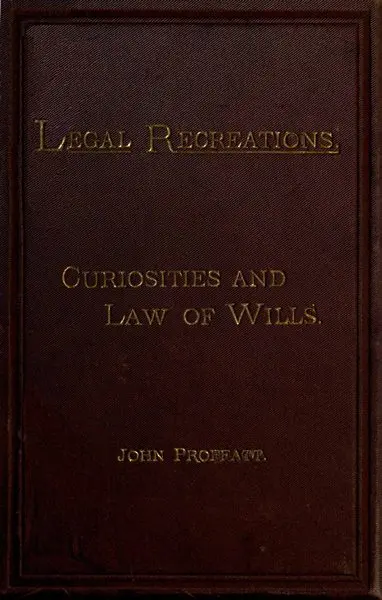
"The Curiosities and Law of Wills" by John Proffatt is a legal treatise written in the late 19th century. This work explores the intricacies surrounding wills, including their formation, legal interpretations, and peculiar cases that highlight human nature. The author aims to present the subject matter in an engaging manner while providing practical and systematic guidance for students, lawyers, and interested readers alike. At the start of the treatise, the author introduces the profound significance of making a last will and testament, noting that it represents a person's final opportunity to express thoughts and feelings about their life and relationships. Proffatt emphasizes that wills can reflect an individual's personality, demonstrating eccentricities, emotions, and views on life and death. He illustrates this premise with various unusual and curious examples of wills throughout history, setting the stage for a deeper exploration of the legal complexities of testamentary documents. The introduction serves as an engaging prelude to the text's more serious discussions on the laws and principles governing wills.
Introduction adapted from the source catalogue; source summaries may be automatically generated.
Free to read · English · 54,497 words · No account needed
MAKE TIME FOR A GOOD BOOK
On by default. Untick to stop anonymous reading totals. Each page counts after 10 seconds in view. How this works.
Anonymous counting is on unless you have switched it off.
[92] Mr. William Kensett, whose will was proved in Doctors' Commons, London, in 1855, left his body to the Directors of the Imperial Gas Company, London, to be placed in one of their retorts, and consumed to ashes; if not, he directed it to be placed in the family grave in St. John's Wood Cemetery, to assist in poisoning the neighborhood. Generally the curious wills are home-made, but this of Mr. Kensett was made by a solicitor.
[93] Taylor, p. 658.
[94] Redfield on Wills, I, p. 84.
In June, 1828, the London papers recorded the singular will of a testator named Garland, containing the following clause: I bequeath to my monkey, my dear and amusing Jacko, the sum of £10 sterling per annum, to be employed for his sole use and benefit; to my faithful dog Shock, and my well-beloved cat Tib, a pension of £5 sterling; and I desire that, in case of the death of either of the three, the lapsed pension shall pass to the other two, between whom it is to be equally divided. On the death of all three, the sum appropriated to this purpose shall become the property of my daughter Gertrude, to whom I give the preference among my children, because of the large family she has, and the difficulty she finds in bringing them up.--Ill. London News, March 2d, 1874.
[95] 2 Bradf. 449.
[96] I am indebted to an admirable essay by Edward Patterson, Esq., of the New York Bar, for the full facts in this case.
[97] 29 Eng. L. and Eq. 38.
[98] Kinleside v. Harrison, 2 Phillm. 419.
[99] 1 Wms. Exrs. 36; Potts v. House, 6 Ga. 324.
[100] 5 Johns. Ch. 148.
[101] 2 Bradf. 360.
[102] 2 Kent 175.
[103] Tucker v. Inman, 4 M. & G. 1049.
[104] Gen. Stat., 1855.
[105] Black. II, 497.
[106] Redfield on Wills, I, 26.
[107] 2 Lans. (N. Y.) 21.
[108] Toucht. 433.
[109] 1 Atk. 417.
[110] Richards v. Richards, 9 Price 219.
[111] Toucht. 433.
[112] Selwood v. Mildmay, 3 Ves. 306; 1 Bro. C. C. 477.
[113] Ellis v. Walker, Amb. 310; Kirby v. Potter, 4 Ves. 748; Tifft v.
Porter, 8 N. Y. 516.
[114] 1 Atk. 508.
[115] 3 Bro. C. C. 416.
[116] Richards v. Richards, 9 Price, 226.
[117] Barton v. Cooke, 5 Ves. 461.
[118] Walton v. Walton, 7 Johns. 258.
[119] 2 Ves. Sen. 561.
[120] Wms. Exrs. 994.
[121] 1 Roper, 215.
[122] Sayer v. Sayer, 2 Vern. 688.
[123] 5 Ves. 150.
[124] Duncan v. Alt, 3 Penn. 383.
[125] Wms. Exrs. 759.
[126] Idem. 1035.
[127] Bacon's Ab. Leg. (E); 2 Vent. 342; Moore v. Smith, 9 Watts, 403.
[128] 11 Wend. 259.
[129] 2 Vern. 673; Van Wyck v. Bloodgood, 1 Bradf. 154.
[130] Collins v. Metcalfe, 1 Vern. 462. To avoid the lapse of a legacy by the death of the legatee during the lifetime of the testator, the following States have provided against it, if any issue of the legatee be living at the death of the testator: Pennsylvania, South Carolina, Virginia, Maryland, Massachusetts, Connecticut, Vermont, New Jersey, Mississippi, Maine, Rhode Island. (4 Kent, 542.)
[131] 1 Roper, 216; 1 Paige, 33; Harris v. Fly, 7 Paige, 429; Sweet v.
Chase, 2 N. Y. 73.
[132] May v. Wood, 3 Bro. 471.
[133] Barlow v. Grant, 1 Vern. 255.
[134] Duke of Chandos v. Talbot, 2 P. Wms. 612; Smith v. Smith, 2 Vern.
92.
[135] 1 Roper, 645.
[136] Bacon's Ab. Leg. (F.)
[137] 37 Miss. 114.
[138] 2 Meriv. 26.
Your reading position is saved on this browser. Take it to another device with a library code. Reading pages adapt to text, rather than matching a printed edition.
BEHIND THE BOOK
This eBook is for the use of anyone anywhere in the United States and most other parts of the world at no cost and with almost no restrictions whatsoever. You may copy it, give it away or re-use it under the terms of the Project Gutenberg License included with this eBook or online at www.gutenberg.org. If you are not located in the United States, you will have to check the laws of the country where you are located before using this eBook. Read the source licence.
The original source file, including credits and licence, is retained by this library. Request an original-format copy at no charge. Please include the book title and Project Gutenberg identifier #41075.
KEEP YOUR CURIOSITY GOING
Charles G. (Charles Griffith) Ross
Hannah Webster Foster

Emily Lawless
Edwin Hamlin Carr

Charles De Lano Hine
Andrew Ure