
The Writing of News A Handbook with Chapters on Newspaper Correspondence and Copy Reading
Charles G. (Charles Griffith) Ross
THE CLASSIC COLLECTION · 1876
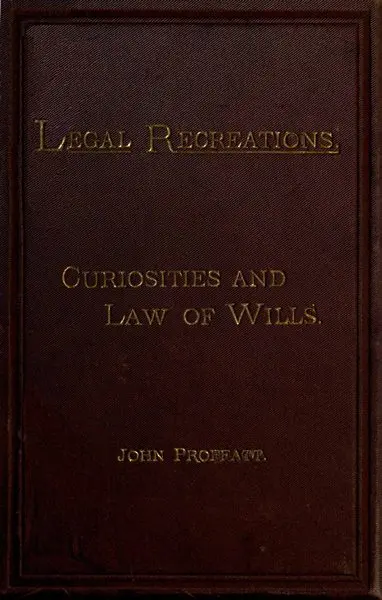
"The Curiosities and Law of Wills" by John Proffatt is a legal treatise written in the late 19th century. This work explores the intricacies surrounding wills, including their formation, legal interpretations, and peculiar cases that highlight human nature. The author aims to present the subject matter in an engaging manner while providing practical and systematic guidance for students, lawyers, and interested readers alike. At the start of the treatise, the author introduces the profound significance of making a last will and testament, noting that it represents a person's final opportunity to express thoughts and feelings about their life and relationships. Proffatt emphasizes that wills can reflect an individual's personality, demonstrating eccentricities, emotions, and views on life and death. He illustrates this premise with various unusual and curious examples of wills throughout history, setting the stage for a deeper exploration of the legal complexities of testamentary documents. The introduction serves as an engaging prelude to the text's more serious discussions on the laws and principles governing wills.
Introduction adapted from the source catalogue; source summaries may be automatically generated.
Free to read · English · 54,497 words · No account needed
MAKE TIME FOR A GOOD BOOK
On by default. Untick to stop anonymous reading totals. Each page counts after 10 seconds in view. How this works.
Anonymous counting is on unless you have switched it off.
[51] The statute of Pennsylvania requires every will to "be in writing," and the curious question was recently presented to the Court of Common Pleas of Chester County, whether a writing on a slate, intended by the decedent to be her last will and testament, came within the statute. The court thought the case not within the spirit of the statute, because a slate was neither intended for nor adapted to writing of a permanent character. The rule has been carried quite far enough by the admission to probate of wills written with lead pencils, as was done in Dyer's Estate, 3 Ecc. E. 92, and in Dickson v. Dickson, 1 Id. 222. In 21 P. F. Smith, 454, it was thought that a will should not be written or signed in pencil, on account of the facility of alteration; but the point was not decided. In Merritt v. Clason, 12 Johns. 102, a memorandum required by the Statute of Frauds, written with a lead pencil, was held sufficient, and in Clason v. Bailey, 14 Johns. 484, this point was affirmed. In Rymes v. Clarkson, 1 Phillim. 22, it was ruled that a codicil written in pencil was valid. See also Geary v. Physic, 5 Barn. and Cress. 234, and McDowell v. Chambers, 1 Strobh. Eq. 347.
[52] Jarman on Wills, 70.
[53] Civil Code, 1276.
[54] 2 Rev. Stat. 63.
[55] Doe v. Roe, 2 Barb. 200.
[56] Seguine v. Seguine, 2 Barb. 385, 395.
[57] 4 Comst. 140.
[58] McGuire v. Kerr, 2 Bradf. 244.
[59] Civil Code, 1276.
[60] Dayton on Surrog. p. 78.
[61] 1 Barb. 533. It is claimed he may subscribe in presence of one, and acknowledge it separately to the other. 4 Kent, 516; 36 N. Y. 416.
[62] 10 Barb. 608.
[63] Den v. Mitton, 7 Halst. 70.
[64] Torrey v. Bowen, 15 Barb. 304.
[65] Lewis v. Lewis, 1 Kern. 222.
[66] 1 Denio, 33.
[67] 26 Wend. 325.
[68] Not yet reported; may be in 59 N. Y.
[69] Ruddon v. McDonald, 1 Bradf. 352; Lyon v. Smith, 11 Barb. 124.
[70] Davy v. Smith, 3 Salk. 395.
[71] Doe v. Manifold, 1 M. & S. 294.
[72] Reed v. Roberts, 26 Ga. 294.
[73] Lamb v. Girtman, 26 Ga. 625.
[74] Black. II, 497.
[75] Redfield on Wills, I, 15.
[76] 2 Rev. Stat. 60.
[77] 1 Salk. 44.
[78] Black. I, 463; 2 Kent, 233.
[79] Wills, I, 20.
[80] Com. II, 497.
[81] Wills, B.
[82] Weir v. Fitzgerald, 2 Bradf. 42.
[83] Swinb. Pt. II, Secs. 1 and 6.
[84] No better illustration of this ever took place than the case of the will of Captain Ward, over whose will a remarkable contest is taking place [1875] in Detroit.
[85] Sir John Nicholl, in Dew v. Clark, 3 Add. 79.
[86] White v. Wilson, 13 Vesey, 88.
[87] The case of Lucas v. Parsons, 24 Ga. 640, was very similar to this case of Greenwood. There, the testator's delusion was in respect to his eldest son, whom he disinherited. The will was set aside.
[88] 3 Add. 75.
[90] 11 Penn. L. I. 179.
[91] Taylor, Med. Jur. p. 657.
Your reading position is saved on this browser. Take it to another device with a library code. Reading pages adapt to text, rather than matching a printed edition.
BEHIND THE BOOK
This eBook is for the use of anyone anywhere in the United States and most other parts of the world at no cost and with almost no restrictions whatsoever. You may copy it, give it away or re-use it under the terms of the Project Gutenberg License included with this eBook or online at www.gutenberg.org. If you are not located in the United States, you will have to check the laws of the country where you are located before using this eBook. Read the source licence.
The original source file, including credits and licence, is retained by this library. Request an original-format copy at no charge. Please include the book title and Project Gutenberg identifier #41075.
KEEP YOUR CURIOSITY GOING
Charles G. (Charles Griffith) Ross
Hannah Webster Foster

Emily Lawless
Edwin Hamlin Carr

Charles De Lano Hine
Andrew Ure