
The Writing of News A Handbook with Chapters on Newspaper Correspondence and Copy Reading
Charles G. (Charles Griffith) Ross
THE CLASSIC COLLECTION · 1876
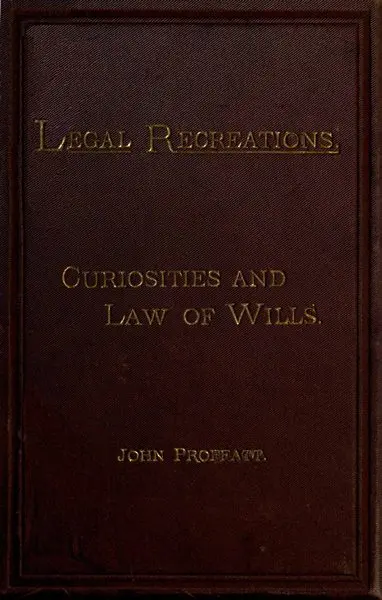
"The Curiosities and Law of Wills" by John Proffatt is a legal treatise written in the late 19th century. This work explores the intricacies surrounding wills, including their formation, legal interpretations, and peculiar cases that highlight human nature. The author aims to present the subject matter in an engaging manner while providing practical and systematic guidance for students, lawyers, and interested readers alike. At the start of the treatise, the author introduces the profound significance of making a last will and testament, noting that it represents a person's final opportunity to express thoughts and feelings about their life and relationships. Proffatt emphasizes that wills can reflect an individual's personality, demonstrating eccentricities, emotions, and views on life and death. He illustrates this premise with various unusual and curious examples of wills throughout history, setting the stage for a deeper exploration of the legal complexities of testamentary documents. The introduction serves as an engaging prelude to the text's more serious discussions on the laws and principles governing wills.
Introduction adapted from the source catalogue; source summaries may be automatically generated.
Free to read · English · 54,497 words · No account needed
MAKE TIME FOR A GOOD BOOK
On by default. Untick to stop anonymous reading totals. Each page counts after 10 seconds in view. How this works.
Anonymous counting is on unless you have switched it off.
=Van Hanrigh, Mrs.=--will of, p. 14.
=Virginia=--bequest to, in trust, by Commodore Levy, p. 133.
=West, Lady Alice=--curious will of, p. 18.
=Wife=--who will answer for in a will, p. 124. reproachful allusions to in a will, pp. 11, 12. affectionate allusions to in a will, pp. 13, 14.
=Will=--acknowledgment of signature to, p. 55.
appointment of executor in, p. 52.
attestation of, p. 64.
definition and nature of, p. 41.
destroying, what it signifies, p. 164.
directions in as to burial, pp. 10, 11, 16, 77.
directions in as to debts, p. 51.
divided into two classes, verbal and written, p. 42.
duplicate, effect of destroying, p. 163.
erasures in, p. 163.
holographic, and where valid, p. 50.
importance of, p. 9.
inofficious, pp. 31, 75.
introductory clause in, p. 51.
language of, immaterial, p. 53.
making, solemnity of act, pp. 9, 51.
may consist of many instruments, pp. 52, 158.
mode of writing, p. 53.
nature of, among Romans, pp. 31, 32.
not of effect until death, pp. 121, 152.
opinions of others in, freely expressed, pp. 10, 15.
of personal property, pp. 68, 121.
of real estate, p. 69.
of real estate, must conform to law where real estate is situated,
p. 182.
power of disposition by, in early law, p. 36.
publication of, where required, pp. 60-64.
qualities of, p. 152.
references to wives in, pp. 11, 12, 110.
restraints on marriage in, pp. 14, 105-108, 111.
requisites as to execution of, p. 55.
right to make did not exist in early society, p. 30.
seal not required in, p. 52.
signing of, how under Statute of Frauds, p. 54.
signing of, illustrated in cases, pp. 56, 60.
what it is necessary to contain, pp. 50, 51.
witnesses to, number required, p. 64.
=Widow=--prohibited remarrying by will, p. 108.
recommended to marry, p. 13.
=Widower=--cannot be prohibited remarrying by will, p. 110.
=Witnesses=--manner of signing by, pp. 64-66.
number required in different States, p. 64.
cannot take interest by the will, p. 119.
cutting out names of in will, effect of, p. 164.
=Zimmerman=--will of, p. 10.
[1] Illustrated London News, October 18th, 1873. I have selected from this reliable journal many of the examples of curious wills I give in this introduction, taken from Doctors' Commons, London.
[2] Illustrated London News, February 21st, 1874.
[3] Illustrated London News, November 8th, 1873.
[4] Black. II, 21.
[5] Thirlwall: Hist. of Greece, 187.
[6] Dwight's Introd. to Maine's Ancient Law.
[7] Tac. Germ. 2.
[8] Dig. lib. 28, tit. 2.
[9] Spence: Eq. Juris. I, 188.
[10] Selden: Orig. Prob. Juris., 15.
[11] Milton, p. 318.
[12] Selden, pp. 3, 4.
[13] Code: lib. I, tit. 3, leg. 42.
[14] Idem, leg. 41.
[15] Decret. lib. 3, tit. 26, C. 19.
[16] Marriot v. Marriot, 1 Strange 667.
[17] Black. III, 95.
[18] Matt. Paris, fo. 56.
[19] Idem, fo. 161.
[20] 1 Strange 667.
[21] Black. II, ch. 32.
[22] Hale, Hist. of Com. Law, 28.
[23] Greenleaf, Evid., vol. I, §26.
[24] Lord Hardwicke, in Ross v. Ewer, 3 Atk. 156, said: "There is nothing that requires so little solemnity as the making of a will of personal estate. There is scarcely any paper writing that will not be admitted as such."
[25] Moore, 177.
[26] Cro. Eliz. 100.
Your reading position is saved on this browser. Take it to another device with a library code. Reading pages adapt to text, rather than matching a printed edition.
BEHIND THE BOOK
This eBook is for the use of anyone anywhere in the United States and most other parts of the world at no cost and with almost no restrictions whatsoever. You may copy it, give it away or re-use it under the terms of the Project Gutenberg License included with this eBook or online at www.gutenberg.org. If you are not located in the United States, you will have to check the laws of the country where you are located before using this eBook. Read the source licence.
The original source file, including credits and licence, is retained by this library. Request an original-format copy at no charge. Please include the book title and Project Gutenberg identifier #41075.
KEEP YOUR CURIOSITY GOING
Charles G. (Charles Griffith) Ross
Hannah Webster Foster

Emily Lawless
Edwin Hamlin Carr

Charles De Lano Hine
Andrew Ure