THE CLASSIC COLLECTION✦An outlaw’s diary: the CommuneCLASSIC FREE BOOKS
An outlaw’s diary: the Commune
Cécile Tormay
THE CLASSIC COLLECTION · 1906
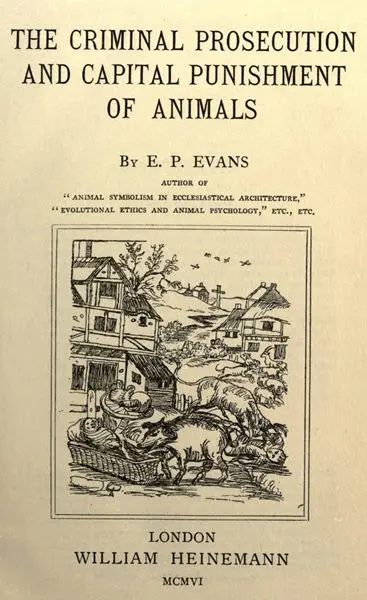
"The Criminal Prosecution and Capital Punishment of Animals" by E. P. Evans is a historical account written in the early 20th century. The book delves into the fascinating, if bizarre, legal practices of prosecuting animals for crimes in medieval and early modern Europe, exploring the absurdity and seriousness with which these cases were handled. It investigates the implications of these trials within the contexts of societal norms, religion, and the evolution of legal thought. The opening of the work outlines the origins of animal trials and the varying perspectives on their legality, notably the distinctions made between different types of prosecutions—those for domestic animals versus vermin. Evans introduces Bartholomew Chassenée, a jurist famous for defending rats charged with crop destruction, illustrating the lengths to which legal arguments were stretched to defend these creatures. He also discusses the interplay between secular and ecclesiastical courts in such cases, underscoring the peculiar belief that animals could be held accountable for their actions as if they were human actors in the legal system. Overall, this section sets the stage for a deeper exploration of the cultural and legal ramifications of treating animals as subjects of criminal law.
Introduction adapted from the source catalogue; source summaries may be automatically generated.
Free to read · English · 87,241 words · No account needed
MAKE TIME FOR A GOOD BOOK
On by default. Untick to stop anonymous reading totals. Each page counts after 10 seconds in view. How this works.
Anonymous counting is on unless you have switched it off.
Racine, his caricature of beast trials in Les Plaideurs, 166, 361
Ram, banished to Siberia, 175
Randolph, his allusion to rhyming rats, 130
Rats, prosecution of, 18-21, 136;
friendly letters of advice to, 129;
Irish custom of rhyming, 130
Raven, an imp of Satan, 57
Renaud d’Alleins, on equal rights of Waldenses and rats, 20
Responsibility, moral and penal, 210
Reusch, Prof. Dr. Fr. Heinrich, denounces bishops as promoters of
superstition, 14
Ro-ro-ro-ro, an anti-semitic devil cast out in 1842, 73
Rosarius, Hierolymus, describes the exposure of crucified lions and gibbeted wolves as a warning to their kind, 251; regards animals as often more rational than men, 252
Satan, his earthly sovereignty, 60, 70;
the doctrine of his final redemption, 68
Schilling, on the prosecution of inger, 113, 120
Schläger, cited, 176
Schleswig, its punishment of homicidal timber, 187
Schmid, Bernard, his sermon on the devastations by inger, 113-115
Scholasticism, quiddities of, 33
Schopenhauer, his theory of the will, 127; man’s responsibility for character alone, 239, 243
Schwabenspiegel, barbarity of this old German code, 178
Schwarz Mining, prosecutor of moles, 112
Schweinfurter Sauhenker, origin of the term, 147
Serpents, destroyed by St. Eldrad, 51;
freed from poison by St. Hugon, 103
Shakespeare, alludes to “be-rhymed” rats, 130;
and a wolf on the gallows, 157
Silius Italicus, quoted, 103
Simon, Max, on the morbid spirit of imitation, 253
Sociology, its influence on criminal jurisprudence, 238
Socrates, on self-perfection, 234
Sodomy. See Buggery
Soldan, cited, 17
Sparrows, put under ban by a Protestant parson, 128
Stephen VI., Pope, adjures locusts, 65;
prosecutes the corpse of his predecessor, 198;
strangled in prison, 199
Suicide, punishment of the wife and children of a, 190; condemned as a crime and also recognized as a right, 191, 192; due to manifold influences, 229
Superstition, fostered by bishops and Jesuits, 14
Swallows, anathematized for chattering in church, 28
Swine, execution of, 16, 140-145, 149, 153-157, 161, 169; as stenchy beasts peculiarly attractive to devils, 56, 165; Gadarene, 69, 91, 165
Swords, tainted, 187
Taine, his definition of man, 214
Tarde, defines the mob as a mad beast, 236
Tatian, his fellow-citizen punished for his offences, 180
Tattooing, not peculiar to criminals, 213
Termites, prosecuted by Franciscans in Brazil and praised by their defender as more industrious than the friars, 123
Tertullian, quoted, 106
Theognis, his bust punished for murder, 172
Thomas à Becket, his bones burned by Henry VIII., 198
Thomas Aquinas, regarded animals only as diabolical incarnations, 53-55,
88, 101, 103
Thurneysser, his bottled scorpions and elk feared as demons, 90
Tithes, importance of the prompt payment of, 37, 94, 107
Tobler, G., on animal prosecutions in Switzerland, 1, 170
Treason, barbarously punished by Roman, Prussian, and Judaic law, 179-181
Trench, Richard Chevenix, his justification of the cursing of the
fig-tree, 25
Treufels, Richard, his belief in the exorcism at Wemding in 1891, 75
Tribunals, proper office of criminal, 211, 232, 248
Tritheim, on Satan’s invisible apparition, 166
Tschech, executed, and his innocent daughter exiled for his crime, 179
Türler, records the rejection of the Mosaic law by the ecclesiastical court of Berne, 170
Vampires, superstitions concerning, 195-198
Vendetta, in semi-civilized communities, 178
Venidad, quoted, 63
Your reading position is saved on this browser. Take it to another device with a library code. Reading pages adapt to text, rather than matching a printed edition.
BEHIND THE BOOK
This eBook is for the use of anyone anywhere in the United States and most other parts of the world at no cost and with almost no restrictions whatsoever. You may copy it, give it away or re-use it under the terms of the Project Gutenberg License included with this eBook or online at www.gutenberg.org. If you are not located in the United States, you will have to check the laws of the country where you are located before using this eBook. Read the source licence.
The original source file, including credits and licence, is retained by this library. Request an original-format copy at no charge. Please include the book title and Project Gutenberg identifier #43286.
KEEP YOUR CURIOSITY GOING
Cécile Tormay

Moritz Busch
John L. Ransom
Frances Wright
Cécile Tormay

Mabel Potter Daggett