THE CLASSIC COLLECTION✦An outlaw’s diary: the CommuneCLASSIC FREE BOOKS
An outlaw’s diary: the Commune
Cécile Tormay
THE CLASSIC COLLECTION · 1906
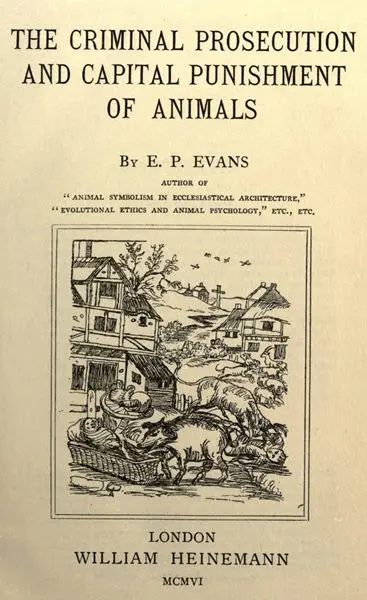
"The Criminal Prosecution and Capital Punishment of Animals" by E. P. Evans is a historical account written in the early 20th century. The book delves into the fascinating, if bizarre, legal practices of prosecuting animals for crimes in medieval and early modern Europe, exploring the absurdity and seriousness with which these cases were handled. It investigates the implications of these trials within the contexts of societal norms, religion, and the evolution of legal thought. The opening of the work outlines the origins of animal trials and the varying perspectives on their legality, notably the distinctions made between different types of prosecutions—those for domestic animals versus vermin. Evans introduces Bartholomew Chassenée, a jurist famous for defending rats charged with crop destruction, illustrating the lengths to which legal arguments were stretched to defend these creatures. He also discusses the interplay between secular and ecclesiastical courts in such cases, underscoring the peculiar belief that animals could be held accountable for their actions as if they were human actors in the legal system. Overall, this section sets the stage for a deeper exploration of the cultural and legal ramifications of treating animals as subjects of criminal law.
Introduction adapted from the source catalogue; source summaries may be automatically generated.
Free to read · English · 87,241 words · No account needed
MAKE TIME FOR A GOOD BOOK
On by default. Untick to stop anonymous reading totals. Each page counts after 10 seconds in view. How this works.
Anonymous counting is on unless you have switched it off.
Ventilation, “bewitched kine” the result of bad, 8
Vermin. See Insects
Virgil, quoted, 26
Weevils, prosecuted for damage to vineyards, 38-49
Wemding, recent case of diabolical possession in, 75
Were-wolves, incarnate ghosts, 195;
decree for their extermination, 198
Werther, Goethe’s, sentimentalism and suicidism produced by, 253
Winterstetter, Georg, his rescript concerning gadflies, 125
Witches in Judaic and mediæval law, on a par with animals, 145; rendered harmless by burning, 196
Worms, Council of, its decree concerning tainted honey, 9
Zarathushtra (Zoroaster), his ethics and its workings, 57-59
Zoöpsychology, in its relation to anthropopyschology and criminology, 237
Zupetta, on partial vitiation of mind, 201
Richard Clay & Sons, Limited, London and Bungay.
[1] The name is also spelled Chassanée and Chasseneux. In the Middle Ages, and even as late as the end of the eighteenth century, the orthography of proper names was very uncertain.
[2] “Item: a été délibéré que la ville se joindra aux paroisses de cette province qui voudront obtenir de Rome une excommunication contre les insects et que l’on contribuera aux frais au pro rata.”
[3] These animals are spoken of as unvernünftige Thierlein genannt Lutmäuse. Lut might be derived from the Old German lût (Laut, Schrei), in which case Lutmaus would mean shrew-mouse; but it is more probably from lutum (loam, mould), and signifies mole or field-mouse. Field-mice are exceedingly prolific rodents, and in modern as well as in mediæval times have often done grievous harm to husbandry and arboriculture by consuming roots and fruits and gnawing the bark of young trees. The recklessness of hunters in exterminating foxes, hedgehogs, polecats, weasels, buzzards, crows, kites, owls and similar beasts and birds, which are destructive of field-mice, has frequently caused the latter to multiply so as to become a terrible plague. This was the case in England in 1813-14, and in Germany in 1822, and again in 1856.
[4] The first part of this treatise, consisting of seventeen chapters, discusses the different kinds of “monitoires” and their applications. Only the second part, describing the legal procedure, is here printed.
[5] A few early instances of excommunication and malediction, our knowledge of which is derived chiefly from hagiologies and other legendary sources, are not included in the present list, such, for example, as the cursing and burning of storks at Avignon by St. Agricola in 666, and the expulsion of venomous reptiles from the island Reichenau in 728 by Saint Perminius.
[6] This case is probably identical with and an adjournment of that of
1478.
[7] Identical with the sentences covering the period of 1500-1530.
Your reading position is saved on this browser. Take it to another device with a library code. Reading pages adapt to text, rather than matching a printed edition.
BEHIND THE BOOK
This eBook is for the use of anyone anywhere in the United States and most other parts of the world at no cost and with almost no restrictions whatsoever. You may copy it, give it away or re-use it under the terms of the Project Gutenberg License included with this eBook or online at www.gutenberg.org. If you are not located in the United States, you will have to check the laws of the country where you are located before using this eBook. Read the source licence.
The original source file, including credits and licence, is retained by this library. Request an original-format copy at no charge. Please include the book title and Project Gutenberg identifier #43286.
KEEP YOUR CURIOSITY GOING
Cécile Tormay

Moritz Busch
John L. Ransom
Frances Wright
Cécile Tormay

Mabel Potter Daggett