THE CLASSIC COLLECTION✦An outlaw’s diary: the CommuneCLASSIC FREE BOOKS
An outlaw’s diary: the Commune
Cécile Tormay
THE CLASSIC COLLECTION · 1906
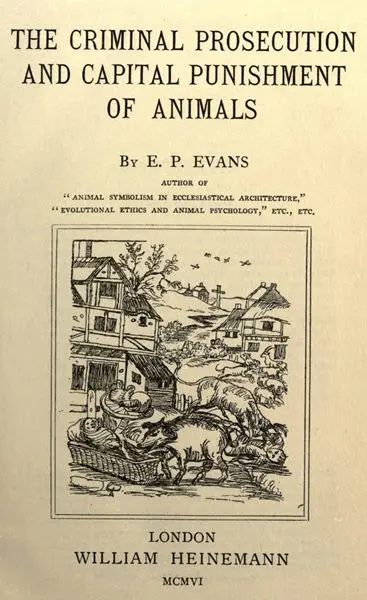
"The Criminal Prosecution and Capital Punishment of Animals" by E. P. Evans is a historical account written in the early 20th century. The book delves into the fascinating, if bizarre, legal practices of prosecuting animals for crimes in medieval and early modern Europe, exploring the absurdity and seriousness with which these cases were handled. It investigates the implications of these trials within the contexts of societal norms, religion, and the evolution of legal thought. The opening of the work outlines the origins of animal trials and the varying perspectives on their legality, notably the distinctions made between different types of prosecutions—those for domestic animals versus vermin. Evans introduces Bartholomew Chassenée, a jurist famous for defending rats charged with crop destruction, illustrating the lengths to which legal arguments were stretched to defend these creatures. He also discusses the interplay between secular and ecclesiastical courts in such cases, underscoring the peculiar belief that animals could be held accountable for their actions as if they were human actors in the legal system. Overall, this section sets the stage for a deeper exploration of the cultural and legal ramifications of treating animals as subjects of criminal law.
Introduction adapted from the source catalogue; source summaries may be automatically generated.
Free to read · English · 87,241 words · No account needed
MAKE TIME FOR A GOOD BOOK
On by default. Untick to stop anonymous reading totals. Each page counts after 10 seconds in view. How this works.
Anonymous counting is on unless you have switched it off.
Malleolus, Felix, his theory of exorcisms endorsed by Heidelberg
professors, 27;
records a prosecution of Spanish flies, 110;
his formula for banning serpents, 121
Mangin, Arthur, cited, 16, 139
Manicheans, their doctrine of good and evil, 60
Manouvrier, Dr., likens Gambetta’s skull to that of a savage, 217
Mantegazza, Prof., his “tormentatore,” 245
Manu, Institutes of, 168
Marro, on metaphors as facts, 216
Mather, Cotton, records the execution of a pious Sodomite and eight
beasts, 148
Ménebréa, M. L., 2, 17;
his theory untenable, 40
Mephistopheles, the lord of rodents and vermin, 85
Mithridates, experiments with poisons, 244
Moles, prosecution of, 111-113
Monks, as landed proprietors in France, 158
Monomania, frequency of, 227
Morel, Claude, defender of weevils, 38
Mornacius, his record of mad dogs sentenced to death, 176
Morselli, Prof., on the causes of suicide, 229
Mosaic law, the, rejected by an ecclesiastical court, 170;
barbarity of, 167, 180
Murder, miasma of, 9, 174;
weapons tainted by, 187-190
Mutilations, in accordance with the Lex talionis, 176, 182
Mythology, monstrosities and metamorphoses of classical, 64;
in modern life, 228
Naquet, regards criminals as no more culpable than poisons, 212
Narrenkötterlein, dog sentenced to a, 175
Nature, imperfection of, 61
Navarre, Dr., regards fish as cacodemons, 90
Nebuchadnezzar, a satanic metamorphosis, 63
Nikôn, his statue punished for manslaughter committed in self-defence,
172
Noah, God’s covenant with him required the capital punishment of beasts,
168
Novels, morbific influence of sensational, 253
Numa Pompilius, quoted, 106;
his law for protecting boundary stones, 183
Origen, believed in the ultimate redemption of Satan, 68
Osenbrüggen, Eduard, his theory of the personification of animals, 10, 17
Ovid, quoted, 101, 103
Oxen, executed, 168;
punished although innocent, 183
Pachacutez, barbarous code of this Peruvian Justinian, 179
Papal See, trial and punishment of corpses by the, 198
Pape, Guy, cited, 108
Paracelsus, on the magnetic power of the will, 126
Pardoning power, exercise of the, 248
Parsis, their Dasturs, 59;
co-workers of Ahuramazda, 61, 82;
no doctrine of atonement, 63
Pasteur, exterminates noxious microbes, 62
Patriotism as a perverter of justice, 185
Pausanias cited, 172
Penology, man and beast in modern, 14, 193;
mediæval and modern, 15, 200, 206-210;
in Italy and Germany, 203-206;
brutality of mediæval, 206-209;
moral and penal responsibility, 210;
still inchoate, 15, 219-223, 257;
deterrent aims of, 211, 248, 249;
law of the survival of the fittest in, 221-223;
punitive and preventive, 237;
its relation to psycho-pathology, 248
Pereira Gomez, forerunner of Descartes, 66
Perjury, retaliative punishment of, 182
Perrodet, Jean, defender of inger, 118
Phlebotomy. See Blood-letting
Pico di Mirandola, quoted, 103
Piety, market value of, 7
Pigs. See Swine
Pirminius, St., his anathema of venomous reptiles, 29
Plato, his theory of creation, 59;
on homicidal animals, 173;
on retributive and preventive punishment, 237
Pliny, quoted, 103
Pollux, Julius, quoted, 172
Potter, a pious Sodomite executed, 148
Predestination in theology and science, 232-234
Prussia, barbarous punishments, 180;
opposed to reform, 205
Prytaneion (Prytaneum), condemned inanimate objects for crime, 172;
but not corpses, 199
Pufendorf, Samuel, on contagiousness in crime, 256
Puritans, their penal enactments, 209
Pythagoras, his doctrine of transmigration, 87
Queen Reason, her discourse on animals in reply to King Mode, 56-58
Your reading position is saved on this browser. Take it to another device with a library code. Reading pages adapt to text, rather than matching a printed edition.
BEHIND THE BOOK
This eBook is for the use of anyone anywhere in the United States and most other parts of the world at no cost and with almost no restrictions whatsoever. You may copy it, give it away or re-use it under the terms of the Project Gutenberg License included with this eBook or online at www.gutenberg.org. If you are not located in the United States, you will have to check the laws of the country where you are located before using this eBook. Read the source licence.
The original source file, including credits and licence, is retained by this library. Request an original-format copy at no charge. Please include the book title and Project Gutenberg identifier #43286.
KEEP YOUR CURIOSITY GOING
Cécile Tormay

Moritz Busch
John L. Ransom
Frances Wright
Cécile Tormay

Mabel Potter Daggett