THE CLASSIC COLLECTION✦An outlaw’s diary: the CommuneCLASSIC FREE BOOKS
An outlaw’s diary: the Commune
Cécile Tormay
THE CLASSIC COLLECTION · 1906
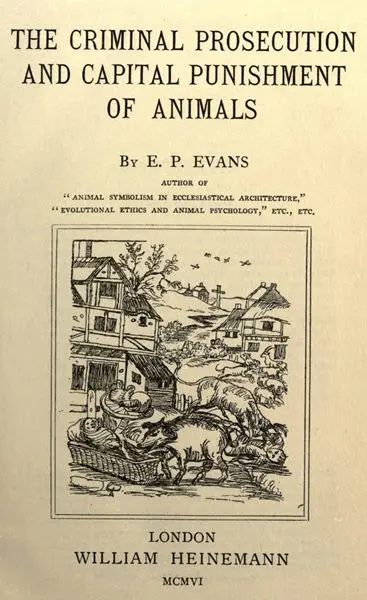
"The Criminal Prosecution and Capital Punishment of Animals" by E. P. Evans is a historical account written in the early 20th century. The book delves into the fascinating, if bizarre, legal practices of prosecuting animals for crimes in medieval and early modern Europe, exploring the absurdity and seriousness with which these cases were handled. It investigates the implications of these trials within the contexts of societal norms, religion, and the evolution of legal thought. The opening of the work outlines the origins of animal trials and the varying perspectives on their legality, notably the distinctions made between different types of prosecutions—those for domestic animals versus vermin. Evans introduces Bartholomew Chassenée, a jurist famous for defending rats charged with crop destruction, illustrating the lengths to which legal arguments were stretched to defend these creatures. He also discusses the interplay between secular and ecclesiastical courts in such cases, underscoring the peculiar belief that animals could be held accountable for their actions as if they were human actors in the legal system. Overall, this section sets the stage for a deeper exploration of the cultural and legal ramifications of treating animals as subjects of criminal law.
Introduction adapted from the source catalogue; source summaries may be automatically generated.
Free to read · English · 87,241 words · No account needed
MAKE TIME FOR A GOOD BOOK
On by default. Untick to stop anonymous reading totals. Each page counts after 10 seconds in view. How this works.
Anonymous counting is on unless you have switched it off.
Greeks, ancient, ascribed pestilence to the miasma of unexpiated murder,
9, 174
Gregory of Tours, on bronze dormice and serpents as talismans, 132
Greysser, Daniel, the efficiency of bans not supernatural, 128
Gross, his mis-statement concerning the cock of Bâle, 162
Guiteau, deterrent effect of his execution, 250
Harpokration, Valerius, cited, 172
Harrison, Miss, cited, 187
Hart, symbolism of the, 56
Hawks, dead, as protectors of hens, 252
Hemmerlein, Felix. See Malleolus
Hens, crowing, 10
Heredity, its predetermining influence as viewed by theologians and
scientists, 232
Heymanns, Mynheer, on responsibility for character, 243
Hierarchies, their failure in civil government, 249
Honorius, his atrocious edict, 179
Horses, condemned to death for homicide, 162
Hubert, St., 56
Hugon, St., expels venom from serpents by excommunication, 103
Hunters among savages, their superstitious fear of killing wild animals,
174
Hypnotism, its causal relation to crime, 223-226; as the basis of the witchcraft delusion, 225
Idols, decapitation of, 174
Inger, prosecuted and put under ban, 113-115;
not in Noah’s Ark, 120
Insanity, degrees of, 200-203;
in Italian and German law, 204-206;
difficulty of defining, 226-228;
in English law, 246;
moral, 250;
as a shelter for crime, 256
Insects, prosecution of, 37, 41-49;
incarnations of demons, 86
Italy, palliation of crime in, 203, 204
Jeanneret, Marie, her toxicomania, 240-246
Jews, in Christian legislation on a par with beasts, 152, 165
John the Lamb, his curse fatal to fish, 28
Jonson, Ben, cited, 130
Jordan, Father, casts out devils with Lourdes water in 1887, 74
Jörgensen, cited, 17
Joshua, his penal cruelty, 180
King Mode, his discourse with Queen Reason, 55
Kirchenheim, Prof. Von, urges reform of our penal codes, 219
Koran, the, on the punishment of beasts, 171
Kukis, destroy homicidal trees, 171
Laas, his definition of judicial punishment, 238
Lacassagne, his six categories of crime, 235
Langevin, Pierre Gilles, fresco of the execution of a sow described by,
141
Lapeyronie, his dissertation proving that cocks never lay eggs, 163
Le Bon, on hereditary criminality, 223
Leipsic, decision of the Law Faculty concerning a homicidal cow, 169
Leo XIII., his exorcism of Satan and apostate angels, 73
Letang, Louis, causal relation of his novel to the Dreyfus affair, 254
Lex talionis, striking applications of this oldest form of penal
justice, 167;
inflicts horrible mutilations, 182
Lilienberg, Mathias Abele Von, his record of a dog sentenced to prison,
175
Liszt, Prof. Von, on retributive and preventive penalties, 237
Locusts, expelled by exorcisms and aspergeoires, 3, 64; dispersed and destroyed by excommunication, 22, 93, 94; prosecution of, 95-108, 136
Lohbauer, Pater Franz Xaver, ascribes nervous disease to diabolical
possession, 71
Lombroso, on animals as born criminals, 14;
opposed to trial by jury, 185;
regards tattooing, dark thick hair and thin beards, as signs of
criminality, 213;
on ativism as the source of crime, 215;
innate criminality not eradicated by education, 223;
compares the capital punishment of cretins and cranks to that of
animals, 251
Lucifer, writhes under the water of Lourdes, 74
Lycia, punished by imputation, 180
Majolus, cited, 86
Maledictions. See Anathemas
Your reading position is saved on this browser. Take it to another device with a library code. Reading pages adapt to text, rather than matching a printed edition.
BEHIND THE BOOK
This eBook is for the use of anyone anywhere in the United States and most other parts of the world at no cost and with almost no restrictions whatsoever. You may copy it, give it away or re-use it under the terms of the Project Gutenberg License included with this eBook or online at www.gutenberg.org. If you are not located in the United States, you will have to check the laws of the country where you are located before using this eBook. Read the source licence.
The original source file, including credits and licence, is retained by this library. Request an original-format copy at no charge. Please include the book title and Project Gutenberg identifier #43286.
KEEP YOUR CURIOSITY GOING
Cécile Tormay

Moritz Busch
John L. Ransom
Frances Wright
Cécile Tormay

Mabel Potter Daggett