THE CLASSIC COLLECTION✦An outlaw’s diary: the CommuneCLASSIC FREE BOOKS
An outlaw’s diary: the Commune
Cécile Tormay
THE CLASSIC COLLECTION · 1906
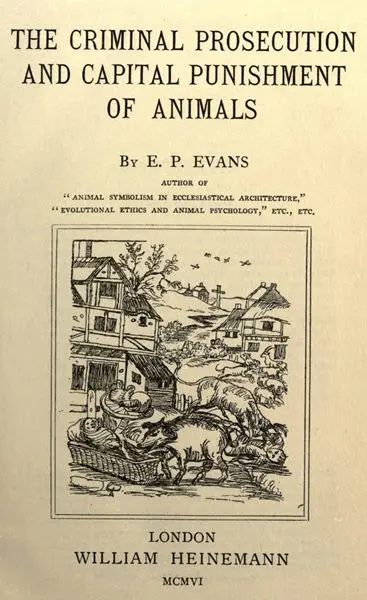
"The Criminal Prosecution and Capital Punishment of Animals" by E. P. Evans is a historical account written in the early 20th century. The book delves into the fascinating, if bizarre, legal practices of prosecuting animals for crimes in medieval and early modern Europe, exploring the absurdity and seriousness with which these cases were handled. It investigates the implications of these trials within the contexts of societal norms, religion, and the evolution of legal thought. The opening of the work outlines the origins of animal trials and the varying perspectives on their legality, notably the distinctions made between different types of prosecutions—those for domestic animals versus vermin. Evans introduces Bartholomew Chassenée, a jurist famous for defending rats charged with crop destruction, illustrating the lengths to which legal arguments were stretched to defend these creatures. He also discusses the interplay between secular and ecclesiastical courts in such cases, underscoring the peculiar belief that animals could be held accountable for their actions as if they were human actors in the legal system. Overall, this section sets the stage for a deeper exploration of the cultural and legal ramifications of treating animals as subjects of criminal law.
Introduction adapted from the source catalogue; source summaries may be automatically generated.
Free to read · English · 87,241 words · No account needed
MAKE TIME FOR A GOOD BOOK
On by default. Untick to stop anonymous reading totals. Each page counts after 10 seconds in view. How this works.
Anonymous counting is on unless you have switched it off.
Criminality, examples of imputed, 177-185;
ancient and mediæval conceptions of, 200;
punished for the safety of society, 211, 248;
compared to vitriol, 212;
supposed physical indices of, 213-217;
casual and constitutional, 214-223;
ativism the source of, 212, 215;
the result of hypnotism, 223-225;
due to many uncontrollable conditions, 230;
motives underlying animal, 235;
animals conscious of, 247;
contagiousness of, 252, 256
Crollanza, his record of the prosecution of caterpillars, 122
Crosiers, vermifugal efficacy of, 30
Cybele, invoked against vermin, 133
Damhouder, Jacobus, picture of animal crimes in his Rerum Criminalium
Praxis, 16;
citations from this work, 109, 146;
regards sexual intercourse with Jews, Turks, and Saracens as sodomy,
153
Dasturs, Parsi, Zarathushtra’s teachings degraded by the, 59
Demosthenes, cited, 172
Deodands, nature of, 186-190, 192;
abolished in England under Queen Victoria, 192
Devils, their damage to landed property, 7;
multiplied by the spread of Christianity, 13, 80;
destined to eternal torments after the Last Judgment, 68-70;
incarnate in every babe, 70;
maladies produced by, 72;
modern inventions the devices of, 229
Didymos, his “Geoponics,” 133
Dimitri, Prince, bell banished to Siberia for rejoicing over his
assassination, 175
Dogs, trial and execution of mad, 176;
crucified in Rome for imputed crime, 177
Döpler, Jacob, on sodomy, 152;
on Lex talionis, 182;
on vampires, 197
Dove, symbol of the Holy Ghost, 57
Draco (Drakôn), his law punishing weapons, 172
Dreyfus, his prosecution instigated by a sensational novel, 253-255
Ducol, Pierre, prosecutor of weevils, 38
Dumas, his Count of Monte Christo cited, 240
Duret, Jean, his Treatise on Pains and Penalties, 108
Ecclesiastical tribunal, an, rejects the Mosaic law and discusses crime from a psychiatrical point of view, 170
Eldrad, St., expels serpents, 50
Electricity, execution by, 210
Elk, as demon, 90
Erechtheus, punishment of deadly weapons, 172
Erinnys, appeasing the, 174
Escheat, in Scotch law, 189
Eusebius, describes hell as very cold, 105
Eustace, St., 56
Evolution, dogma of original sin supplanted by the doctrine of, 232
Excommunications, pronounced against insects by the Church, 3;
sold at Rome, 30;
properly speaking, animals not subject to, 51, 100;
comical survivals of, 128.
See Anathemas
Exorcisms, their efficiency recognized by Heidelberg professors, 27;
applied as plasters, 72;
superseded by conjurations among Protestants, 125;
by Mohammedans, 137
Falcon, Pierre, defender of weevils, 38
Felo de se, a sort of treason, 190.
See Suicide
Feuchtersleben, Baron Von, records cases of morbid imitation, 253
Field-mice, conjuration of, 133
Flesh of executed animals tainted, 169
Flies as demons, 28, 86
Florian, St., the protector of houses from fire, 136
Fly-flaps, papal, 29
Formosus, Pope, his corpse tried and condemned for usurpation, 198
Foscolo, Ugo, his cranium that of an idiot, 218
Fox, diabolical nature of the, 56
Frederic the Great, his penal reforms, 207
Fricker, Thüring, doctor of laws, chancellor and prosecutor of inger, 116
Gadflies, episcopal rescript against, 124
Galton, on heredity, 239
Gambetta, his small and abnormal brain, 217
Geese, sacred, rewarded at Rome for the vigilance of their foremothers,
177
Genius, to madness close allied, 228
Görres, recent case of conjuration recorded by, 125
Gratiolet, on the brain of the “Hottentot Venus,” 218
Your reading position is saved on this browser. Take it to another device with a library code. Reading pages adapt to text, rather than matching a printed edition.
BEHIND THE BOOK
This eBook is for the use of anyone anywhere in the United States and most other parts of the world at no cost and with almost no restrictions whatsoever. You may copy it, give it away or re-use it under the terms of the Project Gutenberg License included with this eBook or online at www.gutenberg.org. If you are not located in the United States, you will have to check the laws of the country where you are located before using this eBook. Read the source licence.
The original source file, including credits and licence, is retained by this library. Request an original-format copy at no charge. Please include the book title and Project Gutenberg identifier #43286.
KEEP YOUR CURIOSITY GOING
Cécile Tormay

Moritz Busch
John L. Ransom
Frances Wright
Cécile Tormay

Mabel Potter Daggett