THE CLASSIC COLLECTION✦An outlaw’s diary: the CommuneCLASSIC FREE BOOKS
An outlaw’s diary: the Commune
Cécile Tormay
THE CLASSIC COLLECTION · 1906
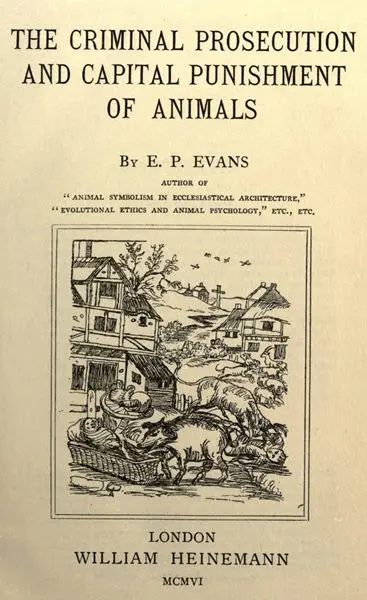
"The Criminal Prosecution and Capital Punishment of Animals" by E. P. Evans is a historical account written in the early 20th century. The book delves into the fascinating, if bizarre, legal practices of prosecuting animals for crimes in medieval and early modern Europe, exploring the absurdity and seriousness with which these cases were handled. It investigates the implications of these trials within the contexts of societal norms, religion, and the evolution of legal thought. The opening of the work outlines the origins of animal trials and the varying perspectives on their legality, notably the distinctions made between different types of prosecutions—those for domestic animals versus vermin. Evans introduces Bartholomew Chassenée, a jurist famous for defending rats charged with crop destruction, illustrating the lengths to which legal arguments were stretched to defend these creatures. He also discusses the interplay between secular and ecclesiastical courts in such cases, underscoring the peculiar belief that animals could be held accountable for their actions as if they were human actors in the legal system. Overall, this section sets the stage for a deeper exploration of the cultural and legal ramifications of treating animals as subjects of criminal law.
Introduction adapted from the source catalogue; source summaries may be automatically generated.
Free to read · English · 87,241 words · No account needed
MAKE TIME FOR A GOOD BOOK
On by default. Untick to stop anonymous reading totals. Each page counts after 10 seconds in view. How this works.
Anonymous counting is on unless you have switched it off.
Basilovitch, Ivan, his conception of retributive justice, 183
Bassos, Kassianos, prefers rat-bane to adjuration, 132
Beasts, sweet and stenchy, 55
Bees, tainted honey of homicidal, 9
Bell, banished to Siberia by the Russian Government, 175
Benedikt Prof., on the brain-formation of criminals, 212
Bernard, Claude, his idea of the physiologist, 245
Bernard, St., kills flies by cursing them, 28
Bernardes, Manoel, his Nova Floresta, 124
Berriat-Saint-Prix, his valuable researches, 2, 17, 20;
list of prosecuted animals, 135-137
Bichat, his defective cranium, 217
Bischofberger, Dr. Theobald, his curious theory of the effects of unexpiated crime on persons and property, 6-8; his recent brochure in defence of exorcisms, 73
Bischoff, Prof., his hobby refuted by the weight of his own brain, 218
Blackstone, on deodands, 186, 189, 192
Blood-letting, as a panacea in law and medicine, 194
“Blue Laws,” an advance in penal legislation, 209
Bodelschwingh, his bacillus infernalis, 91
Boehme, Jacob, his definition of magic, 127
Boër, Nicolaus, on cohabitation with a Jewess as sodomy, 153
Bogos, homicidal beasts executed by the, 155
Bonnivard, François, presides as judge in a trial of vermin, 38
Borromeo, Carlo, his cruelty in punishing heresy, 208
Bougeant, Père, his Amusement Philosophique cited, 66-69;
80-86, 88-90, 92
Bracton, 167;
on deodands, 186
Brain, its size not always a measure of mental capacity, 217-219
Browne, Dr. William Hand, cited, 187
Buggery, instances of this “nameless crime,” 147-153; she-ass acquitted and man condemned to death for, 150; in the Carolina punished with death by fire, 151; in the Mosaic law, 152; sexual intercourse with a Jewess regarded as, 153
Bull, executed for murder, 161
Calvin, his conception of God, 59
Canute, King, 178
Carolina, the, its severe penalties, 182
Carpzov, Benedict, on sodomy, 151
Cattle, bewitched by bad air, 8
Cervantes, 167
Character, factors in the formation of, 219;
responsibility for, 239, 243
Charcot, Dr., on the curative power of faith, 80, 225
Chassenée, Bartholomew, his Consilia, 2, 21-23;
distinguished as a defender of prosecuted rats, 18;
equal rights of rats and Waldenses recognized by, 20;
his erudition, 24;
his absurd deductions, 26;
regards animals as laity in the eye of the law, 32
Chinese, recent beheading of idols for murder, 174
Church, the, its treatment of noxious insects as incarnations of Satan and as agents of God, 3-6; capital punishment never inflicted by, 31; its power to stay the ravages of vermin unquestioned, 50
Cicero, cited, 22, 101;
his approval of atrocious penalties, 178
Cock, burned at the stake for laying eggs, 10, 11, 162; nature and origin of its supposed eggs, 163-5
Cockatrice, 12, 163
Coleridge, his definition of madman, 228
Corpses, prosecuted and executed, 110, 198, 199;
cannot inherit, 110
“Corruption of blood,” in theology and law, 181
Courcelle-Seneuil, his view of prisons, 212
Cows, executed for homicide, 169
Cranks, execution of, 249-251
Cretella, 17
Cretins, their brains not always abnormal, 219;
sentenced to death, 251
Your reading position is saved on this browser. Take it to another device with a library code. Reading pages adapt to text, rather than matching a printed edition.
BEHIND THE BOOK
This eBook is for the use of anyone anywhere in the United States and most other parts of the world at no cost and with almost no restrictions whatsoever. You may copy it, give it away or re-use it under the terms of the Project Gutenberg License included with this eBook or online at www.gutenberg.org. If you are not located in the United States, you will have to check the laws of the country where you are located before using this eBook. Read the source licence.
The original source file, including credits and licence, is retained by this library. Request an original-format copy at no charge. Please include the book title and Project Gutenberg identifier #43286.
KEEP YOUR CURIOSITY GOING
Cécile Tormay

Moritz Busch
John L. Ransom
Frances Wright
Cécile Tormay

Mabel Potter Daggett