THE CLASSIC COLLECTION✦A dead man’s diaryCLASSIC FREE BOOKS
A dead man’s diary
Coulson Kernahan
THE CLASSIC COLLECTION · 1910
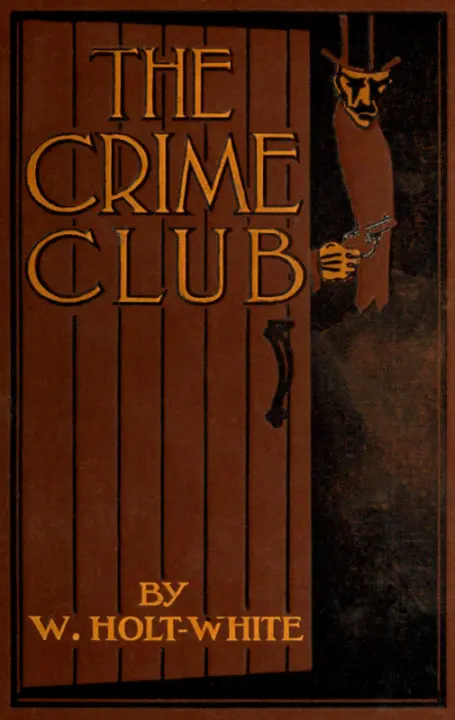
"The Crime Club" by W. Holt-White is a novel written in the early 20th century. The plot revolves around Captain Melun and Sir Paul Westerham, who find themselves embroiled in a complex web of crime, blackmail, and intrigue as they navigate their relationship with Lady Kathleen Carfax, the daughter of the Prime Minister of England. The novel presents a world of deception and moral ambiguity as characters grapple with their motives and the consequences of their actions. At the start of the narrative, Captain Melun confronts Sir Paul Westerham on board the "Gigantic", leading to a tense exchange that reveals their complicated pasts and ambitions. Sir Paul, having inherited immense wealth and a title, is determined to pursue Lady Kathleen, whom he has seen only in a picture. Meanwhile, Melun expresses his own desire to marry her, hinting at a darker intention. The ensuing dialogue exposes themes of blackmail and manipulation, setting the stage for the deeper conspiracies that will unfold as Sir Paul seeks to protect Lady Kathleen from the dangers tied to Melun and the secretive crime syndicate they are both drawn into.
Introduction adapted from the source catalogue; source summaries may be automatically generated.
Free to read · English · 86,385 words · No account needed
MAKE TIME FOR A GOOD BOOK
On by default. Untick to stop anonymous reading totals. Each page counts after 10 seconds in view. How this works.
Anonymous counting is on unless you have switched it off.
“Be so kind as to repeat, as accurately as you can, what I told you,”
Melun ordered him.
Patmore began to speak rapidly, and with what, to a keen observer, might have seemed a somewhat parrot-like air.
“You told me,” he said, looking at Melun, “that this was a matter of
blackmail.”
He spoke quite unblushingly, as though such a business was an every-day affair, which, as a matter of fact, it was.
“You told me,” he continued, “that the person to be blackmailed occupied a high position in the State, and that it was so necessary for him to purchase our silence that he would pay practically any price.
“You mentioned a quarter of a million, of which you yourself proposed to take fifty thousand pounds, dividing the rest of the money among us. You also took the oath of the club before me and declared that whatever might be said to the contrary you were determined to play fair.
“You further said that it was absolutely impossible to reveal any details of the scheme to me, as, should anyone know of the matter besides yourself, discovery would be inevitable.
“In fact, you declared that it was the most difficult, and at the same time the boldest, piece of work that you had ever attempted.”
Patmore stopped abruptly in his recitation.
“And that, gentlemen,” said Melun, nodding towards the men, “is
absolutely true.
“It is also true,” he continued, “that to win this vast amount of money it was necessary to lay out a certain amount of capital. I hadn't the money on hand, and it was inadvisable to approach the usual sources.
“I trusted”—and there was an increased bitterness in his voice—“I trusted this man Robinson.
“But, would you believe me, gentlemen, I have just discovered that he is not Robinson at all, nor Smith, nor Jones—nor anyone, indeed, of small importance in this world?
“Now, gentlemen, it would be inadvisable at this moment to tell you precisely who he is, but one thing I may tell you, and that is that he is a gentleman of title, and a man of wealth and position.”
The men turned their wondering gaze on Westerham.
“Now, for what purpose do you suppose that a man of title, of wealth and position is mixing himself up with our affairs?”
Melun paused for a few minutes, and watched with satisfaction intelligence dawn on the stupid, brutal faces before him, which stared first at himself in amazement, and then gloomily and savagely at Westerham.
Westerham, however, to their further astonishment, was laughing quietly, his teeth bared in quite an amused and pleasant smile.
Your reading position is saved on this browser. Take it to another device with a library code. Reading pages adapt to text, rather than matching a printed edition.
BEHIND THE BOOK
This eBook is for the use of anyone anywhere in the United States and most other parts of the world at no cost and with almost no restrictions whatsoever. You may copy it, give it away or re-use it under the terms of the Project Gutenberg License included with this eBook or online at www.gutenberg.org. If you are not located in the United States, you will have to check the laws of the country where you are located before using this eBook. Read the source licence.
The original source file, including credits and licence, is retained by this library. Request an original-format copy at no charge. Please include the book title and Project Gutenberg identifier #46566.
KEEP YOUR CURIOSITY GOING
Coulson Kernahan

Maurice Baring
Frances Wright
Cécile Tormay

Frederic Jesup Stimson

W. H. P. (William Henry Pope) Jarvis