THE CLASSIC COLLECTION✦A dead man’s diaryCLASSIC FREE BOOKS
A dead man’s diary
Coulson Kernahan
THE CLASSIC COLLECTION · 1910
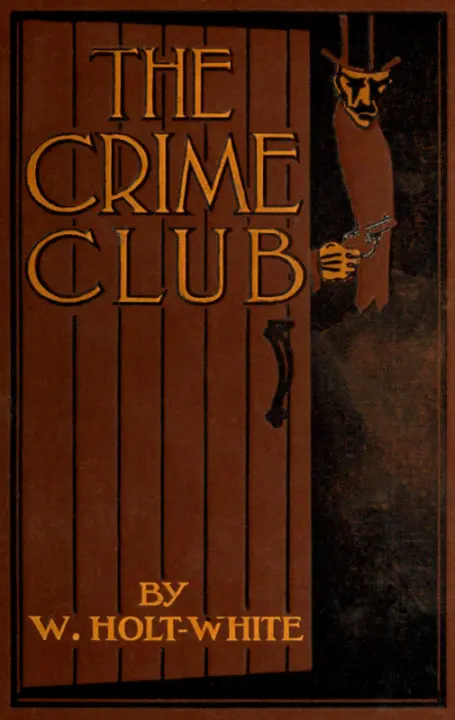
"The Crime Club" by W. Holt-White is a novel written in the early 20th century. The plot revolves around Captain Melun and Sir Paul Westerham, who find themselves embroiled in a complex web of crime, blackmail, and intrigue as they navigate their relationship with Lady Kathleen Carfax, the daughter of the Prime Minister of England. The novel presents a world of deception and moral ambiguity as characters grapple with their motives and the consequences of their actions. At the start of the narrative, Captain Melun confronts Sir Paul Westerham on board the "Gigantic", leading to a tense exchange that reveals their complicated pasts and ambitions. Sir Paul, having inherited immense wealth and a title, is determined to pursue Lady Kathleen, whom he has seen only in a picture. Meanwhile, Melun expresses his own desire to marry her, hinting at a darker intention. The ensuing dialogue exposes themes of blackmail and manipulation, setting the stage for the deeper conspiracies that will unfold as Sir Paul seeks to protect Lady Kathleen from the dangers tied to Melun and the secretive crime syndicate they are both drawn into.
Introduction adapted from the source catalogue; source summaries may be automatically generated.
Free to read · English · 86,385 words · No account needed
MAKE TIME FOR A GOOD BOOK
On by default. Untick to stop anonymous reading totals. Each page counts after 10 seconds in view. How this works.
Anonymous counting is on unless you have switched it off.
Westerham laughed outright. Unless he should so lose control over himself as to act foolishly he knew that Crow would not fire. He had already told two men that they wanted no firing that night.
So, instead of putting his hands up, he folded them placidly on the
table.
“Put that thing away,” he said quietly, “until you explain precisely what you intend to do.”
Crow lowered his weapon but kept it on the table. He even laughed a
hard, short laugh.
“Well, you are a good plucked 'un at any rate,” he said, “and as your number's up, and dead men tell no tales, I don't see why I shouldn't oblige you.
“You think,” he continued, making an attempt to imitate Westerham's cool, off-hand way of speech, “that this is a working-man's club.
“Well, it is not exactly that. It is a club, sure enough, with pretty fixed rules—rules which, if broken, may result in a man's light being put out.
“The same may be said of anyone who offends us. You have offended us.
“Now, though Melun comes in through ‘The Cut,’ we come in the other way. No one in London except the members of this club know that there are two entrances. We come in by the main door, and that gives on to a path which runs by a handy canal.
“Shooting is noisy, and knives mean messy work. Strangling is just as simple and just as easy, and, with the clothes off you, and with a good lead weight on your feet, there'd not be much chance of your disappearance ever being traced to this place.”
He stared at Westerham with a fixed beast-like glare.
Westerham, however, with his hands still folded placidly on the table,
was smiling blandly.
“Allow me,” he said, seeing that Crow had made an end of speaking, “to congratulate you on a very pretty little programme—but a programme which, I fear, is hardly likely to be carried out to-night.”
“Str'wth,” cried a man, craning across the table towards Westerham, “are you a copper's nark? Have you put the police on us?”
Half a dozen men rose from their seats and looked with scared faces at
Crow.
Crow, somewhat to Westerham's admiration, kept his head.
“See to the door,” he said.
Two other men rose, and going to Westerham's side of the long room, opened the door leading into a little porch; through this they went out on to the footpath by the canal and peered cautiously up and down.
Presently they came back shaking their heads.
“Have another look,” said Crow. “Search a little further.”
Your reading position is saved on this browser. Take it to another device with a library code. Reading pages adapt to text, rather than matching a printed edition.
BEHIND THE BOOK
This eBook is for the use of anyone anywhere in the United States and most other parts of the world at no cost and with almost no restrictions whatsoever. You may copy it, give it away or re-use it under the terms of the Project Gutenberg License included with this eBook or online at www.gutenberg.org. If you are not located in the United States, you will have to check the laws of the country where you are located before using this eBook. Read the source licence.
The original source file, including credits and licence, is retained by this library. Request an original-format copy at no charge. Please include the book title and Project Gutenberg identifier #46566.
KEEP YOUR CURIOSITY GOING
Coulson Kernahan

Maurice Baring
Frances Wright
Cécile Tormay

Frederic Jesup Stimson

W. H. P. (William Henry Pope) Jarvis