THE CLASSIC COLLECTION✦A dead man’s diaryCLASSIC FREE BOOKS
A dead man’s diary
Coulson Kernahan
THE CLASSIC COLLECTION · 1910
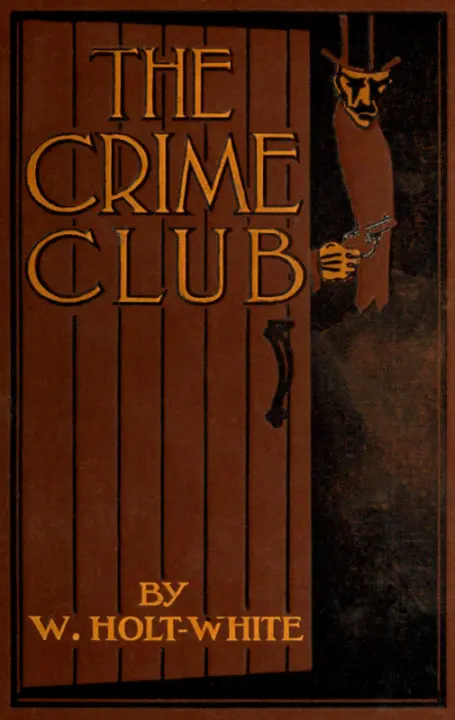
"The Crime Club" by W. Holt-White is a novel written in the early 20th century. The plot revolves around Captain Melun and Sir Paul Westerham, who find themselves embroiled in a complex web of crime, blackmail, and intrigue as they navigate their relationship with Lady Kathleen Carfax, the daughter of the Prime Minister of England. The novel presents a world of deception and moral ambiguity as characters grapple with their motives and the consequences of their actions. At the start of the narrative, Captain Melun confronts Sir Paul Westerham on board the "Gigantic", leading to a tense exchange that reveals their complicated pasts and ambitions. Sir Paul, having inherited immense wealth and a title, is determined to pursue Lady Kathleen, whom he has seen only in a picture. Meanwhile, Melun expresses his own desire to marry her, hinting at a darker intention. The ensuing dialogue exposes themes of blackmail and manipulation, setting the stage for the deeper conspiracies that will unfold as Sir Paul seeks to protect Lady Kathleen from the dangers tied to Melun and the secretive crime syndicate they are both drawn into.
Introduction adapted from the source catalogue; source summaries may be automatically generated.
Free to read · English · 86,385 words · No account needed
MAKE TIME FOR A GOOD BOOK
On by default. Untick to stop anonymous reading totals. Each page counts after 10 seconds in view. How this works.
Anonymous counting is on unless you have switched it off.
“No reason,” said Westerham, in an even voice, “why I should lose my
life?”
Mme. Estelle gave a little gasping sigh and drew away from him.
“Oh!” she cried, turning away her face, “you are pitilessly logical.”
They were standing thus, Westerham looking at Mme. Estelle with his searching gaze while her face was turned towards the window, when the door opened behind them.
The prim voice of the trim maid said, “Captain Melun.”
Westerham gathered himself together with a laugh. It was rather like the star situation of a highly-coloured melodrama.
“If Mme. Estelle will pardon the phrase,” he said. “Speak of the devil——” He stopped short, shrugged his shoulders, and made a little bow towards Melun.
For his part, the captain was entirely without embarrassment, having been warned by the maid that Westerham was with Madame.
“Quite so,” he said. His look, however, was so vicious that Westerham had some inclination to stay and see that Mme. Estelle did not suffer physically as the result of his call. He reflected, however, that Mme. Estelle was evidently a brave woman and Melun a cowardly man.
It was, therefore, with an easy mind on this score that he stepped forward and held out his hand to Madame.
“Thank you very much,” he said, “for an exceedingly pleasant, agreeable hour. I hope that you will allow me to have the pleasure of calling again.”
Madame bowed and took his hand. Her own was clammy and wet.
To Melun, Westerham only nodded. The more he dealt with this man the more he regarded him as a lackey to be ordered here and there.
“I trust,” he said, and there was an undertone of command in his voice, “that I shall see you at the hotel to-night.”
When he gained the street, Westerham told his chauffeur to go home; he had been cramped by travelling in the car, and had a wish to walk. He stepped out briskly towards St. John's Wood Road.
At the corner between the Red Lion Hotel and the underground station he saw a news-boy yelling for dear life and waving about him a fiery-coloured placard. The wind caught it, and blowing it flat against the lad's knees enabled Westerham to read the contents' bill:—
There were times when Westerham suffered from the quick intuition of a woman, and at this moment it came home to him that this contents' bill affected himself.
His second thoughts were that his first impression was nonsense, but his third thoughts were that it was foolish to distrust his intuition; crossing the road, he bought a copy of the paper from the news-boy.
Your reading position is saved on this browser. Take it to another device with a library code. Reading pages adapt to text, rather than matching a printed edition.
BEHIND THE BOOK
This eBook is for the use of anyone anywhere in the United States and most other parts of the world at no cost and with almost no restrictions whatsoever. You may copy it, give it away or re-use it under the terms of the Project Gutenberg License included with this eBook or online at www.gutenberg.org. If you are not located in the United States, you will have to check the laws of the country where you are located before using this eBook. Read the source licence.
The original source file, including credits and licence, is retained by this library. Request an original-format copy at no charge. Please include the book title and Project Gutenberg identifier #46566.
KEEP YOUR CURIOSITY GOING
Coulson Kernahan

Maurice Baring
Frances Wright
Cécile Tormay

Frederic Jesup Stimson

W. H. P. (William Henry Pope) Jarvis