THE CLASSIC COLLECTION✦Quincy Adams Sawyer and Mason’s Corner Folks A Picture of New England Home LifeCLASSIC FREE BOOKS
Quincy Adams Sawyer and Mason’s Corner Folks A Picture of New England Home Life
Charles Felton Pidgin
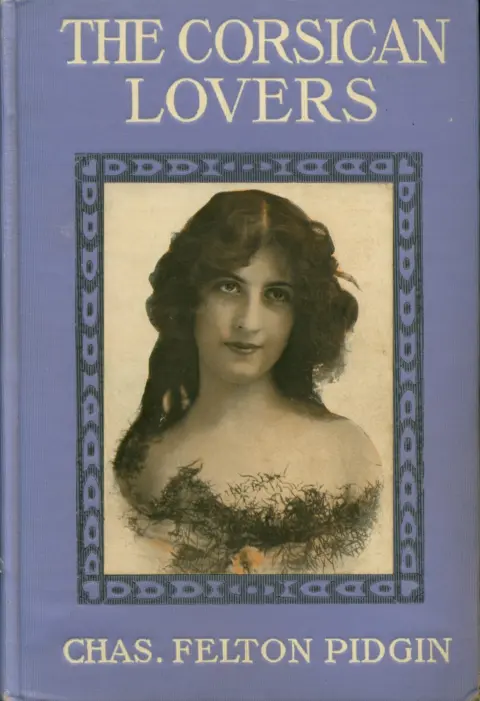
THE CLASSIC COLLECTION · 1906
"The Corsican Lovers" by Charles Felton Pidgin is a historical novel written in the early 20th century. The story centers around the passionate and tumultuous lives of the Batistelli family, particularly focusing on Vivienne, a young woman grappling with the demands of a loveless marriage arranged by her brother Pascal, as she yearns for autonomy and true love amidst the shadow of her father’s vengeful legacy. At the start of the novel, we are introduced to Vivienne Batistelli, who fiercely opposes her brother Pascal's insistence that she marry Count Mont d'Oro's son, Napier. Vivienne is haunted by the memory of her father’s murder, and as she asserts her refusal to enter into a loveless union meant to appease family honor, her determination becomes palpable. The conflict escalates as Pascal reveals that their father's dying wish was for Vivienne to marry Napier, invoking a familial vendetta that looms over their lives. This opening sets the stage for not only personal dilemmas of love and duty but also a broader commentary on the intricacies of honor, revenge, and the expectations placed on women within their family and society.
Introduction adapted from the source catalogue; source summaries may be automatically generated.
Free to read · English · 104,285 words · No account needed
MAKE TIME FOR A GOOD BOOK
On by default. Untick to stop anonymous reading totals. Each page counts after 10 seconds in view. How this works.
Anonymous counting is on unless you have switched it off.
“But I say he shall come!” cried Manassa, and he brought down his heavy staff with a loud whack on the floor.
“Don’t cry, little girl.” Hobbling up to Pascal, he shook his staff in his face and exclaimed with more vehemence than before:
“I say he shall come! Do you hear me, young man? Do you hear me, sir?”
Pascal saw that numerically the odds were against him, for they stood three to one. He knew from past experience that, if goaded on, he would grow more and more intemperate in his language. He would reply to him with dignity and keep his temper:
“You forget yourself, Manassa. I am master here.”
“You master here!” shouted Manassa. “Then who am I? Who am I, sir?”
Clarine interposed: “You are only a servant, Manassa.”
“Am I a servant, Clarine? That boy is getting impudent, extremely impudent! I must bring him down a bit.” He shook his staff in Pascal’s face, again saying:
“I say he shall come. Do you hear?”
“There, there,” said Clarine, soothingly, “you are too old to get angry. A man a hundred years old ought to know better.”
“Old, hey! What if I am a hundred years old? Every day I live I learn something new. Who is this man that Vivienne wants to come to the party? Is he a Corsican?”
“No,” said Clarine, “he is a stranger--an Englishman--a sailor.”
“A sailor! They are good, true men. Speaking of sailors, I remember that soon after Manuel Della Coscia, the murderer and coward, ran away from Corsica, taking his son with him, I had a dream. I thought that the vessel in which he sailed, while on its way to Marseilles, was becalmed, and as it drifted there, helplessly, the devil came up out of the sea and, grasping the old Della Coscia and the young one, dragged them down with him--and I have liked the devil a little ever since.”
Even Pascal could not help smiling at this exhibition of devotion on the part of an old servant, but he did not propose to be further humiliated.
“Manassa,” he said, sternly, “we have had enough of this. Go to your own
room.”
The old man grew still more incensed. “You talk as though you were my master,” he cried, “but you are not. I am master here. How dare you vex your sister? I say he shall come!”
Pascal’s anger rose again: “If you do not leave the room, I will put you
out.”
“How can you speak so,” cried Vivienne, “to a weak, foolish old man?”
Your reading position is saved on this browser. Take it to another device with a library code. Reading pages adapt to text, rather than matching a printed edition.
BEHIND THE BOOK
This eBook is for the use of anyone anywhere in the United States and most other parts of the world at no cost and with almost no restrictions whatsoever. You may copy it, give it away or re-use it under the terms of the Project Gutenberg License included with this eBook or online at www.gutenberg.org. If you are not located in the United States, you will have to check the laws of the country where you are located before using this eBook. Read the source licence.
The original source file, including credits and licence, is retained by this library. Request an original-format copy at no charge. Please include the book title and Project Gutenberg identifier #67412.
KEEP YOUR CURIOSITY GOING
Cécile Tormay

Moritz Busch
Coulson Kernahan
John L. Ransom

Maurice Baring
Frances Wright