THE CLASSIC COLLECTION✦Quincy Adams Sawyer and Mason’s Corner Folks A Picture of New England Home LifeCLASSIC FREE BOOKS
Quincy Adams Sawyer and Mason’s Corner Folks A Picture of New England Home Life
Charles Felton Pidgin
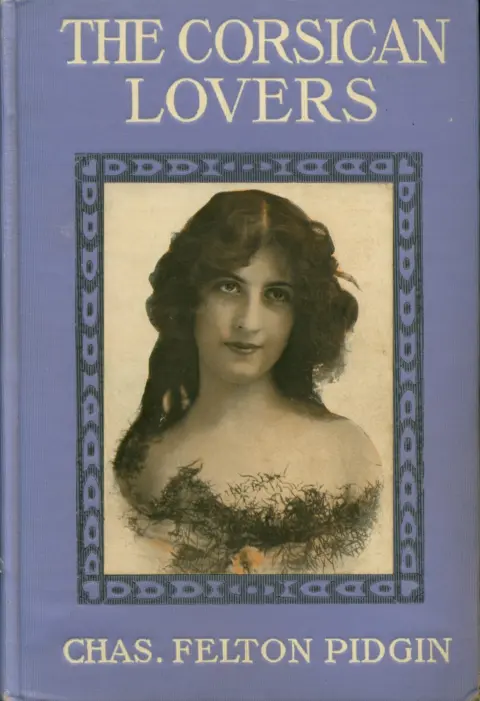
THE CLASSIC COLLECTION · 1906
"The Corsican Lovers" by Charles Felton Pidgin is a historical novel written in the early 20th century. The story centers around the passionate and tumultuous lives of the Batistelli family, particularly focusing on Vivienne, a young woman grappling with the demands of a loveless marriage arranged by her brother Pascal, as she yearns for autonomy and true love amidst the shadow of her father’s vengeful legacy. At the start of the novel, we are introduced to Vivienne Batistelli, who fiercely opposes her brother Pascal's insistence that she marry Count Mont d'Oro's son, Napier. Vivienne is haunted by the memory of her father’s murder, and as she asserts her refusal to enter into a loveless union meant to appease family honor, her determination becomes palpable. The conflict escalates as Pascal reveals that their father's dying wish was for Vivienne to marry Napier, invoking a familial vendetta that looms over their lives. This opening sets the stage for not only personal dilemmas of love and duty but also a broader commentary on the intricacies of honor, revenge, and the expectations placed on women within their family and society.
Introduction adapted from the source catalogue; source summaries may be automatically generated.
Free to read · English · 104,285 words · No account needed
MAKE TIME FOR A GOOD BOOK
On by default. Untick to stop anonymous reading totals. Each page counts after 10 seconds in view. How this works.
Anonymous counting is on unless you have switched it off.
Saturday morning was cloudy.
“I am so glad the sun is not shining to-day,” remarked Jack, as the little party took their seats at the breakfast table.
“Why so?” asked Bertha, and she cast an inquiring glance at the speaker.
“Because it will be so much better for fishing, and I never like to fish unless I catch something.”
“I see,” remarked Bertha, “you are a practical angler, not a political
one.”
“Exactly,” said Jack. “I remember reading somewhere the definition of a person who fishes for compliments.”
“The answer to that must be a joke,” said Clarence.
Jack laughed. “Something near. I think it was this: A man who fishes for compliments is one who uses himself for bait.”
At this they laughed, Mr. Thomas Glynne the loudest of them all.
After breakfast Bertha said: “You must come with me, Mr. De Vinne, and see Guardy’s beautiful flowers. They say he has the finest greenhouses and the most beautiful conservatory in this part of England--some say, in all England.”
As they entered the conservatory, Bertha turned towards Jack and remarked: “I am sorry I cannot agree with you, Mr. De Vinne, but I wish very much that the sun was shining. Flowers never look so beautiful as when the sun falls upon them. They are always beautiful, but the sunlight makes them more so.”
They were alone and Jack grew venturesome.
“There is something else that the sun has the same effect upon,” he
remarked.
“Why, what can that be?”
“A pretty girl,” answered Jack, with a laugh. “Especially if she has”--he hesitated, but decided to finish his speech--“especially if she has golden hair.”
Bertha avoided the compliment. “I have heard that it is still more effective when it falls upon a certain shade of red.”
“That may be so,” said Jack, “but my acquaintance is rather limited and I must confess I never knew a young lady with red hair.”
They walked about, Bertha extolling the beauty of the flowers and
calling many of them by name.
“I do not think you love flowers as I do, Mr. De Vinne.”
“I will be honest, Miss Renville, I prefer fish. Now, could I induce you to come with me on the river this morning?”
“I am no great lover of Father Thames,” she replied. “I have been in his embrace once and it was not very pleasant.”
“They say lightning never strikes twice in the same place,” remarked Jack, “and I don’t think you are in any danger of falling overboard again. If you refuse I shall consider it as a personal reflection upon my ability as a sailor.”
Your reading position is saved on this browser. Take it to another device with a library code. Reading pages adapt to text, rather than matching a printed edition.
BEHIND THE BOOK
This eBook is for the use of anyone anywhere in the United States and most other parts of the world at no cost and with almost no restrictions whatsoever. You may copy it, give it away or re-use it under the terms of the Project Gutenberg License included with this eBook or online at www.gutenberg.org. If you are not located in the United States, you will have to check the laws of the country where you are located before using this eBook. Read the source licence.
The original source file, including credits and licence, is retained by this library. Request an original-format copy at no charge. Please include the book title and Project Gutenberg identifier #67412.
KEEP YOUR CURIOSITY GOING
Cécile Tormay

Moritz Busch
Coulson Kernahan
John L. Ransom

Maurice Baring
Frances Wright