
Last letters from the living dead man
David Patterson (Spirit) Hatch
THE CLASSIC COLLECTION · 1899
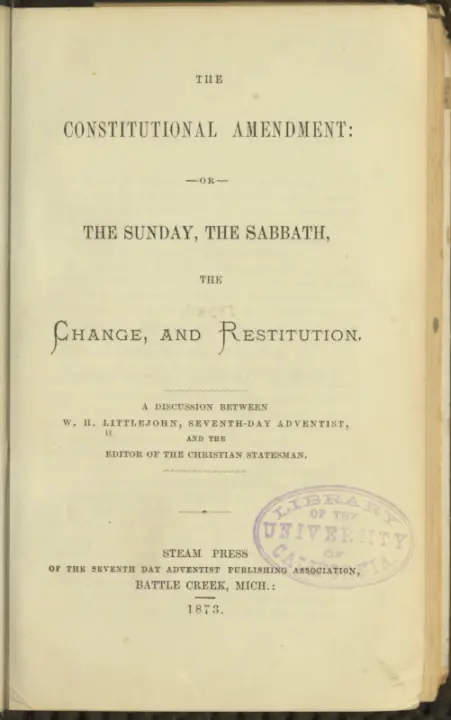
"The Constitutional Amendment: or, The Sunday, the Sabbath, the Change, and…." is a religious discussion text likely written in the late 19th century. The work features a debate primarily between W. H. Littlejohn, a Seventh-Day Adventist, and the editor of the Christian Statesman, addressing the contentious issue of Sabbath observance and the proposed amendments to the U.S. Constitution aimed at promoting the recognition of Sunday as a day of rest. This dialogue situates itself within a broader cultural and religious conflict regarding the interpretation of biblical laws and the implications of their enforcement in a modern, pluralistic society. The opening of the book sets the stage for an intense discourse centered on the Sabbath question, indicating that public sentiment is heating up around the observance of religious days, particularly Sunday versus Saturday. Littlejohn presents his viewpoint emphasizing the biblical basis for the Sabbath as the seventh day, stressing that advocating for Sunday to be enshrined in law could infringe on religious liberties. The initial articles lay the groundwork for an exploration of varying beliefs regarding the Sabbath's significance, the arguments for change, and the repercussions of enforcing religious observance through legal means, highlighting the passionate divides forming among the involved parties.
Introduction adapted from the source catalogue; source summaries may be automatically generated.
Free to read · English · 99,631 words · No account needed
MAKE TIME FOR A GOOD BOOK
On by default. Untick to stop anonymous reading totals. Each page counts after 10 seconds in view. How this works.
Anonymous counting is on unless you have switched it off.
I say proposed, because, of course, the result is as yet more or less uncertain; nevertheless, we incline to the opinion that the end desired will be substantially realized, so far as appearance is concerned. Yet this will not be brought about in a moment, nor will it be accomplished without a hard fight. It must, from the very necessity of the case, be a contest which will enter, divide, and distract families, and which will alienate a large portion of the community from the other. But, with a united and well-drilled ministry, on the one band, backed by the compact organization of their respective churches, and opposed by a heterogeneous mass of discordant elements, there can be little doubt as to final success.
First, then, let us suppose that the policy inaugurated shall be that of the class represented above as desiring to strip the subject of its religious garb, and to array it in the habiliments of mere policy and temporal considerations. Are the benefits reasonably to be expected from such a course such as would warrant the enthusiasm now manifested by the advocates of the proposed reformation? We believe not. In fine, so certain are we of it, that we should not hesitate to predict immediate and perfect paralysis to their efforts, so soon as they should inscribe this doctrine upon their banners. How many of the gentlemen in question are really so profoundly interested in the social status of the working-man that their zeal in his behalf could be wrought up to the point of sacrificing time and money, and of devoting voice and pen to the mere work of giving him a septenary day of physical rest? What satisfaction would be afforded them by the reflection that, as the result of legal enactment, the carefully appointed police in our great cities should be able to meet each other on the boundary lines of their respective beats, on the morning of Sunday, with the accustomed salutation, All is quiet! and cessation from labor is complete in all parts of the great metropolis? Who would highly prize a coerced rest of this sort? What particular gratification would be afforded to the religious world, as they gather, in their costly churches, by the thought that the great mass of the people were quietly sleeping, or lazily lounging in the various places of their retirement? Certainly there is nothing in such a state of things which offers results sufficiently desirable either to reward them for the great sacrifices with which it would be necessary that they should be purchased, in the first instance, or to secure that patient continuance in vigilant perseverance which would be required to insure the perpetuity of an order of things at once so compulsory and so precarious. We say, therefore, that to rest the contest upon this issue would be simply to falsify the facts. It is not the physical consideration of rest, in any large degree, which animates the mind and strengthens the resolve of those engaged in the newly organized reform. No; there is something behind all this. The informing soul, that which electrifies, stimulates, and nerves to action, is the profound conviction that this is a religious movement; that which is sought is the honoring of God by the observance of a Sabbath such as is found in his word. If this be not so, if the higher idea of Christian worship as the primary one is not paramount in this matter, then the whole thing is a farce, from beginning to end. Not only so; if what is sought is merely the improvement of bodily condition, then the plan suggested is, in many cases, far from being the best which might be offered. Take, if you please, our over-populated cities, with the dense masses of human beings who are there crowded together, under most unfavorable circumstances, many of them perishing for lack of pure air, and others pale and sickly for want of exposure to the vivifying rays of the sun, which is continually shut out from their gaze by the massive piles of masonry by which they are inclosed; who will not say that, leaving the spiritual out of consideration, and setting aside the idea of the sanctity of the day, it would be a blessing incalculably greater for them, should provision be made whereby this should become to them a day of recreation, while wandering amid flowers, and over hills, and through groves, instead of one in which, either from necessity or choice, they should still perpetuate the confinement which has already nearly proved fatal in their cases?
Your reading position is saved on this browser. Take it to another device with a library code. Reading pages adapt to text, rather than matching a printed edition.
BEHIND THE BOOK
This eBook is for the use of anyone anywhere in the United States and most other parts of the world at no cost and with almost no restrictions whatsoever. You may copy it, give it away or re-use it under the terms of the Project Gutenberg License included with this eBook or online at www.gutenberg.org. If you are not located in the United States, you will have to check the laws of the country where you are located before using this eBook. Read the source licence.
The original source file, including credits and licence, is retained by this library. Request an original-format copy at no charge. Please include the book title and Project Gutenberg identifier #61071.
KEEP YOUR CURIOSITY GOING
David Patterson (Spirit) Hatch

David Patterson (Spirit) Hatch

David Patterson (Spirit) Hatch
Cécile Tormay

Moritz Busch
John L. Ransom