
Last letters from the living dead man
David Patterson (Spirit) Hatch
THE CLASSIC COLLECTION · 1899
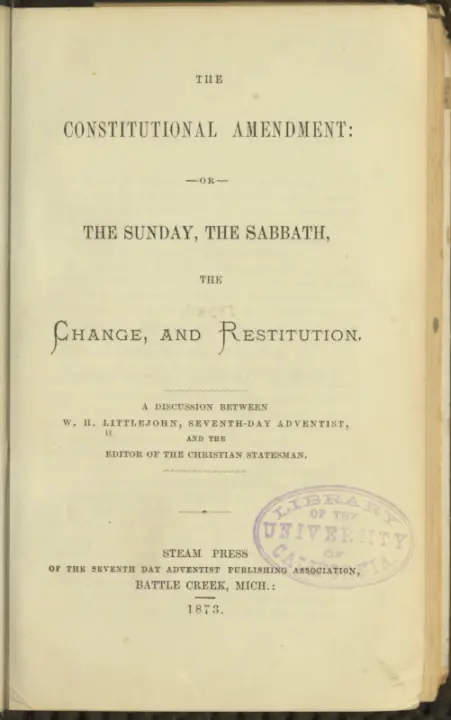
"The Constitutional Amendment: or, The Sunday, the Sabbath, the Change, and…." is a religious discussion text likely written in the late 19th century. The work features a debate primarily between W. H. Littlejohn, a Seventh-Day Adventist, and the editor of the Christian Statesman, addressing the contentious issue of Sabbath observance and the proposed amendments to the U.S. Constitution aimed at promoting the recognition of Sunday as a day of rest. This dialogue situates itself within a broader cultural and religious conflict regarding the interpretation of biblical laws and the implications of their enforcement in a modern, pluralistic society. The opening of the book sets the stage for an intense discourse centered on the Sabbath question, indicating that public sentiment is heating up around the observance of religious days, particularly Sunday versus Saturday. Littlejohn presents his viewpoint emphasizing the biblical basis for the Sabbath as the seventh day, stressing that advocating for Sunday to be enshrined in law could infringe on religious liberties. The initial articles lay the groundwork for an exploration of varying beliefs regarding the Sabbath's significance, the arguments for change, and the repercussions of enforcing religious observance through legal means, highlighting the passionate divides forming among the involved parties.
Introduction adapted from the source catalogue; source summaries may be automatically generated.
Free to read · English · 99,631 words · No account needed
MAKE TIME FOR A GOOD BOOK
On by default. Untick to stop anonymous reading totals. Each page counts after 10 seconds in view. How this works.
Anonymous counting is on unless you have switched it off.
REPLY ONE.
Seventh-day Sabbatarianism and the Christian Amendment, 87
Supposed Action of Missionaries, 89
The Proposed Amendment Expresses only Fundamental Principles, 91
FIRST REJOINDER.
Amendment Not Related merely to Principles, but to Sunday in
Particular, 96
Supposition of Missionary Action Examined, 103
REPLY TWO.
The Seventh Day Not Observed by the Early Christian Church, 107
Examination of New-Testament Proofs, 108
SECOND REJOINDER.
Our Common Ground, 116
The Seventh Day, only, the Sabbath in the New Testament, 119
No Effort Has been Made to Place Sunday upon Precept, 124
Consideration of Col. 2:14-17, 125
Rom. 14:5, Examined, 129
Survey of the Ground Passed Over, 131
REPLY THREE.
Testimony of the Gospels for the First-day Sabbath, 133
Resurrection of Christ, 134
John 20, 136
THIRD REJOINDER.
No Evidence of First-day Sacredness, 140
The Gospels do Not Call First Day the Sabbath, 150
REPLY FOUR.
Argument for the First-day Sabbath from the Gift of the Holy Spirit
on the Day of Pentecost, 154
Authors Differing Concerning the Day of the week, 155
Argument for the First Day, 156
FOURTH REJOINDER.
Value of Testimony—First-day Keepers Witnessing that Pentecost Fell
on the Sabbath, 163
No Reason Stated, nor Commandment Found, for First-day Sabbath, 172
REPLY FIVE.
First-day Sabbath at Troas, 177
The Reckoning of Time Considered, 179
FIFTH REJOINDER.
No Custom Found in Acts 20, 183
Argument for Change of Time Considered, 191
Evidence of Acts 20 Favorable to the Sabbath, 201
REPLY SIX.
Testimony of Paul and John to the First-day Sabbath, 202
Examination of 1 Cor. 16:2, 203
Of Rev. 1:10, 205
SIXTH REJOINDER.
1 Cor. 16:2, 207
—Testimony of J. W. Morton, 207
—Concession of Albert Barnes, 209
—Paul’s Plan of Systematic Beneficence, 211
—Devotion at Home, 214
Rev. 1:10, 219
—The Sabbath is the Lord’s Day, 220
—Christ Lord of the Sabbath, 221
—No Proof Given that First Day is the Lord’s Day, 222
REPLY SEVEN.
Testimony of the Early Fathers to the First-day Sabbath, 225
Testimony of Ignatius, 225
Errors of Dr. Dwight, etc., Corrected, 227
Barnabas and Justin Martyr, 228
Dionysius, 229
Pliny, 230
SEVENTH REJOINDER.
Value of Traditional Testimony, 231
Ignatius, 235
Barnabas, 239
Justin Martyr, 243
What Justin Martyr Believed, 246
Dionysius, Melito, Pliny, 250
Deficiency of Testimony for First-day as a Sabbath, 253
REPLY EIGHT.
Patristic Testimony to the First-day Sabbath, 254
Irenæus, 254
Errors of Dr. Dwight and Others in Quoting this Father, 256
Tertullian, Origen, Cyprian, 257
EIGHTH REJOINDER.
The Apostasy, 261
Testimony of Irenæus, 262
Of Tertullian, 267
Of Origen, 273
Of Cyprian, 276
Summary View of the Case, 277
REPLY NINE.
Theories of the Christian Sabbath, 280
Claim of an Unwarranted Change of the Sabbath Considered, 284
NINTH REJOINDER.
No Advance Ground Taken, 287
Harmony of Sabbath Law and Sacred History, 289
Roman Apostasy and Change of Sabbath, 293
Seventh-day Sabbath in the Early Church, 296
Testimony of Romanists, 304
REPLY TEN.
The Principle as to Time in Sabbath Observance, 313
One Day in Seven, not the Seventh Day, Required, 313
Difficulties of Keeping Definite Day, 314
Your reading position is saved on this browser. Take it to another device with a library code. Reading pages adapt to text, rather than matching a printed edition.
BEHIND THE BOOK
This eBook is for the use of anyone anywhere in the United States and most other parts of the world at no cost and with almost no restrictions whatsoever. You may copy it, give it away or re-use it under the terms of the Project Gutenberg License included with this eBook or online at www.gutenberg.org. If you are not located in the United States, you will have to check the laws of the country where you are located before using this eBook. Read the source licence.
The original source file, including credits and licence, is retained by this library. Request an original-format copy at no charge. Please include the book title and Project Gutenberg identifier #61071.
KEEP YOUR CURIOSITY GOING
David Patterson (Spirit) Hatch

David Patterson (Spirit) Hatch

David Patterson (Spirit) Hatch
Cécile Tormay

Moritz Busch
John L. Ransom