
Last letters from the living dead man
David Patterson (Spirit) Hatch
THE CLASSIC COLLECTION · 1899
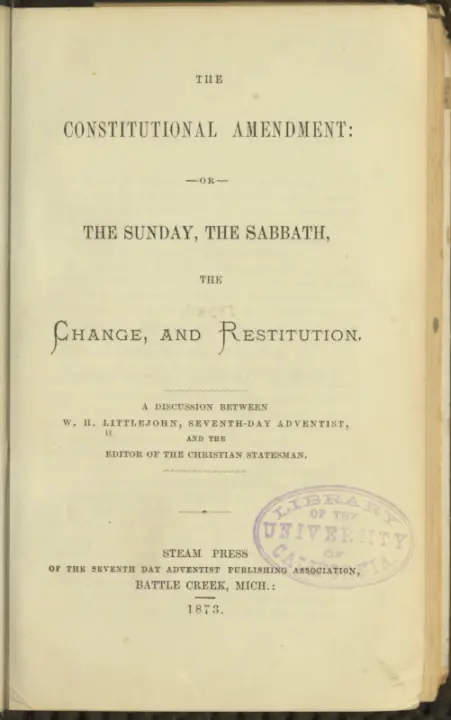
"The Constitutional Amendment: or, The Sunday, the Sabbath, the Change, and…." is a religious discussion text likely written in the late 19th century. The work features a debate primarily between W. H. Littlejohn, a Seventh-Day Adventist, and the editor of the Christian Statesman, addressing the contentious issue of Sabbath observance and the proposed amendments to the U.S. Constitution aimed at promoting the recognition of Sunday as a day of rest. This dialogue situates itself within a broader cultural and religious conflict regarding the interpretation of biblical laws and the implications of their enforcement in a modern, pluralistic society. The opening of the book sets the stage for an intense discourse centered on the Sabbath question, indicating that public sentiment is heating up around the observance of religious days, particularly Sunday versus Saturday. Littlejohn presents his viewpoint emphasizing the biblical basis for the Sabbath as the seventh day, stressing that advocating for Sunday to be enshrined in law could infringe on religious liberties. The initial articles lay the groundwork for an exploration of varying beliefs regarding the Sabbath's significance, the arguments for change, and the repercussions of enforcing religious observance through legal means, highlighting the passionate divides forming among the involved parties.
Introduction adapted from the source catalogue; source summaries may be automatically generated.
Free to read · English · 99,631 words · No account needed
MAKE TIME FOR A GOOD BOOK
On by default. Untick to stop anonymous reading totals. Each page counts after 10 seconds in view. How this works.
Anonymous counting is on unless you have switched it off.
2. That Sabbath is the seventh, and not the first, day of the week, for the following reasons:—
(1.) In the beginning God rested on the seventh day, thereby laying the foundation for its Sabbatic honor (Gen. 2:3); whereas, he never rested upon the first day.
(2.) He blessed the seventh day; whereas, he never blessed the first
day.
(3.) He sanctified the seventh day, or devoted it to a religious use; whereas, he never sanctified the first day.
(4.) The day of his rest, his blessing, and his sanctification, he commanded to be kept holy, in a law of perpetual obligation; whereas, he never commanded the observance of the first day.
(5.) The Lord Jesus Christ recognized the obligation of the seventh day by a life-long custom of observing it (Luke 4:16); whereas, the Lord Jesus Christ never rested upon the first day of the week; but always treated it as a secular day.
(6.) He also recognized its perpetuity forty years after his death, when speaking of events connected with the destruction of Jerusalem, by instructing his disciples to pray that their flight might not occur thereon (Matt. 24:20); whereas, he never spoke of the first day as one to be honored in the future, nor, indeed, so far as we know, did he ever take it upon his lips at all.
(7.) It is the day which the holy women kept, according to the commandment, after the crucifixion of our Lord (Luke 23:66); whereas, there is no account that any good man has ever rested upon the first day out of regard for its sanctity.
(8.) It is the day on which Paul, as his manner was, taught in the synagogue (Acts 17:2); whereas, Paul never made the first day of the week, habitually, one of public teaching, a thing which he would have been sure to do had he looked upon it as sacred to the Lord.
(9.) Being mentioned fifty-six times in the New Testament, it is in all these instances called the Sabbath; whereas, the first day is mentioned eight times in the New Testament, and in every case it is called, simply, the first day of the week.
(10.) In the year of our Lord 95, it is spoken of by John as the Lord’s day (Rev. 1:10); whereas, the first day is in no case mentioned in the use of a sacred title.
(11.) It is mentioned not only as the Sabbath, but it is also spoken of as the next Sabbath, and every Sabbath, thus proving that it had no rival (Acts 13:4; 15:21); whereas, the day before the first, and the sixth day after it, being spoken of as the Sabbath, it (i. e., the first day) is classed with the other days of the week.
Your reading position is saved on this browser. Take it to another device with a library code. Reading pages adapt to text, rather than matching a printed edition.
BEHIND THE BOOK
This eBook is for the use of anyone anywhere in the United States and most other parts of the world at no cost and with almost no restrictions whatsoever. You may copy it, give it away or re-use it under the terms of the Project Gutenberg License included with this eBook or online at www.gutenberg.org. If you are not located in the United States, you will have to check the laws of the country where you are located before using this eBook. Read the source licence.
The original source file, including credits and licence, is retained by this library. Request an original-format copy at no charge. Please include the book title and Project Gutenberg identifier #61071.
KEEP YOUR CURIOSITY GOING
David Patterson (Spirit) Hatch

David Patterson (Spirit) Hatch

David Patterson (Spirit) Hatch
Cécile Tormay

Moritz Busch
John L. Ransom