
Dark Hester
Anne Douglas Sedgwick
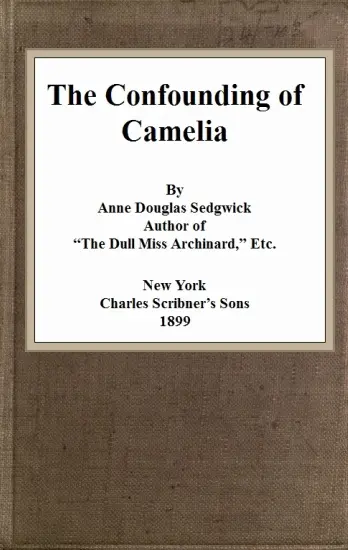
THE CLASSIC COLLECTION · 1899
"The Confounding of Camelia" by Anne Douglas Sedgwick is a novel written in the late 19th century. The story revolves around the character Camelia Paton, who returns to her family estate in the country after a successful but disconcerting season in London. As she navigates the expectations and judgments of those around her, particularly concerning her unconventional nature and her family's legacy of quiet respectability, the narrative explores themes of identity, societal norms, and personal ambition. The opening of the novel introduces us to Camelia's background, including her lineage of “good, quiet people” and her father's rebellious spirit that sets her apart. The text paints a vivid picture of the contrast between her vibrant personality and the conservative views of her community in Clievesbury, establishing her as a figure both admired and scrutinized. We learn about her complex relationships, particularly with her mother, Lady Paton, and her childhood friend, Michael Perior, who seems critical yet protective of her. The dynamics in their interactions suggest an underlying tension and potential for deeper connections as Camelia seeks to assert her identity amidst the conformity she despises while also yearning for acceptance. The stage is set for a rich exploration of her character and the relationships in her life as she confronts societal expectations and her own desires.
Introduction adapted from the source catalogue; source summaries may be automatically generated.
Free to read · English · 74,100 words · No account needed
MAKE TIME FOR A GOOD BOOK
On by default. Untick to stop anonymous reading totals. Each page counts after 10 seconds in view. How this works.
Anonymous counting is on unless you have switched it off.
"Well, I should like you to. He is one of the strongest men in the
government, you know."
"Quite. He is the man for me, despite past differences of opinion. The man for you, too, perhaps," he added, glancing sharply up at her from the letter; "his devotion is public property, you know."
"But my reception of his devotion isn't," laughed Camelia.
"I am snubbed," said Perior, returning to the letter, and flushing a little. Camelia noted the flush. Dear old Alceste! Shielding so ineffectually, under his sharp blunt bearing, that quivering sensitiveness.
She put her hand through his arm, sinking down beside him, her eyes over his shoulder following his, while he read her--certificate. Perior quite understood the smooth making of amends.
"Well, what do you say to that?" she asked when he had obediently read
to the very end.
"I should say that he was a man very much in love," said Perior, folding
the letter.
"You are subtle if you can trace an amorous influence in that letter."
"It doesn't call for subtlety. Samson only abandons himself so completely under amorous circumstances. I hope you are not going to shear the poor fellow."
"For shame," said Camelia, while Perior, looking at her reflectively, softly slapped the palm of his hand with Arthur Henge's letter. "I am his comrade. I help him; I am on his side, if you please, and against the Philistines."
"Oh, are you? And this? Ah! this is from the leader of the Philistines, Rodrigg. Yes, I heard that Rodrigg was in the toils." Perior examined the small, compact handwriting without much apparent curiosity.
"That is simply nonsense. There was a time--but he soon saw the hopelessness. He is my friend now; not that I am particularly fond of him--the grain is rather coarse: but he is a good creature, far more honest than he imagines, simple, after a clumsy fashion. He aims at distinguished diplomatic complexity, I may tell you, and, I fancy, comes to me for the necessary polishing. Read his letter."
Perior had looked at her, still smiling, but more absently, while she
spoke.
"Oh! Rodrigg is more cautious," he said glancing through the great man's neatly constructed phrases. "You are not with the Philistines; he feels that."
"Politically no; but I have a good deal of influence with him. You see those reviews he mentions; I went through a lot of heavy French and Italian reading for him--sociology, industrialism--and saw the result in his last speech."
"Really."
"Ah, really. Don't be sarcastic, Alceste, to me. One of those men will probably be Prime Minister some day. You can't deny that they are eminent men."
Your reading position is saved on this browser. Take it to another device with a library code. Reading pages adapt to text, rather than matching a printed edition.
Anne Douglas Sedgwick
Anne Douglas Sedgwick

Anne Douglas Sedgwick

Anne Douglas Sedgwick
BEHIND THE BOOK
This eBook is for the use of anyone anywhere in the United States and most other parts of the world at no cost and with almost no restrictions whatsoever. You may copy it, give it away or re-use it under the terms of the Project Gutenberg License included with this eBook or online at www.gutenberg.org. If you are not located in the United States, you will have to check the laws of the country where you are located before using this eBook. Read the source licence.
The original source file, including credits and licence, is retained by this library. Request an original-format copy at no charge. Please include the book title and Project Gutenberg identifier #41917.
KEEP YOUR CURIOSITY GOING
Coulson Kernahan

Maurice Baring
Frances Wright
Cécile Tormay

Frederic Jesup Stimson

W. H. P. (William Henry Pope) Jarvis