
Dark Hester
Anne Douglas Sedgwick
THE CLASSIC COLLECTION · 1899
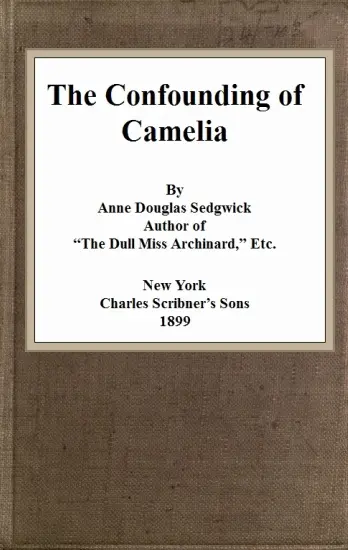
"The Confounding of Camelia" by Anne Douglas Sedgwick is a novel written in the late 19th century. The story revolves around the character Camelia Paton, who returns to her family estate in the country after a successful but disconcerting season in London. As she navigates the expectations and judgments of those around her, particularly concerning her unconventional nature and her family's legacy of quiet respectability, the narrative explores themes of identity, societal norms, and personal ambition. The opening of the novel introduces us to Camelia's background, including her lineage of “good, quiet people” and her father's rebellious spirit that sets her apart. The text paints a vivid picture of the contrast between her vibrant personality and the conservative views of her community in Clievesbury, establishing her as a figure both admired and scrutinized. We learn about her complex relationships, particularly with her mother, Lady Paton, and her childhood friend, Michael Perior, who seems critical yet protective of her. The dynamics in their interactions suggest an underlying tension and potential for deeper connections as Camelia seeks to assert her identity amidst the conformity she despises while also yearning for acceptance. The stage is set for a rich exploration of her character and the relationships in her life as she confronts societal expectations and her own desires.
Introduction adapted from the source catalogue; source summaries may be automatically generated.
Free to read · English · 74,100 words · No account needed
MAKE TIME FOR A GOOD BOOK
On by default. Untick to stop anonymous reading totals. Each page counts after 10 seconds in view. How this works.
Anonymous counting is on unless you have switched it off.
"As a noticeably pretty girl is a personage. You really are beating your drum rather deafeningly, Camelia."
"Yes; I'll shock you by mere noise. But, Alceste, I am not as conceited as I seem; no, really, I am not," and with her change of tone her look became humorously grave. "I know very well that the people who make much of me--who think me a personage--are sillies. Still, in a world of sillies, I am a personage. It does come round to that, you see."
"Yes; I see."
Camelia leaned back in her end of the little sofa, her arms folded, her head bent in a light scrutiny of her companion's face. The warm quiet of the summer day pervaded the peaceful room, a room with so many associations for both of them. They had studied, read there together for years; laughed, quarrelled, been the best of friends and the fondest of enemies. Perior, as he looked about it, could call up a long vista of Camelias, all gay, all attaching, all evasive, all culminating and fulfilling themselves with an almost mathematical inevitableness, as was now so apparent to him, in the long, slim "personage" beside him, her eyes, as he knew, studying him, her mind amused with conjectures as to what he really thought of her, she herself quite ready to display the utmost sincerity in the attempt to elicit that thought. Oh no, Camelia would keep up very few pretences with him. Perior, gazing placidly enough at the sunlit green outside the morning-room, knew very well what he thought of her.
"Are you estimating the full extent of my folly," she asked presently, "tempering your verdict by the consideration of extenuations?"
This was so apt an exposition of his mental process that Perior smiled
rather helplessly.
"See," she said, rising and going to the writing-table, "I'll help you to leniency; show you some very evident extenuations." From a large bundle of letters she selected two. "Weigh the extent of my influence, and find it funny, if you like, as I do."
"I wonder if you quite realize the ludicrous aspect of our
conversation," said Perior, taking a thick sheaf of paper from the first
letter.
"Quite--quite. Only you push me to extremes. I must make you own my importance--my individuality."
"Ah, from Henge," said Perior, looking at the end of the letter. "He was my fag at Eton, you know; dear old Arthur!"
"Yes, and you quarrelled with him five years ago, about politics."
"We didn't quarrel," said Perior, with a touch of asperity; "he was quite big enough not to misunderstand my opposition. Must I read all this, Camelia? It looks rather dry."
Your reading position is saved on this browser. Take it to another device with a library code. Reading pages adapt to text, rather than matching a printed edition.
Anne Douglas Sedgwick
Anne Douglas Sedgwick

Anne Douglas Sedgwick

Anne Douglas Sedgwick
BEHIND THE BOOK
This eBook is for the use of anyone anywhere in the United States and most other parts of the world at no cost and with almost no restrictions whatsoever. You may copy it, give it away or re-use it under the terms of the Project Gutenberg License included with this eBook or online at www.gutenberg.org. If you are not located in the United States, you will have to check the laws of the country where you are located before using this eBook. Read the source licence.
The original source file, including credits and licence, is retained by this library. Request an original-format copy at no charge. Please include the book title and Project Gutenberg identifier #41917.
KEEP YOUR CURIOSITY GOING
Coulson Kernahan

Maurice Baring
Frances Wright
Cécile Tormay

Frederic Jesup Stimson

W. H. P. (William Henry Pope) Jarvis