
Dark Hester
Anne Douglas Sedgwick
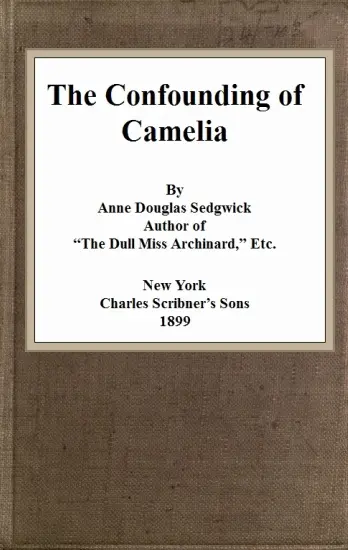
THE CLASSIC COLLECTION · 1899
"The Confounding of Camelia" by Anne Douglas Sedgwick is a novel written in the late 19th century. The story revolves around the character Camelia Paton, who returns to her family estate in the country after a successful but disconcerting season in London. As she navigates the expectations and judgments of those around her, particularly concerning her unconventional nature and her family's legacy of quiet respectability, the narrative explores themes of identity, societal norms, and personal ambition. The opening of the novel introduces us to Camelia's background, including her lineage of “good, quiet people” and her father's rebellious spirit that sets her apart. The text paints a vivid picture of the contrast between her vibrant personality and the conservative views of her community in Clievesbury, establishing her as a figure both admired and scrutinized. We learn about her complex relationships, particularly with her mother, Lady Paton, and her childhood friend, Michael Perior, who seems critical yet protective of her. The dynamics in their interactions suggest an underlying tension and potential for deeper connections as Camelia seeks to assert her identity amidst the conformity she despises while also yearning for acceptance. The stage is set for a rich exploration of her character and the relationships in her life as she confronts societal expectations and her own desires.
Introduction adapted from the source catalogue; source summaries may be automatically generated.
Free to read · English · 74,100 words · No account needed
MAKE TIME FOR A GOOD BOOK
On by default. Untick to stop anonymous reading totals. Each page counts after 10 seconds in view. How this works.
Anonymous counting is on unless you have switched it off.
Perior surveyed the emptiness; it hardly surprised him, and well understanding her determination to wheedle him, he felt an added strength of determination not to be wheedled.
"What have you got to say, now that you've got me here?" he asked, putting down his music and looking at her.
"You bandersnatch!" Camelia still held his arm. "I am sure you look like a bandersnatch; a biting, snarling creature. You have a truly snatching way of speaking."
"What have you got to say, Camelia?" Perior repeated, withdrawing his arm from the circling clasp upon it.
"I have got to say that you must stay to lunch."
"Well, I can't do that."
"Then you may sit down and talk to me a little--scold me if you like; do you feel like scolding me?"
"I have never scolded you, Camelia," said Perior, knowing that before her lightness his solemnity showed to disadvantage; but he would be nothing but solemn, ludicrously solemn if necessary.
"You were never sure I deserved it, then," said Camelia, stooping to gather up her dog for a swift kiss, and laughing over his round head at Perior's stiffness; "else you would have done your duty, I am sure--you never forget your duty."
"Thanks; your recognition is flattering."
"There, my pet, go--poor Sir Arthur is lonely, go to him," said Camelia, opening the window for Siegfried's exit, "you know your sarcasm doesn't impress me one bit--not one bit," she added.
"I don't fancy that anything I could say would impress you," Perior replied, eyeing her little manoeuvres, "and since I have seen Siegfried receive his kiss, I really must go," and at this Perior took up his music with decision; to see him assuming indifference so badly was delightful to Camelia.
"Why were you so rude to poor Lady Henge the other evening?" she demanded, couching her lance and preparing for the shock of encounter; "you were hideously rude, you know."
"Yes, I know." Perior still eyed her, his departure effectually checked.
"Then, why were you?"
"Because you lied."
"Oh, what an ugly word!" cried Camelia lightly, though with a little chill, for the unpleasant sincerity of Perior's look she felt to be more than she had bargained for. "What a big, ungainly word to fling at poor little me! You should eschew such gross elementary forms of speech, Alceste; really, they are not becoming."
"I hate lies," said Perior tersely, thinking, as he spoke, that by the logic of the words he should hate Camelia too--for what was she but unmitigated falseness personified? He had lost his nervousness, now that the moment for plain speaking had arrived.
"And you call that a lie?"
Your reading position is saved on this browser. Take it to another device with a library code. Reading pages adapt to text, rather than matching a printed edition.
Anne Douglas Sedgwick
Anne Douglas Sedgwick

Anne Douglas Sedgwick

Anne Douglas Sedgwick
BEHIND THE BOOK
This eBook is for the use of anyone anywhere in the United States and most other parts of the world at no cost and with almost no restrictions whatsoever. You may copy it, give it away or re-use it under the terms of the Project Gutenberg License included with this eBook or online at www.gutenberg.org. If you are not located in the United States, you will have to check the laws of the country where you are located before using this eBook. Read the source licence.
The original source file, including credits and licence, is retained by this library. Request an original-format copy at no charge. Please include the book title and Project Gutenberg identifier #41917.
KEEP YOUR CURIOSITY GOING
Coulson Kernahan

Maurice Baring
Frances Wright
Cécile Tormay

Frederic Jesup Stimson

W. H. P. (William Henry Pope) Jarvis