
Last letters from the living dead man
David Patterson (Spirit) Hatch
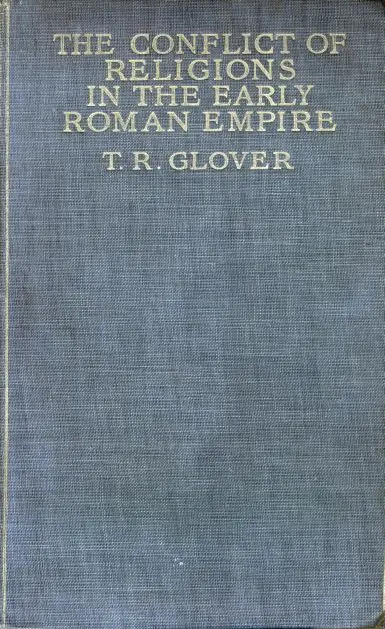
THE CLASSIC COLLECTION · 1909
"The Conflict of Religions in the Early Roman Empire" by T. R. Glover is a historical account written in the early 20th century. The book explores the complex interactions and struggles between various religious ideologies during the early Roman Empire, particularly highlighting the emergence of Christianity alongside established pagan traditions. Glover’s aim seems to be to shed light on how these conflicts shaped the cultural and spiritual landscape of the time. The opening of the text presents a vivid portrayal of the political and social condition of Rome following the assassination of Julius Caesar, setting the stage for the subsequent turmoil and eventual consolidation of power under Augustus. Glover reflects on the chaotic aftermath of Caesar's death and the societal decline that occurred as competing factions struggled for control, leading to widespread disorder. As he introduces the dynamics of Roman religion, Glover indicates a profound concern regarding the moral and spiritual decay of society, hinting at how Augustus sought to restore stability through a revival of traditional Roman religious practices, juxtaposed with the rise of new faiths and ideas, including the nascent Christian movement. This introduction effectively frames the subsequent discussions on the interplay of religious thought and state authority in ancient Rome.
Introduction adapted from the source catalogue; source summaries may be automatically generated.
Free to read · English · 142,040 words · No account needed
MAKE TIME FOR A GOOD BOOK
On by default. Untick to stop anonymous reading totals. Each page counts after 10 seconds in view. How this works.
Anonymous counting is on unless you have switched it off.
[1] Keim, Celsus' Wahres Wort (1873).
[2] Keim, pp. 264-273.
[3] Tertullian, Apol. 38, nec ulla res aliena magis quam publica. Elsewhere Tertullian explains this: laedimas Romanos nec Romani habemur qui non Romanorum deum colimus, Apol. 24.
[4] Apud Origen, c. Cels. viii, 2. References in what follows will be made to the book and chapter of this work without repetition of Origen's name. The text used is that of Koetschau.
[5] c. Cels. iii, 44.
[6] Ibid. iii, 59.
[7] iii, 55. I have omitted a clause or two.
Clem A. Strom. iv, 67, on the other hand, speaks of the difficult position of wife or slave in such a divided household, and (68) of conversions in spite of the master of the house. Tert. ad Scap. 3, has a story of a governor whose wife became a Christian, and who in anger began a persecution at once.
[8] iii, 75.
[9] i, 9. Cf. Clem. Alex. Strom. i, 43, on some Christians who think themselves euphusis and "ask for faith--faith alone and bare." In Paed. i, 27, he says much the same himself, to pisteusai monon kai anagennethunai teleiois estin en zoe.
[10] vi, 10. Clem. Alex. Strom. ii, 8, "The Greeks think Faith empty and barbarous, and revile it," but (ii, 30) "if it had been a human thing, as they supposed, it would have been quenched."
[11] iii, 62.
[12] iii, 62.
[13] iii, 65, tous hamartangin pephykotas te kai eithismenous.
[14] iii, 71.
[15] Clement of Alexandria, Protr. 92, uses this simile of worms in the mud of swamps, applying it to people who live for pleasure.
[16] iv, 23.
[17] iv, 74.
[18] So Lucian Icaromenippus, 19, explicitly.
[19] iv, 88. Cf. Clem. Alex. Paedag. i, 7, to philtron endon estin en to anthropo touth' oper emphysema legetai theou.
[20] c. Cels. iv, 74-99. Cf. Plato, Laws, 903 B, hos to tou pantos epimeloumeno pros ten soterian kai areten tou holou pant' esti syntetagmena kte, explicitly developing the idea of the part being for the whole. Also Cicero, N.D. ii, 13, 34-36.
[21] Of. M. Aurelius, xi, 3, the criticism of the theatricality of the
Christians. See p. 198.
[22] c. Cels. vii, 42, ton men oun poieten kai patera toude tou pantos ehurein te epgon kai ehuronta eis pantas adynaton legein; Timaeus, 28 C--often cited by Clement too.
[23] vii, 42.
[24] vii, 42.
[25] vii, 45.
[26] iv, 14.
[27] iv, 18. See Tertullian's argument on this question of God changing, in de Carne Christi, 3. See Plato, Rep. ii, 381 B.
[28] iv, 52. See Timaeus, 34 B ff. on God making soul.
Your reading position is saved on this browser. Take it to another device with a library code. Reading pages adapt to text, rather than matching a printed edition.
BEHIND THE BOOK
This eBook is for the use of anyone anywhere in the United States and most other parts of the world at no cost and with almost no restrictions whatsoever. You may copy it, give it away or re-use it under the terms of the Project Gutenberg License included with this eBook or online at www.gutenberg.org. If you are not located in the United States, you will have to check the laws of the country where you are located before using this eBook. Read the source licence.
The original source file, including credits and licence, is retained by this library. Request an original-format copy at no charge. Please include the book title and Project Gutenberg identifier #39092.
KEEP YOUR CURIOSITY GOING
David Patterson (Spirit) Hatch

David Patterson (Spirit) Hatch

David Patterson (Spirit) Hatch
Cécile Tormay

Moritz Busch
John L. Ransom