
Last letters from the living dead man
David Patterson (Spirit) Hatch
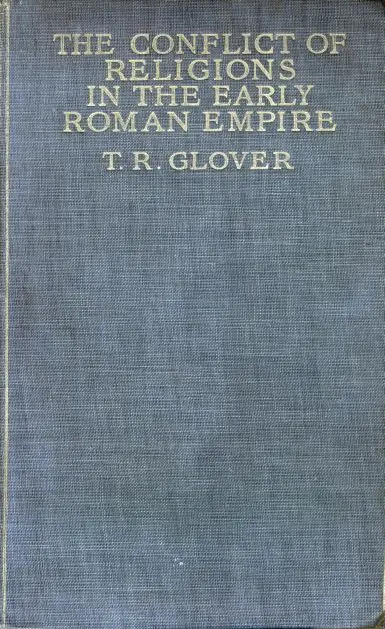
THE CLASSIC COLLECTION · 1909
"The Conflict of Religions in the Early Roman Empire" by T. R. Glover is a historical account written in the early 20th century. The book explores the complex interactions and struggles between various religious ideologies during the early Roman Empire, particularly highlighting the emergence of Christianity alongside established pagan traditions. Glover’s aim seems to be to shed light on how these conflicts shaped the cultural and spiritual landscape of the time. The opening of the text presents a vivid portrayal of the political and social condition of Rome following the assassination of Julius Caesar, setting the stage for the subsequent turmoil and eventual consolidation of power under Augustus. Glover reflects on the chaotic aftermath of Caesar's death and the societal decline that occurred as competing factions struggled for control, leading to widespread disorder. As he introduces the dynamics of Roman religion, Glover indicates a profound concern regarding the moral and spiritual decay of society, hinting at how Augustus sought to restore stability through a revival of traditional Roman religious practices, juxtaposed with the rise of new faiths and ideas, including the nascent Christian movement. This introduction effectively frames the subsequent discussions on the interplay of religious thought and state authority in ancient Rome.
Introduction adapted from the source catalogue; source summaries may be automatically generated.
Free to read · English · 142,040 words · No account needed
MAKE TIME FOR A GOOD BOOK
On by default. Untick to stop anonymous reading totals. Each page counts after 10 seconds in view. How this works.
Anonymous counting is on unless you have switched it off.
[29] iv, 73. See Clem. Alex. Paed. i, ch. 10, on God threatening; and Strom, ii, 72; iv, 151; vii, 37, for the view that God is without anger, and for guidance as to the understanding of language in the O.T. which seems to imply the contrary. For a different view, see Tertullian, de Testim. Animae, 2, unde igitur naturalis timor animae in deum, si deus nan novit irasci? adv. Marc. i, 26, 27, on the necessity for God's anger, if the moral law is to be maintained; and adv. Marc. ii, 16, a further account of God's anger, while a literal interpretation of God's "eyes" and "right hand" is excluded.
[30] iv, 65.
[31] iv, 69.
[32] iv, 70. Long before (about 500 B.C.) Heraclitus had said (fragm. 61): "To God all things are beautiful and good and just; but men have supposed some things to be unjust and others just." For this doctrine of the relativity of good and bad to the whole, cf. hymn of Cleanthes to Zeus:--
alla su kai ta perissa t' epistasai artia theinai, kai kosmein ta kosma, kai ou phila soi phila estin. ode gar eis en panta synermokas esthla kakoisin osth' ena gignesthai panton logon aien eonta.
Cf. also the teaching of Chrysippus, as given by Gellius, N.A. vii, 1: cum bona malis contraria sint, utraque necessum est opposita inter sese et quasi mutuo adverse quaeque fulta nisu consistere; nullum adeo contrarium est sine contrario altero ... situleris unum abstuleris utrumque. See also M. Aurelius in the same Stoic vein, viii, 50; ix, 42. On the other side see Plutarch's indignant criticism of this attribution of the responsibility for evil to God, de comm. not. adv. Sto. 14, 1065 D, ff. In opposition to Marcion, Tertullian emphasizes the worth of the world; his position, as a few words will show, is not that of Celsus, but Stoic influence is not absent: adv. Marc. i, 13, 14; Ergo nec mundus deo indignus: nihil etenim deus indignum st fecit, etsi mundum homini non sibi fecit, etsi omne opus inferius est suo artifice; see p. 317.
[33] iv, 3.
[34] iv, 6.
[35] iv, 7.
[36] vii, 36.
[37] viii, 63.
[38] viii, 66.
[39] vi, 69. "Men, who count themselves wise," says Clement (Strom. i, 88), "count it a fairy tale that the son of God should speak through man, or that God should have a son, and he suffer."
[40] vi, 72.
[41] vi, 73. Cf. the Marcionite view; cf. Tert. adv. Marc. iii, 11; iv, 21; v, 19, cuius ingeniis tam longe abest veritas nostra ut ... Christum ex vulva virginis natum non erubescat, ridentibus philosophis et haereticis et ethnicis ipsis. See also de carne Christi, 4, 5, where he strikes a higher note; Christ loved man, born as man is, and descended for him.
[42] vi, 75. Cf. Tert. de carne Christi, 9, adeo nec humanae honestatis corpus fuit; adv. Jud. 14, ne aspectu quidem honestus.
Your reading position is saved on this browser. Take it to another device with a library code. Reading pages adapt to text, rather than matching a printed edition.
BEHIND THE BOOK
This eBook is for the use of anyone anywhere in the United States and most other parts of the world at no cost and with almost no restrictions whatsoever. You may copy it, give it away or re-use it under the terms of the Project Gutenberg License included with this eBook or online at www.gutenberg.org. If you are not located in the United States, you will have to check the laws of the country where you are located before using this eBook. Read the source licence.
The original source file, including credits and licence, is retained by this library. Request an original-format copy at no charge. Please include the book title and Project Gutenberg identifier #39092.
KEEP YOUR CURIOSITY GOING
David Patterson (Spirit) Hatch

David Patterson (Spirit) Hatch

David Patterson (Spirit) Hatch
Cécile Tormay

Moritz Busch
John L. Ransom