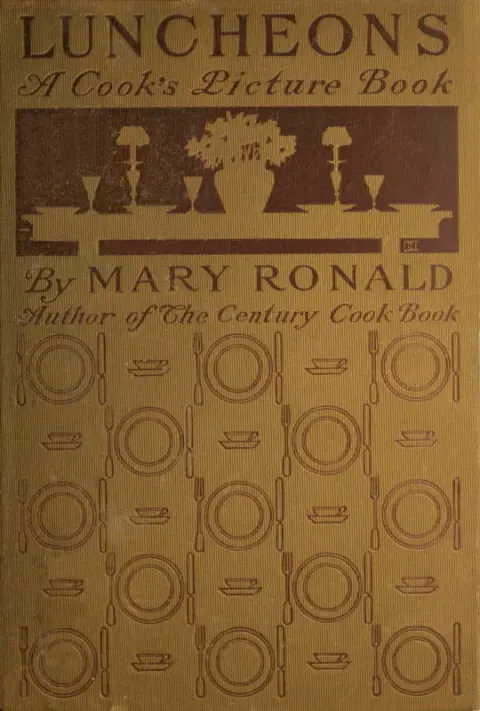
Luncheons: A Cook’s Picture Book
Mary Ronald
THE CLASSIC COLLECTION · 1895
"The Century Cook Book" by Mary Ronald is a culinary guide written in the late 19th century. This comprehensive resource covers a wide range of cooking techniques, recipes for various dishes, and essential etiquette for dinner parties. It aims to equip readers with skills for both simple meals and elaborate entertaining, emphasizing the importance of both nutrition and presentation in cooking. At the start of the book, Ronald discusses the significance of cooking as both an art and a science, stressing that a knowledgeable cook can elevate a meal from mere sustenance to an enjoyable experience. The opening sections outline the etiquette of hosting dinner parties, including how to arrange invitations and order the courses, while also providing practical tips for laying the table and expressing hospitality. She highlights the distinction between cooking as a functional task and as a form of creative expression, setting a tone for the detailed instructions and recipes that follow.
Introduction adapted from the source catalogue; source summaries may be automatically generated.
Free to read · English · 180,173 words · No account needed
MAKE TIME FOR A GOOD BOOK
On by default. Untick to stop anonymous reading totals. Each page counts after 10 seconds in view. How this works.
Anonymous counting is on unless you have switched it off.
As nothing is easier than making good soups, they should be
the first lesson in cooking.
They are one of the most nutritious and inexpensive foods presented, and have a very wide range, extending from the clear, transparent soups, through many degrees of consistency, color and material, to the heavy varieties which contain enough nourishment for a meal in themselves. The pot-au-feu as managed in the families of the French peasantry furnishes their chief source of diet. The pot on the fire receives every bit of nutritious material of every kind; by slow cooking the juices and flavors are extracted, and a savory combination is made which is both pleasant to the taste and satisfying to the hunger.
The stock-pot should be on every range, and its contents ever ready to be drawn upon, not only for soup, but for sauces, and for flavoring the numerous dishes which can be enriched and improved by stock.[84-*]
The many kinds of soups are variations of the few kinds of
stock.
[Sidenote: Brown Stock, see page 88.]
The brown stock is made from beef, or from beef, veal, and
fowl combined, and mixed vegetables.
[Sidenote: White Stock, see page 99.]
White stock is made of veal and chicken together, or from veal alone, seasoned with onion, celery, white pepper, and salt, nothing being used which will give color.
[Sidenote: Chicken Consomme or Broth, see page 98.]
Chicken stock is made from the fowl alone, and seasoned with
celery, white pepper, and salt.
[Sidenote: Cream Soups, see page 105.]
Cream soups are made without stock, the basis being
vegetables boiled and mashed to a puree by being pressed
through a colander or sieve, then mixed with cream or milk
and seasoned to taste.
[Sidenote: Soup Meats.]
The meats used for soups are: the lower or tough part of the round, the shin, and the neck pieces of beef, the knuckle of veal, and fowls. Mutton is not used except for mutton broth. A very little ham is sometimes used; game also gives good flavor.
Bones contain gelatine and cause the stock to jelly when
cold.
[Sidenote: Soup Vegetables.]
The soup vegetables are onions, carrots, turnips, and celery. They are cut into small pieces and are sometimes fried before being added to the soup pot.
[Sidenote: The Bouquet.]
Parsley wrapped around peppercorns, cloves, bay-leaves and other herbs, excepting sage, and tied, makes what is called a bouquet. In this shape the herbs are more easily removed.
[Sidenote: Proportions.]
Your reading position is saved on this browser. Take it to another device with a library code. Reading pages adapt to text, rather than matching a printed edition.
Mary Ronald
BEHIND THE BOOK
This eBook is for the use of anyone anywhere in the United States and most other parts of the world at no cost and with almost no restrictions whatsoever. You may copy it, give it away or re-use it under the terms of the Project Gutenberg License included with this eBook or online at www.gutenberg.org. If you are not located in the United States, you will have to check the laws of the country where you are located before using this eBook. Read the source licence.
The original source file, including credits and licence, is retained by this library. Request an original-format copy at no charge. Please include the book title and Project Gutenberg identifier #34822.
KEEP YOUR CURIOSITY GOING

Charles G. (Charles Griffith) Ross
Hannah Webster Foster

Emily Lawless
Edwin Hamlin Carr

Charles De Lano Hine
Andrew Ure