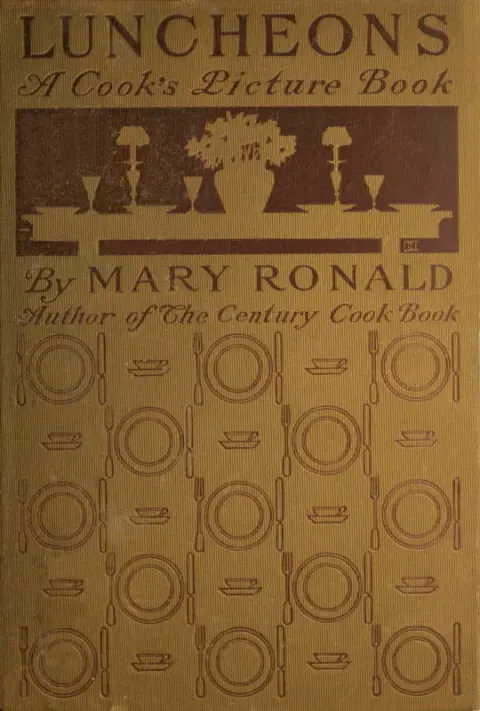
Luncheons: A Cook’s Picture Book
Mary Ronald
THE CLASSIC COLLECTION · 1895
"The Century Cook Book" by Mary Ronald is a culinary guide written in the late 19th century. This comprehensive resource covers a wide range of cooking techniques, recipes for various dishes, and essential etiquette for dinner parties. It aims to equip readers with skills for both simple meals and elaborate entertaining, emphasizing the importance of both nutrition and presentation in cooking. At the start of the book, Ronald discusses the significance of cooking as both an art and a science, stressing that a knowledgeable cook can elevate a meal from mere sustenance to an enjoyable experience. The opening sections outline the etiquette of hosting dinner parties, including how to arrange invitations and order the courses, while also providing practical tips for laying the table and expressing hospitality. She highlights the distinction between cooking as a functional task and as a form of creative expression, setting a tone for the detailed instructions and recipes that follow.
Introduction adapted from the source catalogue; source summaries may be automatically generated.
Free to read · English · 180,173 words · No account needed
MAKE TIME FOR A GOOD BOOK
On by default. Untick to stop anonymous reading totals. Each page counts after 10 seconds in view. How this works.
Anonymous counting is on unless you have switched it off.
[Sidenote: Baking.]
The most difficult part of cake-making is the baking. Unless the oven is right, the cake will be a failure, no matter how carefully it may have been mixed.
Have everything ready before beginning to mix the cake.
Have the weights and measures exact.
[Sidenote: Fire.]
Have the fire so it will last through the baking, and the heat of the oven just right (see below), for on this the success of the cake mostly depends.
Do not mix the cake until the oven is entirely ready for it
to go in.
Sift the flour before measuring it.
If baking-powder or cream of tartar is used, sift it with
the flour.
Mix in an earthen bowl with a wooden spoon.
Beat the yolks and whites of the eggs separately.
Grease the tins with lard, as butter blackens.
For some cakes it is better to line the pans with paper.
[Sidenote: Fruit.]
When fruit is used, roll it in flour, and add it the last
thing.
If the fruit is wanted in layers, add it while the mixture
is being poured into the tins.
[Sidenote: Salt.]
Add one quarter teaspoonful of salt to all cakes.
[Sidenote: Sugary crust.]
If a sugary crust is wanted, sprinkle the top with sugar
before the cake is baked.
[Sidenote: Cause of cracking.]
If the cake cracks open as it rises, too much flour has been
used.
[Sidenote: Uneven rising.]
If it rises in a cone in the center, the oven is too hot.
[Sidenote: Beating.]
Beating eggs and butter makes them light, beating flour makes it tough; hence the rule to add it last.
[Sidenote: Adding white of egg.]
When the whipped whites are added do not stir, but turn or fold them in lightly, so as not to break the air-cells.
[Sidenote: Pans, how filled.]
In filling the pans let the mixture be a little higher on
the sides than in the middle.
[Sidenote: Soda and baking powder.]
When molasses is used, baking-powder (also cream of tartar) must be omitted, and soda alone used for raising the cake.
[Sidenote: Equivalents.]
One teaspoonful of baking-powder is the equivalent of one
teaspoonful of cream of tartar, and one half teaspoonful of
soda.
[Sidenote: Whites.]
[Sidenote: Yolks.]
Your reading position is saved on this browser. Take it to another device with a library code. Reading pages adapt to text, rather than matching a printed edition.
Mary Ronald
BEHIND THE BOOK
This eBook is for the use of anyone anywhere in the United States and most other parts of the world at no cost and with almost no restrictions whatsoever. You may copy it, give it away or re-use it under the terms of the Project Gutenberg License included with this eBook or online at www.gutenberg.org. If you are not located in the United States, you will have to check the laws of the country where you are located before using this eBook. Read the source licence.
The original source file, including credits and licence, is retained by this library. Request an original-format copy at no charge. Please include the book title and Project Gutenberg identifier #34822.
KEEP YOUR CURIOSITY GOING

Charles G. (Charles Griffith) Ross
Hannah Webster Foster

Emily Lawless
Edwin Hamlin Carr

Charles De Lano Hine
Andrew Ure