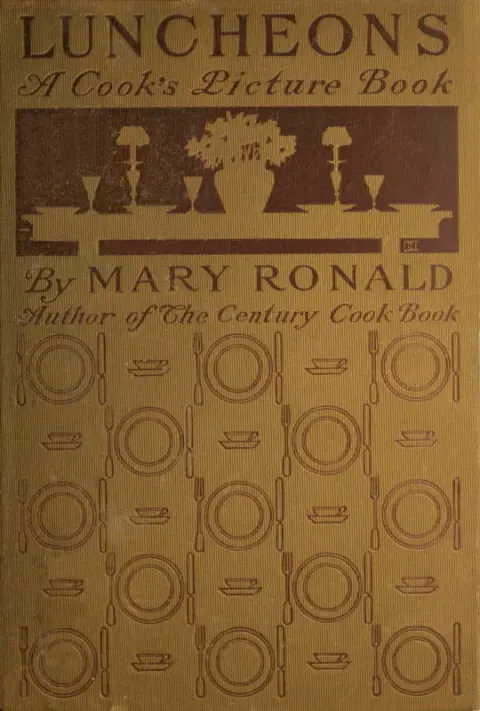
Luncheons: A Cook’s Picture Book
Mary Ronald
THE CLASSIC COLLECTION · 1895
"The Century Cook Book" by Mary Ronald is a culinary guide written in the late 19th century. This comprehensive resource covers a wide range of cooking techniques, recipes for various dishes, and essential etiquette for dinner parties. It aims to equip readers with skills for both simple meals and elaborate entertaining, emphasizing the importance of both nutrition and presentation in cooking. At the start of the book, Ronald discusses the significance of cooking as both an art and a science, stressing that a knowledgeable cook can elevate a meal from mere sustenance to an enjoyable experience. The opening sections outline the etiquette of hosting dinner parties, including how to arrange invitations and order the courses, while also providing practical tips for laying the table and expressing hospitality. She highlights the distinction between cooking as a functional task and as a form of creative expression, setting a tone for the detailed instructions and recipes that follow.
Introduction adapted from the source catalogue; source summaries may be automatically generated.
Free to read · English · 180,173 words · No account needed
MAKE TIME FOR A GOOD BOOK
On by default. Untick to stop anonymous reading totals. Each page counts after 10 seconds in view. How this works.
Anonymous counting is on unless you have switched it off.
There are prepared flours from which biscuits may be quickly made; prepared buckwheat which makes good pancakes for supper or for breakfast. A few cans of condensed milk should be in the store-room for use in case of real necessity only; it answers very well for puddings, sweet dishes, or chocolate.
Outside the store-room supplies, eggs furnish a variety of dishes quickly prepared. Eggs a l'aurore, or Bourguignonne, omelets with peas, tomatoes, mushrooms, minced meat, etc., are for luncheon, and cheese omelets, sweet omelets, and souffles for dinner dishes.
It is well to have fondant (page 513) in close jars ready for icing cakes or for bonbons, candied fruits for sweets or for ornamenting desserts, ginger and brandied peaches to serve with ice-cream. Lady-fingers are easily made, and will keep in a cracker-box indefinitely. If these are at hand, a Charlotte russe is quickly made, and is one of the simplest and most acceptable light desserts.
There are olives, gherkins, and chow-chow for hors d'oeuvres. There are catsups and condiments in variety to make barbecues (page 331), or to make cold meats acceptable.
The growing plant, the globe of gold fish, the bird-cage partly concealed with branches, may be utilized for table decoration. As circumstances alter cases, there are many expedients to which a housekeeper may resort in supplying deficiencies which might not be in rule, were the occasion a formal one. The chafing-dish on the luncheon or supper-table, or a dish more appropriate to a different meal, would not only be excused, but perhaps give to an embarrassing occasion the pleasant feature of informality.
[Sidenote: Eggs.]
A dash of salt added to the whites of eggs makes them whip
better.
Not a speck of the yolk must get into the whites which are
to be whipped.
Fold the whipped whites into any mixture rather than stir them in, as the latter method breaks the air cells.
Break eggs one at a time into a saucer, so any can be rejected if necessary and the mixture not be spoiled.
Add a tablespoonful of water to an egg used for crumbing in
order to remove the stringiness.
Use a double boiler for milk.
[Sidenote: Milk.]
Milk is scalded when the water in the lower pan boils.
A pinch of bi-carbonate of soda mixed with tomato before milk or cream is added prevents the milk from curdling.
With sour milk, or molasses, use soda instead of baking
powder.
[Sidenote: Butter.]
Milk and butter should be kept in closely covered vessels, as they readily absorb flavor and odor from other articles.
Butter added slowly in small bits to creamy mixtures, or
sauces, prevents a greasy line forming.
[Sidenote: Crumbs.]
Your reading position is saved on this browser. Take it to another device with a library code. Reading pages adapt to text, rather than matching a printed edition.
Mary Ronald
BEHIND THE BOOK
This eBook is for the use of anyone anywhere in the United States and most other parts of the world at no cost and with almost no restrictions whatsoever. You may copy it, give it away or re-use it under the terms of the Project Gutenberg License included with this eBook or online at www.gutenberg.org. If you are not located in the United States, you will have to check the laws of the country where you are located before using this eBook. Read the source licence.
The original source file, including credits and licence, is retained by this library. Request an original-format copy at no charge. Please include the book title and Project Gutenberg identifier #34822.
KEEP YOUR CURIOSITY GOING

Charles G. (Charles Griffith) Ross
Hannah Webster Foster

Emily Lawless
Edwin Hamlin Carr

Charles De Lano Hine
Andrew Ure