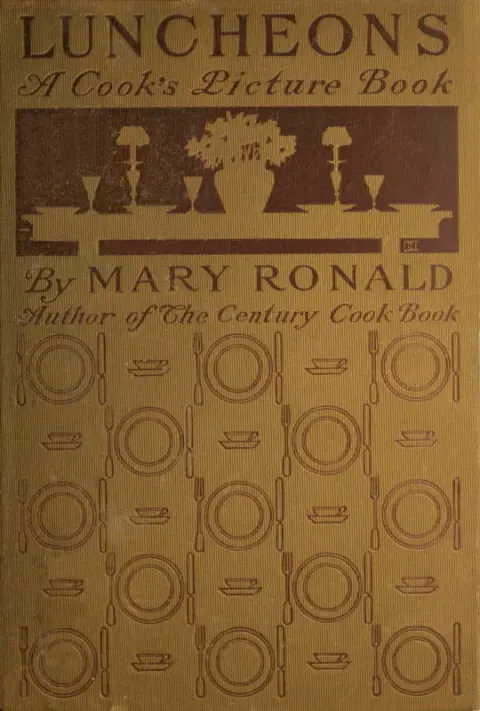
Luncheons: A Cook’s Picture Book
Mary Ronald
THE CLASSIC COLLECTION · 1895
"The Century Cook Book" by Mary Ronald is a culinary guide written in the late 19th century. This comprehensive resource covers a wide range of cooking techniques, recipes for various dishes, and essential etiquette for dinner parties. It aims to equip readers with skills for both simple meals and elaborate entertaining, emphasizing the importance of both nutrition and presentation in cooking. At the start of the book, Ronald discusses the significance of cooking as both an art and a science, stressing that a knowledgeable cook can elevate a meal from mere sustenance to an enjoyable experience. The opening sections outline the etiquette of hosting dinner parties, including how to arrange invitations and order the courses, while also providing practical tips for laying the table and expressing hospitality. She highlights the distinction between cooking as a functional task and as a form of creative expression, setting a tone for the detailed instructions and recipes that follow.
Introduction adapted from the source catalogue; source summaries may be automatically generated.
Free to read · English · 180,173 words · No account needed
MAKE TIME FOR A GOOD BOOK
On by default. Untick to stop anonymous reading totals. Each page counts after 10 seconds in view. How this works.
Anonymous counting is on unless you have switched it off.
The champagne should be very dry (brut) and served very cold. Half an hour in ice and salt before dinner will bring it to about the right temperature. Sweet champagnes are but seldom served nowadays, and are more appreciated, perhaps, at ladies' luncheons than at dinners. Sweet champagne cannot be too cold and should be frappe if convenient. Clarets and Burgundies should stand upright on the dining-room mantelpiece for at least twenty-four hours before they are required, in order that the wine may acquire the temperature of the room, as well as be prepared for decanting. Wines old in bottle will form more or less deposit, which, if shaken up with the wine, will injure it. After standing twenty-four hours the sediment will fall and the wine should then be decanted (with the aid of a candle), care being taken that no sediment passes into the decanter.
[Sidenote: Port.]
Neither claret nor Burgundy is good the second day after decanting. They contain too small a percentage of alcohol to keep their flavor more than a few hours after the bottle is opened, and what remains over from dinner should be put into the vinegar demijohn. Ports and Madeiras are but little used at dinners, but may still be served with the cheese at the end of dinner, or with the dessert. A glass of port with a biscuit at five o'clock is very popular in many quarters, and will be welcomed by those who are afraid of tea.
[Sidenote: Madeira.]
[Sidenote: Brandy.]
[Sidenote: Liqueurs.]
A fine Madeira may be served with the soup instead of sherry, and is the wine par excellence to drink with terrapin. A superior quality of brandy and various liqueurs are usually served with coffee. In buying wines it is always best to go directly to a reliable wine merchant and take his advice. Especially is this true when the buyer himself has no great knowledge of the different kinds of wines. It has been said that a man's wine merchant should stand in as close relation to him as his lawyer or his physician.
=Agra Dolce=, 291.
=Allemande Sauce=, 279.
=Almonds, burnt=, 520.
Chopping, 59.
Hardbake, 526.
Salted, 533.
" No. 2, 533.
Sugared, 520.
" Wafers, 478.
=Anchovy canapes=, 368.
=Angel cake=, 467.
Ice-cream, 497.
Parfait, 505.
=Angelica=, 392.
=Apples=, 530.
Baked for breakfast, 432.
" " luncheon, 432.
Compote of, 535.
Clarified, 243.
Charlotte, 430.
Dumplings, 429.
Flaming, 432.
Fritters, 427.
Fried with pork, 176.
Jelly, 544.
Marmalade of, 543.
Pie, 454.
Pudding, 429.
Sauce, 243, 288.
Souffle, 424.
With rice, 430.
" " No. 2, 431.
" Corn-starch, 432.
=Apricot Sauce=, 446.
=Artichokes=, 220.
Bottoms, 221.
=Asparagus=, 211.
Cream of, 106.
Tips, 212.
=Aspic jelly=, 321.
To chop, 323.
To clear, 322.
Chicken, 323.
Croutons, 323.
To mold, 323.
To ornament molds for, 324.
Quick, 322.
Of pate en Bellevue, 384.
=Baba=, 440.
=Bacon=, 178.
" how to cut, 78.
=Baked Apples=, 432.
Beans, 217, 234.
Custard, 396.
Fish, 115.
Ham, 177.
Lobster, 137.
Macaroni, 225.
=Baking=, 69.
Bread, 343.
Cake, 464.
Custards, 396.
=Balloons=, 428.
=Banana trifle=, 412.
=Bananas, sliced=, 531.
Sauted, fried, 531.
Your reading position is saved on this browser. Take it to another device with a library code. Reading pages adapt to text, rather than matching a printed edition.
Mary Ronald
BEHIND THE BOOK
This eBook is for the use of anyone anywhere in the United States and most other parts of the world at no cost and with almost no restrictions whatsoever. You may copy it, give it away or re-use it under the terms of the Project Gutenberg License included with this eBook or online at www.gutenberg.org. If you are not located in the United States, you will have to check the laws of the country where you are located before using this eBook. Read the source licence.
The original source file, including credits and licence, is retained by this library. Request an original-format copy at no charge. Please include the book title and Project Gutenberg identifier #34822.
KEEP YOUR CURIOSITY GOING

Charles G. (Charles Griffith) Ross
Hannah Webster Foster

Emily Lawless
Edwin Hamlin Carr

Charles De Lano Hine
Andrew Ure