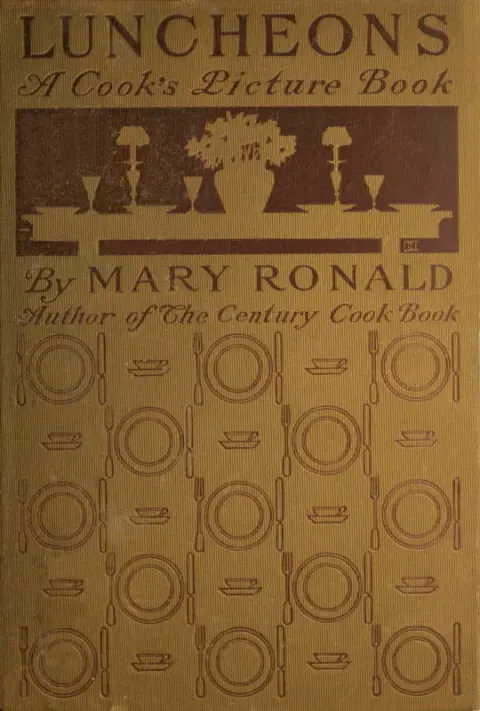
Luncheons: A Cook’s Picture Book
Mary Ronald
THE CLASSIC COLLECTION · 1895
"The Century Cook Book" by Mary Ronald is a culinary guide written in the late 19th century. This comprehensive resource covers a wide range of cooking techniques, recipes for various dishes, and essential etiquette for dinner parties. It aims to equip readers with skills for both simple meals and elaborate entertaining, emphasizing the importance of both nutrition and presentation in cooking. At the start of the book, Ronald discusses the significance of cooking as both an art and a science, stressing that a knowledgeable cook can elevate a meal from mere sustenance to an enjoyable experience. The opening sections outline the etiquette of hosting dinner parties, including how to arrange invitations and order the courses, while also providing practical tips for laying the table and expressing hospitality. She highlights the distinction between cooking as a functional task and as a form of creative expression, setting a tone for the detailed instructions and recipes that follow.
Introduction adapted from the source catalogue; source summaries may be automatically generated.
Free to read · English · 180,173 words · No account needed
MAKE TIME FOR A GOOD BOOK
On by default. Untick to stop anonymous reading totals. Each page counts after 10 seconds in view. How this works.
Anonymous counting is on unless you have switched it off.
To roast beef and baste frequently, roast potatoes in the
same pan, pages 146 and 204.
To draw and truss a chicken, pages 180 and 183.
To clear the beef stock for clear soup, page 86.
To make common stock, page 87.
To make potato soup, page 103.
To clarify drippings, page 74.
To try out all other fat, page 74.
To dry bread and roll it into crumbs, page 51.
To make bread and bread biscuits, page 340.
To make rice pudding, page 433.
To make bread pudding, page 434.
To make plain cornstarch pudding, page 397.
A compote to serve with cornstarch pudding, page 535.
Cottage pudding, sabayon sauce, pages 435 and 446.
Cup cake, page 470.
Cookies, page 481.
Plain pie-crust, page 451.
Baked apple-dumplings, hard sauce, pp. 429 and 448.
Some variations of cornstarch pudding, page 398.
Plain wine-jelly, page 415.
When a woman has learned to do these few simple things
perfectly, she will have no difficulty in following any
ordinary receipt, and having a knowledge of the first
principles of cooking, can then advance to more elaborate
dishes.
Frying should not be attempted until she can roast, broil,
and bake.
Croquettes of various kinds can then be made; to mold them uniformly requires a little practice--the care of the fat and the right degree of heat are the essential things to emphasize in frying.
In one month a woman of ordinary intelligence, with the desire to learn, should be able to make perfectly, and serve attractively, enough simple dishes to supply the family table with sufficient variety, without troubling the mistress to plan and think for her.
An insistence upon system and exactness will insure immunity
from failures.
A very pleasant book called "$10.00 Enough" explains how a family of two lived well on that sum per week, including house rent and wages of one servant. Mrs. Rorer says $2.00 per head a week is a liberal allowance. Articles are published giving directions for living on ten cents a day; also of dinners for six people costing twenty-five cents. In examining these formulae it is evident that in order to accomplish this very small cost of living, one must first understand the comparative values of foods, so as to select those which at low prices furnish the necessary nourishment, and secondly, to be able to cook them in such a way as to make them acceptable; in fact the rule holds good, however high the scale of living, that the proper cooking of food counts for more than the cost of it. The cheap and the expensive articles can be equally spoiled in the cooking; while the cheap ones, well cooked, are more esteemed than the high-priced ones poorly prepared. The first thing excluded from the list of cheap nutritive foods is white bread. Refining the flour to the whiteness of the so-called best qualities takes out most of its nutritive elements, while the lower grades or brown flours retain the gluten, and make a bread which is preferred when one becomes familiar with it. Beans, peas, and corn-meal have an important place on the list of accepted foods. They supply the wastes of the system and afford a hearty meal. Meat, which is the most expensive food, has come to be regarded here as a necessity, but in the old countries the classes who perform the hardest labor consider it only as a luxury, and seldom use it oftener than once a week. Often the cost of living is more in the waste than in the actual consumption of food. Another needless and unwise expense is buying more than is required, providing for three persons enough for six; and still another extravagance is in buying articles which are out of season. For instance, in the spring veal is a very cheap meat; in the autumn it is the most expensive one, but, at the right times, one may indulge in sweetbreads, calf's head, calf's brains, and liver. In its season game is frequently abundant and reasonably cheap. The idea prevails that, in order to have variety, it is necessary to buy whatever the market offers, whereas variety may be attained by variation in the ways of cooking, in serving with different sauces, and with different accompaniments, and in arranging the menu so that one course is in pleasing contrast to the preceding one, thus avoiding surfeit.
Your reading position is saved on this browser. Take it to another device with a library code. Reading pages adapt to text, rather than matching a printed edition.
Mary Ronald
BEHIND THE BOOK
This eBook is for the use of anyone anywhere in the United States and most other parts of the world at no cost and with almost no restrictions whatsoever. You may copy it, give it away or re-use it under the terms of the Project Gutenberg License included with this eBook or online at www.gutenberg.org. If you are not located in the United States, you will have to check the laws of the country where you are located before using this eBook. Read the source licence.
The original source file, including credits and licence, is retained by this library. Request an original-format copy at no charge. Please include the book title and Project Gutenberg identifier #34822.
KEEP YOUR CURIOSITY GOING

Charles G. (Charles Griffith) Ross
Hannah Webster Foster

Emily Lawless
Edwin Hamlin Carr

Charles De Lano Hine
Andrew Ure