THE CLASSIC COLLECTION✦An outlaw’s diary: the CommuneCLASSIC FREE BOOKS
An outlaw’s diary: the Commune
Cécile Tormay
THE CLASSIC COLLECTION · 1922
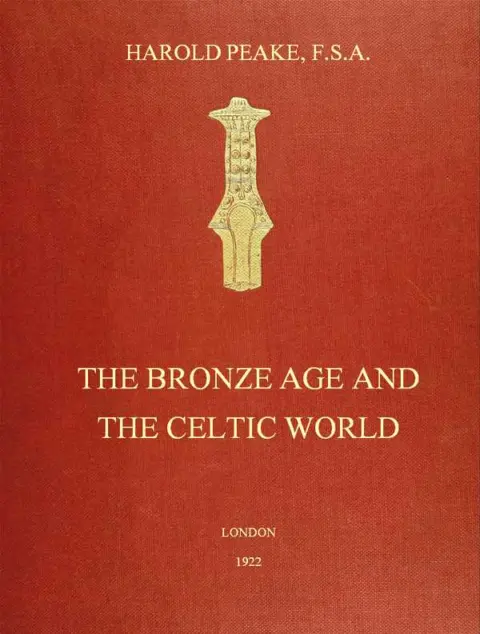
"The Bronze Age and the Celtic World" by Harold Peake is a historical account written in the early 20th century. The book explores the early inhabitants of Celtic lands and their interactions during the Bronze Age, with a specific focus on the evolution and spread of Celtic languages, cultures, and metallic trade. Likely appealing to readers interested in archaeology, anthropology, and the history of European prehistory, the text emphasizes how ancient cultures have influenced the modern understanding of Celtic origins. The opening of the book establishes the framework for Peake's examination of Celtic languages and their historical context. He outlines that for the last fifteen hundred years, the Celtic tongues have been confined mainly to regions in the north-west of Europe but were once more widespread. Peake discusses the significant role of Roman influence in the language's decline and presents complex questions regarding the languages' origin and spread, hinting at the diverse groups that occupied these regions before the Celts. The chapter sets the stage for a more in-depth exploration of prehistoric archaeology, physical anthropology, and comparative philology, all aimed at understanding the Celtic roots and their interactions with other cultures throughout history.
Introduction adapted from the source catalogue; source summaries may be automatically generated.
Free to read · English · 68,568 words · No account needed
MAKE TIME FOR A GOOD BOOK
On by default. Untick to stop anonymous reading totals. Each page counts after 10 seconds in view. How this works.
Anonymous counting is on unless you have switched it off.
[Footnote 502: Déchelette (1908-14) ii. 593.]
[Footnote 503: Herodotus i. 6, 15, 16.]
[Footnote 504: Déchelette (1908-14) ii. 615, 616.]
[Footnote 505: Pliny iv. 95; Solinus xix. 2; quoted by Rhys and
Brynmor-Jones (1900) 80.]
[Footnote 506: Rhys and Brynmor-Jones (1900) 80.]
[Footnote 507: Bulleid & Grey (1911, 1917).]
[Footnote 508: Macalister (1921) 2, 24, 50.]
[Footnote 509: Macalister (1921) 2, 256.]
[Footnote 510: Bushe-Fox (1915).]
[Footnote 511: Budgen, Rev. W., Hallstatt Pottery from Eastbourne. A.J.
II. 354-360.]
[Footnote 512: Geoffrey of Monmouth, Hist. Brit. iii. 8-10.]
[Footnote 513: Jubainville (1904) 80.]
[Footnote 514: Liv. v. 34.]
[Footnote 515: Déchelette (1908-14) ii. 572, 573.]
[Footnote 516: Geer (1896). (1912).]
[Footnote 517: Sollas (1911) 395-397.]
[Footnote 518: Brooks (1921).]
[Footnote 519: Penck & Brückner (1909).]
[Footnote 520: Hall (1913) 15-30.]
[Footnote 521: Petrie (1906) ch. xii.]
[Footnote 522: Meyer (1904).]
[Footnote 523: Breasted (1912).]
[Footnote 524: Hall (1913) 25.]
[Footnote 525: Bachofen (1897).]
[Footnote 526: M’Lennan (1886) 195-246.]
[Footnote 527: Hartland (1921) 122-124.]
[Footnote 528: Rose (1911).]
[Footnote 529: Rose (1911) 279.]
[Footnote 530: Rose (1911) 283.]
[Footnote 531: Ridgeway (1901).]
[Footnote 532: Hartland (1921) 123.]
[Footnote 533: Murray (1907) 74.]
[Footnote 534: Rose (1920) 94.]
Your reading position is saved on this browser. Take it to another device with a library code. Reading pages adapt to text, rather than matching a printed edition.
BEHIND THE BOOK
This eBook is for the use of anyone anywhere in the United States and most other parts of the world at no cost and with almost no restrictions whatsoever. You may copy it, give it away or re-use it under the terms of the Project Gutenberg License included with this eBook or online at www.gutenberg.org. If you are not located in the United States, you will have to check the laws of the country where you are located before using this eBook. Read the source licence.
The original source file, including credits and licence, is retained by this library. Request an original-format copy at no charge. Please include the book title and Project Gutenberg identifier #46924.
KEEP YOUR CURIOSITY GOING
Cécile Tormay

Moritz Busch
John L. Ransom
Frances Wright
Cécile Tormay

Mabel Potter Daggett