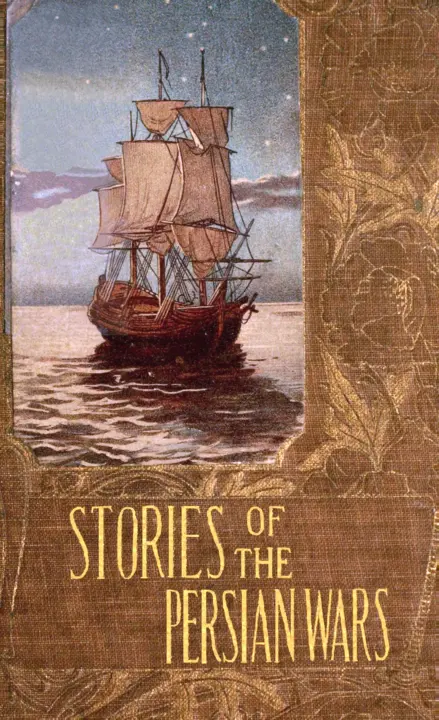
Stories of the Persian wars
Herodotus
THE CLASSIC COLLECTION · 1905
"The Boys' and Girls' Herodotus" by Herodotus is a historical account written in the late 19th century. This edition, edited for younger readers by John S. White, aims to make the classic writings of Herodotus accessible to boys and girls, blending historical facts with engaging storytelling. The work discusses the origins of historical events, particularly the conflicts between the Greeks and various nations, introduced through the lens of Herodotus's experiences and narrative style. At the start of the narrative, the scene is set in ancient Athens, near the end of the year 446 B.C., as the city faces political uncertainty. Herodotus is described as a famed historian sharing captivating tales before an audience, including a young Thucydides. The introduction highlights his intent to document the historical struggles between Greeks and barbarians, showcasing the origins of various conflicts, customs, and significant figures. The narrative establishes Herodotus’s honest and vivid storytelling approach that includes anecdotes, making it relatable and appealing to younger audiences. The opening chapters delve into the early effects of the conflict over respect and relationships that escalated into war, providing a foundation for the historical accounts that follow.
Introduction adapted from the source catalogue; source summaries may be automatically generated.
Free to read · English · 112,601 words · No account needed
MAKE TIME FOR A GOOD BOOK
On by default. Untick to stop anonymous reading totals. Each page counts after 10 seconds in view. How this works.
Anonymous counting is on unless you have switched it off.
On his death Harpagus came down as his successor in the command; he also was by birth a Mede, the same whom Astyages king of the Medes entertained at the impious feast, and who assisted Cyrus in ascending the throne. This man being appointed general by Cyrus, on his arrival in Ionia, took several cities by means of earth-works; for he forced the people to retire within their fortifications, and then, having heaped up mounds against the walls, he carried the cities by storm. Phocæa was the first place in Ionia that he attacked.
These Phocæans were the first of all the Greeks who undertook long voyages, and they are the people who discovered the Adriatic and Tyrrhenian seas, Iberia, and Tartessus.[7] They made their voyages in fifty-oared galleys, and not in merchant-ships. When they arrived at Tartessus they were kindly received by the king of the Tartessians, whose name was Arganthonius; he reigned eighty years over Tartessus, and lived to the age of one hundred and twenty. The Phocæans became such great favorites with him, that he at first solicited them to abandon Ionia, and to settle in any part of his territory they should choose; but afterward, finding he could not prevail with them to accept his offer, and hearing from them the increasing power of the Mede, he gave them money for the purpose of building a wall around their city; he must have given it unsparingly, for the wall is not a few stades in circumference, and is entirely built of large and well-compacted stones. When Harpagus had marched his army against the Phocæans, he besieged them, but offered these terms: "that he would be content if the Phocæans would throw down only one of their battlements, and consecrate one house to the king's use." The Phocæans, detesting slavery, said, "that they wished for one day to deliberate, and would then give their answer"; but while they were deliberating they required him to draw off his forces from the wall. Harpagus said, that "though he well knew their design, yet he would permit them to consult together." In the interval, then, during which Harpagus withdrew his army from the wall, the Phocæans launched their fifty-oared galleys, and having put their wives, children, and goods on board, together with the images from the temples and other offerings, except works of bronze or stone, or pictures, they embarked themselves, and set sail for Chios: and the Persians took possession of Phocæa, abandoned by all its inhabitants. The Phocæans, when the Chians refused to sell them the Œnyssæ Islands, for fear they should become the seat of trade, and their own island be thereby excluded, directed their course to Cyrnus; where, by the admonition of an oracle, they had twenty years before built a city, named Alalia. But Arganthonius was at that time dead. On their passage to Cyrnus, having first sailed down to Phocæa, they put to death the Persian garrison which had been left by Harpagus to guard the city. Afterward, when this was accomplished, they pronounced terrible imprecations on any who should desert the fleet; besides this, they sunk a mass of red-hot iron, and swore "that they would never return to Phocæa, till this burning mass should appear again." Nevertheless, as they were on their way toward Cyrnus, more than one half of the citizens were seized with regret and yearning for their city and dwellings in the country, and violating their oaths, sailed back to Phocæa; but such of them as kept to their oath weighed anchor and sailed from the Œnyssæ Islands. On their arrival at Cyrnus they lived for five years in common with the former settlers: but as they ravaged the territories of all their neighbors, the Tyrrhenians and Carthaginians combined together to make war against them, each with sixty ships: and the Phocæans, on their part, having manned their ships, consisting of sixty in number, met them in the Sardinian Sea; and having engaged, the Phocæans obtained a kind of Cadmean victory;[8] for forty of their own ships were destroyed, and the twenty that survived were disabled, for their prows were blunted. They therefore sailed back to Alalia, took on board their wives and children, with what property their ships were able to carry, and leaving Cyrnus, sailed to Rhegium. As to the men belonging to the ships destroyed, most of them fell into the hands of the Carthaginians and Tyrrhenians, who took them on shore and stoned them to death. But afterward all animals belonging to the Argyllæans that passed by the spot where the Phocæans who had been stoned lay, became distorted, maimed, and crippled, as well sheep, as beasts of burden and men. The Argyllæans, therefore, being anxious to expiate the guilt, sent to Delphi; and the Pythian enjoined them to use those rites which they still observe; for they commemorate their death with great magnificence, and have established gymnastic and equestrian contests. This was the fate of these Phocæans; but the others, who fled to Rhegium, left that place, and got possession of the town in the territory of Œnotria, which is now called Hyela, which they colonized by the advice of a certain Posidonian, who told them the Pythia had directed them to establish sacred rites to Cyrnus as being a hero, but not to colonize the island of that name.
Your reading position is saved on this browser. Take it to another device with a library code. Reading pages adapt to text, rather than matching a printed edition.
BEHIND THE BOOK
This eBook is for the use of anyone anywhere in the United States and most other parts of the world at no cost and with almost no restrictions whatsoever. You may copy it, give it away or re-use it under the terms of the Project Gutenberg License included with this eBook or online at www.gutenberg.org. If you are not located in the United States, you will have to check the laws of the country where you are located before using this eBook. Read the source licence.
The original source file, including credits and licence, is retained by this library. Request an original-format copy at no charge. Please include the book title and Project Gutenberg identifier #55758.
KEEP YOUR CURIOSITY GOING
Cécile Tormay

Moritz Busch
John L. Ransom
Frances Wright
Cécile Tormay

Mabel Potter Daggett